

Child custody lawyers with nearly 20 years of experience guiding clients through complex matters in Tampa and the surrounding area.
If you’re facing a child custody dispute in Tampa, FL, the outcome will shape your relationship with your children for years. Courts decide where kids live, how time is divided, and who gets to make the major decisions about their upbringing. Those rulings don’t get revisited easily.
The McKinney Law Group Family & Divorce Lawyers has handled custody cases in the Tampa Bay area for nearly two decades. Our Tampa, FL child custody lawyer works closely with clients to build strong cases grounded in facts, not emotions. Schedule a consultation with our Tampa family law office so we can review your situation and explain your options.
Why Choose Our Child Custody Lawyer in Tampa, FL?
Our Attorneys Focus on Family Law
The McKinney Law Group Family & Divorce Lawyers was founded by Damien McKinney, who has practiced family law for nearly 20 years. He earned his law degree from Stetson University College of Law in 2005 and studied Psychology at Florida State University. Damien has been admitted to the Florida Bar since 2006 and is a member of the Hillsborough County Bar Association, Family Law Section. He has been named a Rising Star by Super Lawyers every year since 2012 and received the Distinction of Excellence in 2016, awarded to the top 5% of attorneys in Florida.
If you are looking for an experienced Florida family lawyer, our firm’s concentration in family law means you’re working with attorneys who handle both child custody and child support cases in Tampa regularly.
Our Record is Built on Client Results
Our firm has represented parents in contested custody disputes, relocation cases, enforcement actions, and modification proceedings throughout Tampa and Hillsborough County. We have secured favorable outcomes in cases that required both aggressive litigation and skilled negotiation.
Damien is also a recognized artist whose work has appeared at the annual Gasparilla Art Festival, and he actively supports arts organizations such as Tempus Projects and Tampa Bay Businesses for Culture and the Arts. That creative approach carries into how he handles complex custody cases.
How Does Child Custody Work in Tampa, Florida?
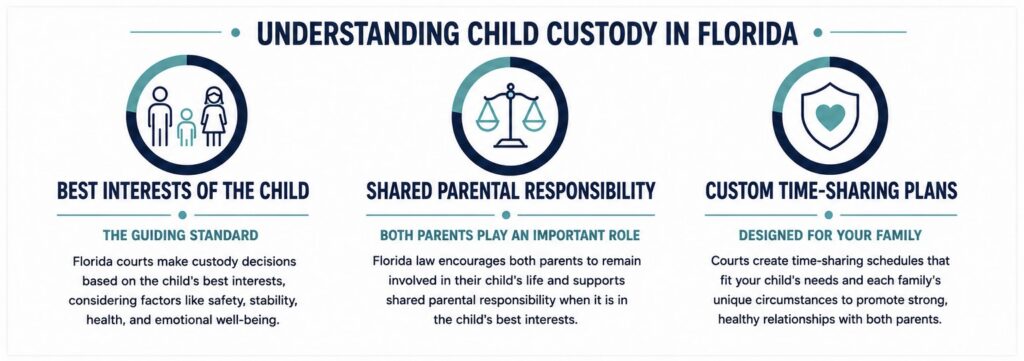
Child custody in Florida is governed by a framework that centers entirely on what is best for the child. The state does not use the term “custody” in its statutes. Instead, Florida law addresses parental responsibility and time-sharing, though most people still refer to these issues as custody.
Parental responsibility determines who makes decisions about a child’s education, healthcare, and religious upbringing. Time-sharing governs the schedule of when the child is with each parent. A child custody attorney in Tampa helps clients navigate both of these issues, whether the case arises during a divorce, a paternity action, or a standalone custody proceeding.
Types of Child Custody Cases We Handle in Tampa
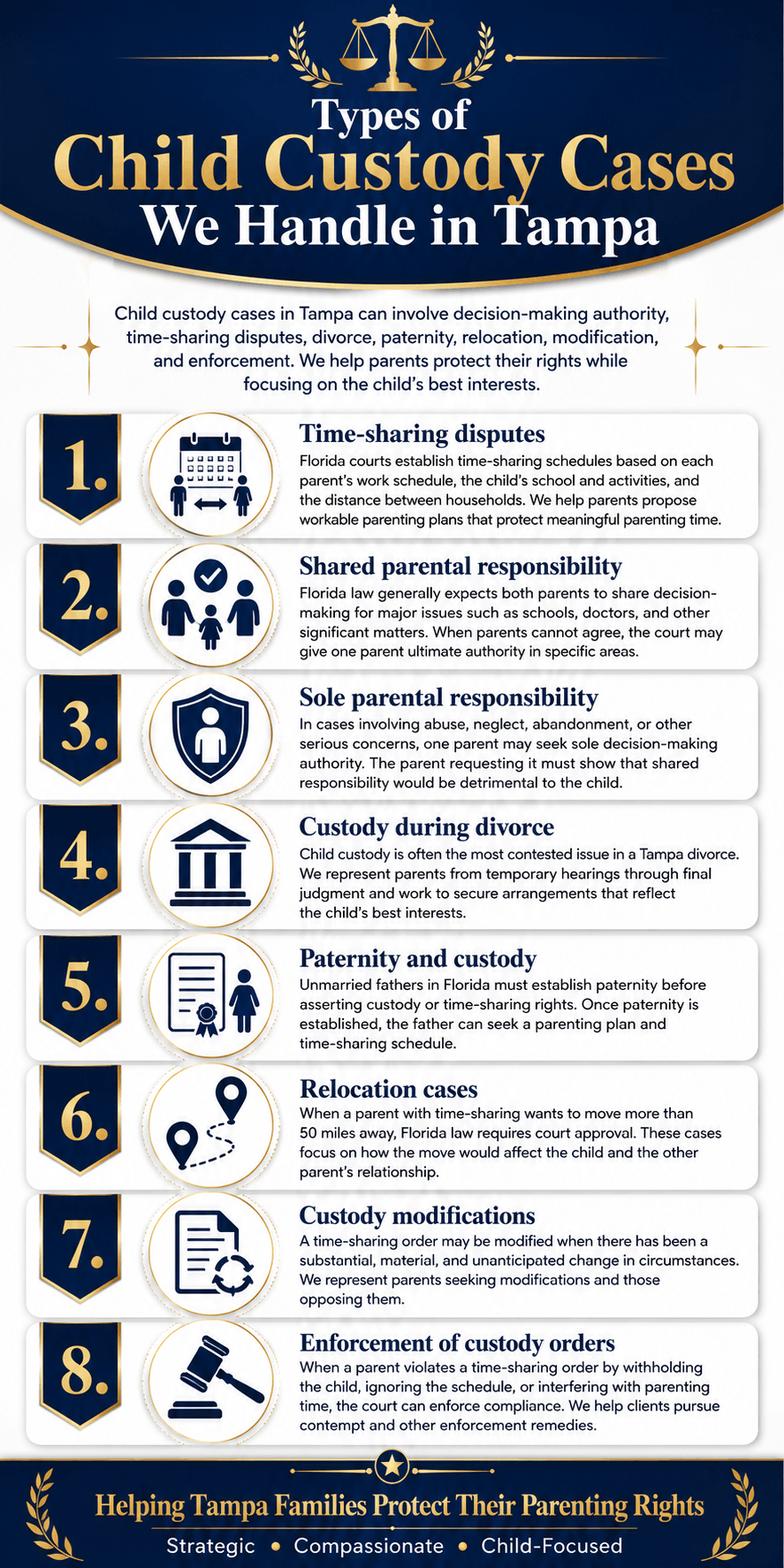
The McKinney Law Group Family & Divorce Lawyers represents parents throughout Tampa in a wide range of custody-related matters. These are the types of cases we see most often.
- Time-sharing disputes. Florida courts establish time-sharing schedules based on factors like each parent’s work schedule, the child’s school and activities, and the geographic distance between households. We help clients propose schedules that serve the child’s needs while protecting meaningful parenting time. Creating a workable parenting plan is often the most important step in the case.
- Shared parental responsibility. Florida law presumes that both parents should share decision-making responsibility for their child. In practice, that means agreeing on schools, doctors, and other significant issues. When parents can’t agree, the court may grant one parent ultimate authority over specific categories of decisions.
- Sole parental responsibility. In cases involving abuse, neglect, abandonment, or other serious concerns, one parent may seek sole decision-making authority. This is a high bar to clear, and the parent requesting it must present evidence that shared responsibility would be detrimental to the child.
- Custody during divorce. Child custody is frequently the most contested issue in a Tampa divorce. We represent parents through every phase, from the initial temporary hearing to the final judgment, working to secure time-sharing arrangements that reflect the child’s best interests and the parent’s involvement.
- Paternity and custody. Unmarried fathers in Florida must establish paternity before they can assert custody or time-sharing rights. Once paternity is confirmed, the father has the same standing as a married parent to seek a parenting plan and time-sharing schedule.
- Relocation cases. When a parent with time-sharing wants to move more than 50 miles away, Florida law requires court approval. These cases involve a detailed analysis of how the move would affect the child and the non-relocating parent’s ability to maintain a relationship. We handle relocation disputes on both sides.
- Custody modifications. A time-sharing order can be modified if there has been a substantial, material, and unanticipated change in circumstances since the original order was entered. We represent parents seeking modifications and those opposing them.
- Enforcement of custody orders. When a parent violates a time-sharing order, whether by withholding the child, ignoring the schedule, or interfering with the other parent’s time, the court has tools to enforce compliance. We help clients pursue contempt actions and other enforcement remedies.
Protecting Your Parenting Rights
How Florida Courts Decide Custody
Florida law requires courts to consider a list of factors when establishing or modifying a parenting plan and time-sharing schedule. A working knowledge of these factors helps you and your attorney build a stronger case.
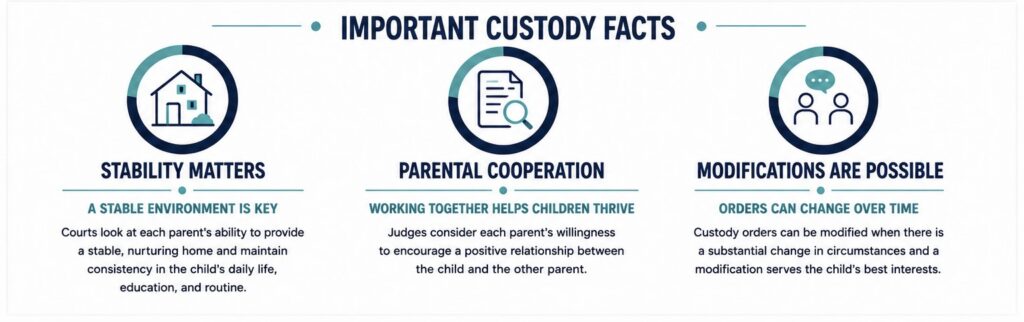
- Best interests of the child. Every custody decision in Florida starts and ends with what arrangement serves the child’s welfare. The court evaluates the child’s age, health, emotional ties to each parent, and the stability of each household.
- Parental cooperation. Judges look at which parent is more likely to encourage the child’s relationship with the other parent. A history of interference works against you.
- Continuity and stability. Courts favor keeping a child in the same school, neighborhood, and community when possible.
- Mental and physical health. Each parent’s ability to meet the child’s day-to-day needs, including any mental health or substance abuse concerns, is evaluated.
- Time-sharing preference. Florida law starts from a presumption that equal time-sharing is in the child’s best interest, but the court can deviate from that based on the evidence.
“I had a lovely experience with the Mckinney Law Group. During the brief time we communicated, they were able to help me with my case fast and efficiently. I would recommend the Mckinney Law Group!”
– Tamara B.
How Are Parenting Plans Arranged?
A Parenting Plan is a legal document that described the responsibilities and decision-making authority of each parent regarding their child’s upbringing after a separation or divorce. Your Parenting Plan will order:
- When the child will spend time with each parent
- How the child will be exchanged between the parents
- How the parents will share breaks and holidays
- How extracurricular activities will be handled
- How major decisions concerning the child will be made
- How parents may communicate with the child when the child is with the other parent
- How parents may communicate with each other
- What happens if one parent wants to take the child out of the state or country on vacation
When creating your Parenting Plan, the court prioritizes the best interests of the child.
What Are Important Aspects of a Child Custody Case?
A custody case can turn on things most parents don’t think about until they’re already in the middle of one.
Documentation matters enormously. Texts, emails, school records, medical records, and even social media posts can all become evidence. Judges want to see who has actually been involved in the child’s daily routine, not who claims to have been. And they pay close attention to how each parent communicates about the other, both in court and outside of it.
Your Tampa child custody attorney also needs complete honesty from you. If there are facts in your history that could be used against you, your lawyer needs to know about them in advance so they can prepare a response rather than scrambling during a hearing.
What Is the Child Custody Case Timeline?
Custody cases in Tampa follow this general path, though the timeline varies depending on the circumstances:
- Consultation. You meet with a custody attorney to discuss the facts and start developing a strategy.
- Filing. A petition is filed with the court, and the other parent is served.
- Temporary orders. In many cases, the court enters a temporary time-sharing order that governs the schedule until a final hearing. This temporary order can be critical.
- Discovery and evaluation. Both parties exchange information. In some cases, the court may appoint a guardian ad litem or order a social investigation.
- Mediation. Florida courts require mediation in most family law cases before allowing them to proceed to trial.
- Trial. If mediation does not resolve the case, the judge hears testimony and enters a final order.
Some custody cases settle at mediation within a few months of filing. Others, particularly those involving allegations of abuse or relocation requests, can take well over a year.
What Should You Bring to Your Tampa Child Custody Consultation?
Having your documents organized before the first meeting helps your attorney assess the case quickly.
- Any existing court orders or parenting plans
- A detailed log of your time-sharing schedule and any violations
- Text messages and emails between you and the other parent
- School records, medical records, and extracurricular schedules
- Documentation of income for both parents
Your attorney will review these materials and explain what other evidence may be needed.
Tampa Child Custody FAQs
When is Child Custody Decided?
When parents separate or file for a divorce, a temporary order can be issued to determine time-sharing. This arrangement may be modified in the final ruling of the divorce or custody case.
When Can a Child Custody Order Be Modified?
In the state of Florida, you may petition to modify a child custody order if there has been a significant change in the circumstances under which the initial agreement was made. As an example, you may petition for more time if your former partner is unemployed and unable to provide for your child.
Hiring an experienced Tampa child custody lawyer is crucial for this legal process. They can help you gather sufficient proof of the changes you allege have occurred since the initial custody order was created.
Will My Child Appear in Court for a Child Custody Case in Tampa?
In most cases, children are not required to appear in court for child custody cases in Florida. Special permission must be sought to allow a child to testify, and this is rarely granted by the court.
Will I Receive Child Support?
In most cases, the parent who has majority time-sharing will receive child support. Child support is calculated using the following factors:
- The Child Support Guidelines Worksheet
- Statutory formula factors in the parties’ income
- Percentage time-share
- Health insurance
- Costs of daycare and uncovered medical expenses.
What Are Important Florida Legal Resources for Child Custody Cases?
Florida provides several resources for parents involved in custody disputes. These are useful for general background but should not replace advice from an attorney.
- The Florida Courts website offers family law self-help resources, including court-approved forms and procedural guides.
- Florida’s custody and time-sharing statutes appear in Chapter 61, available through the Florida Legislature website.
- The Hillsborough County Clerk of Court posts filing instructions, fee schedules, and family law forms for Tampa residents.
- The Hillsborough County Bar Association maintains a family law section with resources for attorneys and the public.
- The Florida Bar publishes a consumer guide to divorce and custody that outlines parental rights and the court process.
Reach Out to The McKinney Law Group Family & Divorce Lawyers to Schedule a Consultation
If you are involved in a child custody dispute in Tampa, FL, The McKinney Law Group Family & Divorce Lawyers is prepared to help. We handle time-sharing disputes, modifications, enforcement actions, and relocation cases across Hillsborough County.
Contact us to schedule a consultation.