

Tampa alimony representation grounded in nearly two decades of Florida family law practice.
If you are facing an alimony issue during or after a Tampa divorce, the financial outcome of your case may depend more on how the statutory factors are presented than on any other single aspect of the dissolution. Florida overhauled its alimony framework in 2023, eliminating permanent alimony and reshaping how courts evaluate need, ability to pay, and the appropriate type of support. Our office represents both paying and receiving spouses in alimony and child support matters throughout Hillsborough County. Founding attorney Damien McKinney represent clients across the region as a Tampa, FL alimony lawyer focused on the financial outcomes that follow Florida’s current statutory framework.
Alimony Lawyer Tampa, FL
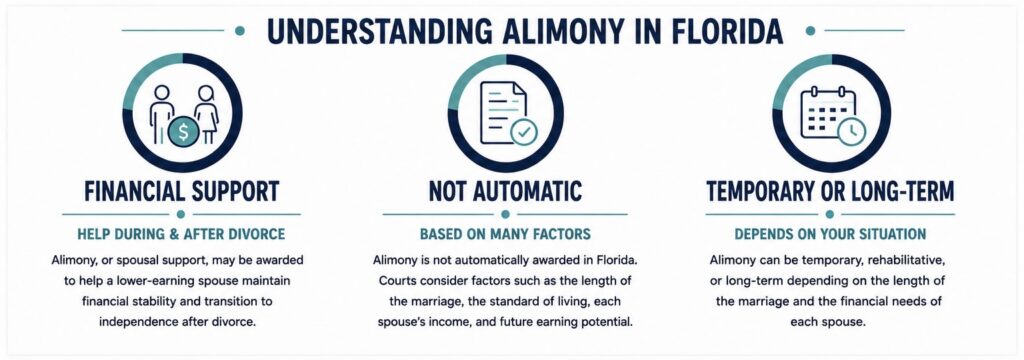
What is alimony, and how does Florida calculate it today? Alimony, also called spousal support, is a financial payment from one former spouse to the other after divorce. The purpose is to address the economic imbalance that often exists between spouses at the end of a marriage, particularly when one spouse earned significantly less or paused their career to support the family. Florida law sets out specific types of alimony, the circumstances under which each may be awarded, and the factors courts consider in determining amount and duration.
Following the 2023 alimony reform, Florida no longer awards permanent alimony in any new case. The available types are now bridge-the-gap, rehabilitative, and durational alimony, each with its own purpose, eligibility criteria, and duration limits. A Tampa alimony attorney works through the statutory analysis with each client to position the case for the most favorable outcome under the current framework, whether the client is seeking support or defending against an unreasonable claim.
Types of Alimony Cases We Handle in Tampa

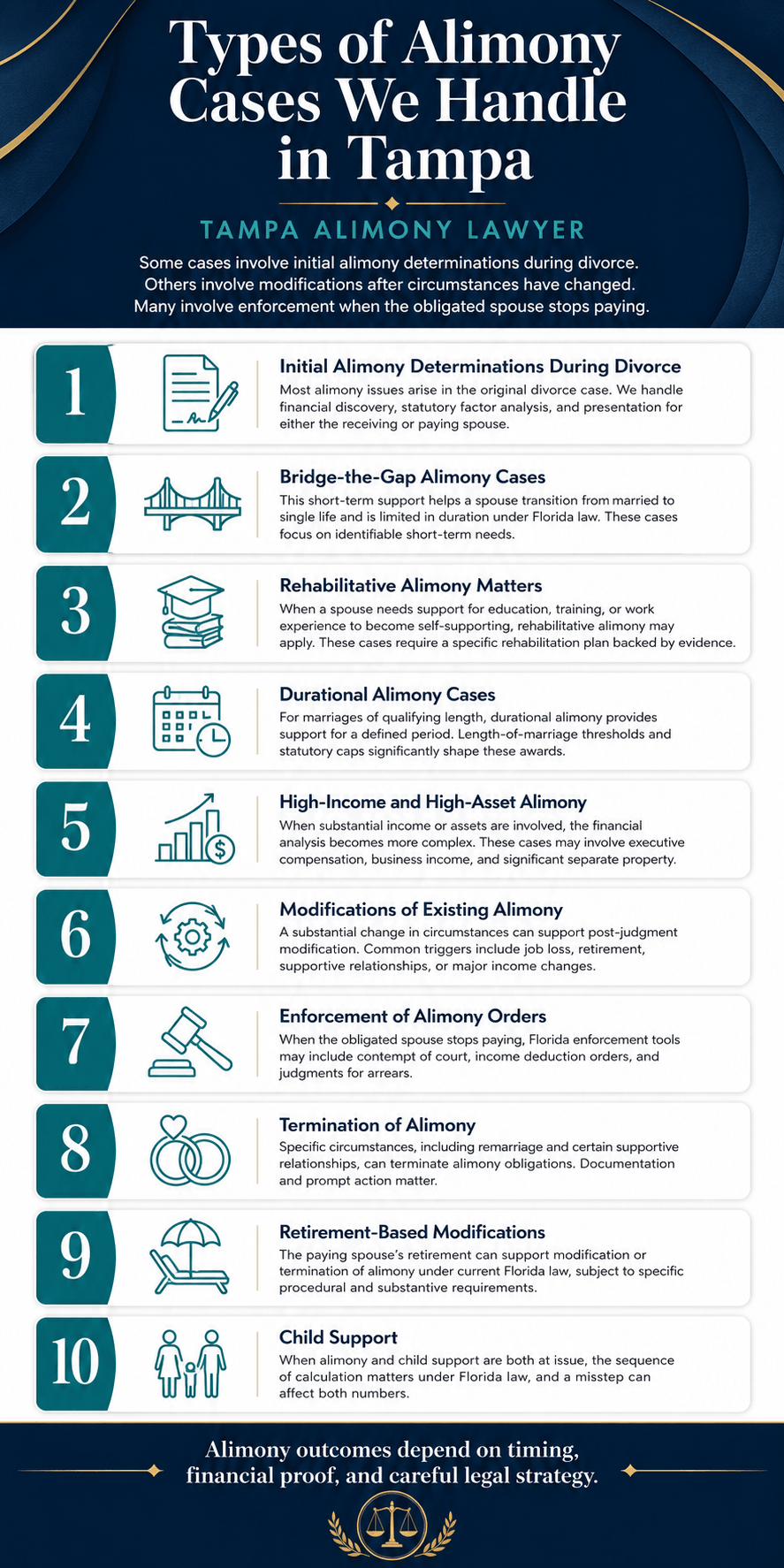
The McKinney Law Group Family & Divorce Lawyers represents Tampa clients across the range of alimony matters. Some cases involve initial alimony determinations during divorce. Others involve modifications after circumstances have changed. Many involve enforcement when the obligated spouse stops paying.
- Initial alimony determinations during divorce. Most alimony issues arise during the original divorce proceeding. We handle the financial discovery, statutory factor analysis, and presentation of the case for either the receiving or paying spouse.
- Bridge-the-gap alimony cases. This short-term support is designed to help a spouse transition from married to single life and is limited in duration under Florida law. The cases focus on identifiable short-term needs.
- Rehabilitative alimony matters. When a spouse needs support to acquire education, training, or work experience to become self-supporting, rehabilitative alimony may be awarded. These cases require a specific rehabilitation plan supported by evidence.
- Durational alimony cases. For marriages of qualifying length, durational alimony provides support for a defined period. Length-of-marriage thresholds and statutory caps on duration shape these awards significantly.
- High-income and high-asset alimony. When substantial income or assets are involved, the financial analysis becomes more complex. Our office handles cases involving executive compensation, business income, and significant separate property as part of our broader high-asset divorce work.
- Modifications of existing alimony. A substantial change in circumstances can support a post-judgment modification of an existing alimony order. Common triggers include job loss, retirement, supportive relationships, or significant income changes.
- Enforcement of alimony orders. When the obligated spouse stops paying, Florida offers enforcement tools including contempt of court, income deduction orders, and judgments for arrears.
- Termination of alimony. Specific circumstances, including the recipient’s remarriage and certain supportive relationships, can terminate alimony obligations. Documentation and prompt action matter.
- Retirement-based modifications. The paying spouse’s retirement can support modification or termination of alimony under current Florida law, subject to specific procedural and substantive requirements.
- Child support. When alimony and child support are both at issue, the sequence of calculation matters under Florida law, and a misstep affects both numbers.
Tampa Alimony Infographic
Why Choose The McKinney Law Group Family & Divorce Lawyers for Alimony Representation in Tampa, FL?
Florida family law experience
Founding attorney Damien McKinney was admitted to the Florida Bar in 2006 and has practiced marital and family law for nearly two decades. He earned his Juris Doctor from Stetson University College of Law in 2005 and his Bachelor of Arts in Psychology from Florida State University in 2002. He is also admitted in North Carolina. Memberships include the Florida Bar Family Law Section and the Hillsborough County Bar Association Family Law Section. Our firm’s alimony work runs through nearly every divorce matter we handle, and the financial preparation that drives strong alimony outcomes is built into how we approach the broader case.
Recognition and approach to alimony matters
Damien has been named a Super Lawyers Rising Star annually since 2012 and received the Super Lawyers Distinction of Excellence in 2016, an honor reserved for the top five percent of Florida lawyers. The firm has handled alimony cases across Tampa under both the prior statutory framework and the current post-reform structure. Alimony outcomes depend on how the statutory factors are documented and presented to the court. The spouse who arrives with organized financial records, a clear position on need or ability to pay, and a realistic understanding of the current framework is consistently positioned more strongly than the spouse without those elements.
What Is Important To Understand About Alimony Cases?

Types of Alimony and Statutory Factors in Florida
Florida law recognizes three types of alimony under the current statutory framework, each serving a distinct purpose:
- Bridge-the-gap alimony addresses short-term needs in the transition from marriage to single life and is limited in duration.
- Rehabilitative alimony supports a spouse pursuing education, training, or work experience to become self-supporting, based on a specific rehabilitation plan.
- Durational alimony provides support for a defined period in marriages that meet length-of-marriage criteria, with statutory caps on the duration.
Permanent alimony was eliminated for new cases under the 2023 reform. Existing permanent alimony orders generally remain in effect, but new awards must fit one of the three current categories.
The statutory factors Florida courts consider in setting alimony include the standard of living during the marriage, the length of the marriage, each spouse’s age and physical and emotional condition, financial resources of each party, earning capacity and educational levels, contributions to the marriage including homemaking and child care, responsibilities each party will have with respect to any minor children, and any other factor the court finds equitable. Need and ability to pay are threshold inquiries before any award is made.
What Are Important Aspects of an Alimony Case?
The threshold inquiry in any Florida alimony case is whether the requesting spouse demonstrates an actual need for support and whether the other spouse has the ability to pay. Without both, an alimony award is not appropriate regardless of the length of the marriage or other factors. The financial affidavits required in every divorce form the foundation of this analysis.
Several practical aspects shape alimony outcomes:
- The completeness and accuracy of financial disclosure by both spouses
- Documentation of the marital standard of living
- Evidence of each spouse’s earning capacity, including imputed income when one spouse is voluntarily unemployed or underemployed
- The length-of-marriage classification, which affects which types of alimony are available
- Evidence of contributions to the marriage, including non-financial contributions
- Anticipated financial circumstances after the divorce, including retirement timing
The 2023 reform brought additional factors into the analysis, including specific provisions on retirement and supportive relationships that affect both initial awards and subsequent modifications.
What Is The Alimony Case Timeline?

Most contested alimony cases in Tampa resolve over the course of the underlying divorce proceeding, which typically takes six months to over a year depending on complexity and the level of conflict. Cases resolved through mediation can move faster.
A typical case progression includes:
- Initial petition for dissolution filed and served
- Mandatory financial disclosure under the Florida Family Law Rules
- Discovery on income, assets, debts, and lifestyle during the marriage
- Court-ordered mediation in most contested family law matters
- Temporary alimony hearing when immediate support is needed
- Final hearing or settlement
- Entry of the final judgment with the alimony provisions
The 13th Judicial Circuit handles Hillsborough County family law matters, including the alimony provisions of dissolution proceedings.
What Should You Bring to Your Alimony Consultation?
Documentation supports an accurate alimony analysis from the first meeting. Useful materials include:
- Recent pay stubs covering the last several months
- The last two to three years of federal tax returns
- Account statements for bank, retirement, and investment accounts
- A monthly budget showing actual living expenses
- Documentation of the marital standard of living
- Records of any prior support arrangements between the spouses
- Information about educational background, work history, and career trajectory
- Any business interests, professional practices, or self-employment income
The consultation is used to identify the strengths and vulnerabilities of the case, run preliminary alimony scenarios under the current framework, and outline the strategic options going forward.
What Are Important Florida Legal Resources for Alimony Cases?

Florida alimony law is located in Chapter 61 of the Florida Statutes, which was significantly amended by the 2023 reform legislation. The official sources contain the current statutory text along with related procedural rules.
- The Florida Statutes Online portal contains the current statutory text governing alimony.
- The Florida Courts Family Law Self-Help page provides procedural information and approved forms used in dissolution proceedings.
- The Florida Bar Family Law Section publishes resources and continuing legal education materials addressing the current alimony framework.
Florida applies general statute of limitations principles to certain enforcement actions involving alimony arrears, with timing rules tied to the obligation rather than the date of the original order.
Reach Out to The McKinney Law Group Family & Divorce Lawyers to Schedule a Consultation
Alimony cases turn on financial preparation and accurate application of the current statutory framework. Contact us to schedule a consultation with a Tampa alimony attorney about your situation and the realistic outcomes available under Florida law.
Alimony Statistics in Tampa
Hillsborough County, with a population estimated above 1.5 million by the U.S. Census Bureau, generates a substantial share of Florida family law filings each year. The 13th Judicial Circuit processes thousands of dissolution cases annually, and alimony is at issue in a meaningful percentage of those matters, particularly in longer marriages where economic dependence has developed.
National divorce and post-divorce financial data published by the Centers for Disease Control and Prevention tracks broader trends that inform Florida policy decisions, including the 2023 alimony reform. The post-reform landscape in Tampa continues to develop as courts apply the amended statute to a growing body of cases. Practitioners working in Hillsborough County family court are tracking how judges interpret the new durational limits and the supportive relationship provisions, and the case law shaping those interpretations is still being written.
Factors That Affect the Outcome of Your Alimony Case

Florida alimony decisions are guided by the statutory factors in the amended Chapter 61. The factors below are the ones that most often shape Tampa alimony outcomes, with the strength of the supporting evidence determining how each factor is weighed in any given case.
- The standard of living established during the marriage. Courts look at how the family lived during the marriage, including housing, vehicles, vacations, and discretionary spending. The marital standard of living serves as a benchmark for what reasonable post-divorce support looks like, though both spouses generally experience some reduction in living standard after divorce.
- The length of the marriage. Florida classifies marriages as short-term, moderate-term, or long-term based on statutory thresholds. The classification affects which types of alimony are available and the maximum duration of any award. Longer marriages generally support longer alimony awards within the statutory caps.
- The age and physical and emotional condition of each party. A spouse’s health affects both earning capacity and the realistic ability to become self-supporting. Documented medical conditions, age-related employment challenges, and similar factors all play into the analysis.
- The financial resources of each party. This includes both marital assets received in equitable distribution and any separate property each party retains. A spouse who receives substantial assets in equitable distribution may need less alimony than one who receives little.
- The earning capacities of both parties. Courts consider not just current income but what each party could reasonably earn. Imputed income may be assigned to a spouse who is voluntarily unemployed or underemployed, based on work history, education, and the local labor market.
- The educational levels and vocational skills of both parties. A spouse with strong educational credentials and recent work experience is positioned differently from a spouse who left the workforce decades earlier. The analysis affects both the type and duration of alimony.
- The contributions of each party to the marriage. This includes financial contributions, homemaking, child care, and support of the other spouse’s career, education, or business. Non-financial contributions are weighed alongside income.
- The responsibilities each party will have with respect to any minor children. A spouse who continues to serve as the primary caregiver for minor children faces different earning constraints than one without those responsibilities. The interaction between custody and alimony is significant.
- Tax treatment and consequences of alimony. Federal tax treatment of alimony changed significantly under the 2017 Tax Cuts and Jobs Act for agreements executed after 2018. The tax consequences affect the after-tax value of any award and should be analyzed at the time of negotiation.
- All sources of income, including investment income. Income from investments, rental properties, and other passive sources factors into both the need analysis and the ability to pay. A spouse with significant investment income may have less need for alimony than one without.
- Any other factor necessary to do equity and justice between the parties. Florida courts retain authority to consider factors beyond the enumerated list when warranted by the circumstances. This catchall provision gives judges discretion to address unusual situations.
- Anticipated retirement or other significant life changes. Under the 2023 reform, retirement of the paying spouse can support modification or termination of alimony under specific circumstances. Cases involving older spouses or pending retirement should account for these provisions from the outset.
Florida courts apply the factors holistically rather than through a fixed formula. The way evidence is presented, the credibility of the parties, and the consistency of the testimony with documentary records all shape how the factors are weighed in any given case.
Tampa Alimony Lawyer FAQs
Did Florida eliminate alimony?
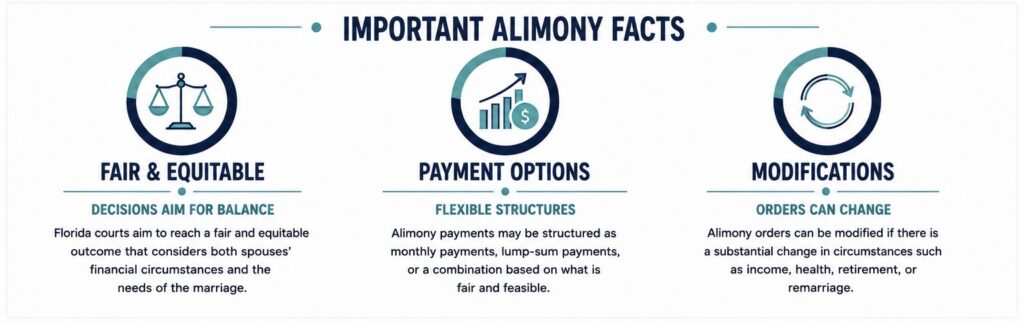
No. Florida eliminated permanent alimony for new cases in 2023, but other forms of alimony remain available. Bridge-the-gap, rehabilitative, and durational alimony are still part of Florida law. The reform changed the structure and duration of awards rather than eliminating spousal support entirely.
How long does alimony last in Florida?
The duration depends on the type of alimony and the length of the marriage. Bridge-the-gap alimony is capped at a relatively short period. Rehabilitative alimony lasts for the period necessary to complete the rehabilitation plan. Durational alimony is capped based on the length of the marriage, with longer marriages supporting longer awards within the statutory limits.
Can I modify my alimony order?
Yes, when a substantial change in circumstances supports modification. Common bases include involuntary job loss, retirement, the receiving spouse’s entry into a supportive relationship, or significant changes in either spouse’s financial circumstances. The change must be material and not contemplated at the time of the original award.
What is a supportive relationship?
A supportive relationship is a relationship in which the alimony recipient is in a relationship resembling marriage, including substantial financial interdependence with another person, without formally remarrying. Under Florida law, a finding that the recipient is in a supportive relationship can reduce or terminate alimony. Documentation of the relationship is critical to these motions.
How does retirement affect alimony?
Under the 2023 reform, the paying spouse’s retirement may support modification or termination of alimony when the retirement is reasonable based on age, health, and the spouse’s industry. The analysis considers whether the paying spouse has retired in good faith and whether the receiving spouse’s financial circumstances justify continued support.
Will my spouse have to pay my attorney fees?
Florida law authorizes attorney fee awards in family law cases based on the relative financial circumstances of the parties. When one spouse has significantly greater financial resources, the court may order that spouse to contribute to the other spouse’s attorney fees. The analysis is fact-specific and depends on the documentation provided.
How is income calculated for alimony purposes?
Florida considers all sources of income, including wages, self-employment income, bonuses, commissions, investment income, rental income, and certain forms of in-kind compensation. Self-employed and business owner spouses face additional scrutiny because business income can be structured to lower reportable earnings without lowering actual cash flow.
What if my spouse is hiding income or assets?
Hidden income or assets are a common issue in alimony cases involving self-employed spouses, business owners, or executives with complex compensation. Forensic accounting may be needed to identify true earning capacity and the actual value of business interests. Discovery tools available in Florida family law cases include subpoenas, depositions, and document requests.
Can a prenup affect my alimony?
Yes. A properly drafted prenup can waive or limit alimony, subject to Florida’s enforceability standards. Postnuptial agreements can do the same. When a prenup is in place, the alimony analysis starts with the agreement’s provisions rather than with the statutory factors.
What happens to alimony if my spouse remarries?
Remarriage of the receiving spouse generally terminates alimony obligations under Florida law. The termination is typically automatic upon remarriage, though specific provisions in the divorce agreement or final judgment may affect the analysis. Documentation of the remarriage supports prompt action to end the obligation.
Can I get alimony if my marriage was short?
Bridge-the-gap and rehabilitative alimony may be available even in shorter marriages, while durational alimony has length-of-marriage thresholds that affect availability. Very short marriages generally do not support significant alimony awards, though specific facts can change the analysis. The threshold inquiries of need and ability to pay apply regardless of marriage length.
Is alimony tax-deductible for the paying spouse?
For divorce agreements executed after December 31, 2018, alimony is no longer tax-deductible for the paying spouse and no longer taxable income for the receiving spouse under federal law. Florida does not have a separate state income tax, so state tax treatment does not affect Florida residents directly. The federal change has significant implications for how alimony amounts are negotiated.
Local Information for Tampa Alimony Cases
Tampa Family Court and Local Resources
Tampa alimony cases are heard in the family law division of the 13th Judicial Circuit, which covers Hillsborough County. Filings move through the Clerk of the Circuit Court’s office in downtown Tampa, with electronic filing available through the Florida Courts e-Filing Portal. Alimony issues are addressed within the broader divorce or post-judgment modification proceedings, with the family law division handling these matters alongside custody, child support, and equitable distribution.
What Are Important Local Resources for Tampa Alimony?
The following resources are listed for informational purposes only and do not constitute an endorsement.
- Hillsborough County Clerk of Court – (813) 276-8100
- 13th Judicial Circuit Court – (813) 272-5894
- Florida Bar Family Law Section – (850) 561-5650
- Hillsborough County Bar Association – (813) 221-7777
About the Attorney
Damien is the founding partner of The McKinney Law Group Family & Divorce Lawyers. His approach to alimony matters emphasizes financial preparation and accurate documentation of the marital standard of living, both of which drive outcomes under Florida’s current statutory framework.
What Our Clients Say
★★★★★
“Mr. McKinney was exactly what I was looking for. He was able to answer my questions completely and without rush. It was helpful to get a clearer idea of the process and what was involved. I look forward to working with him more in the future.” – Carrie Wallick
Read more reviews on our Google Business Profile.
Contact The McKinney Law Group Family & Divorce Lawyers
Alimony cases turn on financial preparation, accurate application of the current statutory framework, and disciplined presentation of the statutory factors. The spouse who arrives with organized records, a clear position on need or ability to pay, and a realistic view of the current framework is positioned to achieve a stronger outcome than the spouse without those elements. Our office represents both paying and receiving spouses throughout Tampa and Hillsborough County. To schedule a consultation with a Tampa alimony lawyer, reach out through our contact page.
Visit Our Tampa Alimony Lawyers
1105 W Swann Ave Suite 100, Tampa, FL 33606