


Tampa uncontested divorce representation grounded in nearly two decades of Florida family law practice.
If you and your spouse have agreed on the terms of your separation and want to dissolve the marriage without a contested courtroom fight, an uncontested divorce may be the most efficient path under Florida law. The process moves faster than a litigated dissolution, costs less, and gives both parties greater control over the outcome. Our office handles these proceedings throughout Hillsborough County. Founding attorney Damien McKinney and attorney Stephanie Koether represent spouses as a Tampa, FL uncontested divorce lawyer for couples who want a cooperative resolution.
Uncontested Divorce Lawyer Tampa, FL
What is an uncontested divorce, and how does it differ from a contested one? An uncontested divorce is a dissolution of marriage in which both spouses agree on every issue. That includes division of assets and debts, alimony if applicable, time-sharing and parental responsibility for any minor children, and child support. When all issues are resolved by agreement, the court enters a final judgment based on the parties’ marital settlement agreement without the need for a trial.
The contrast with a contested case is significant. Contested divorces involve discovery, motions, depositions, mediation, and often a final hearing on disputed issues. An uncontested case avoids most of that work because the parties have already reached agreement. A Tampa uncontested divorce attorney can confirm whether your situation truly qualifies as uncontested and prepare the documents required to finalize the dissolution.
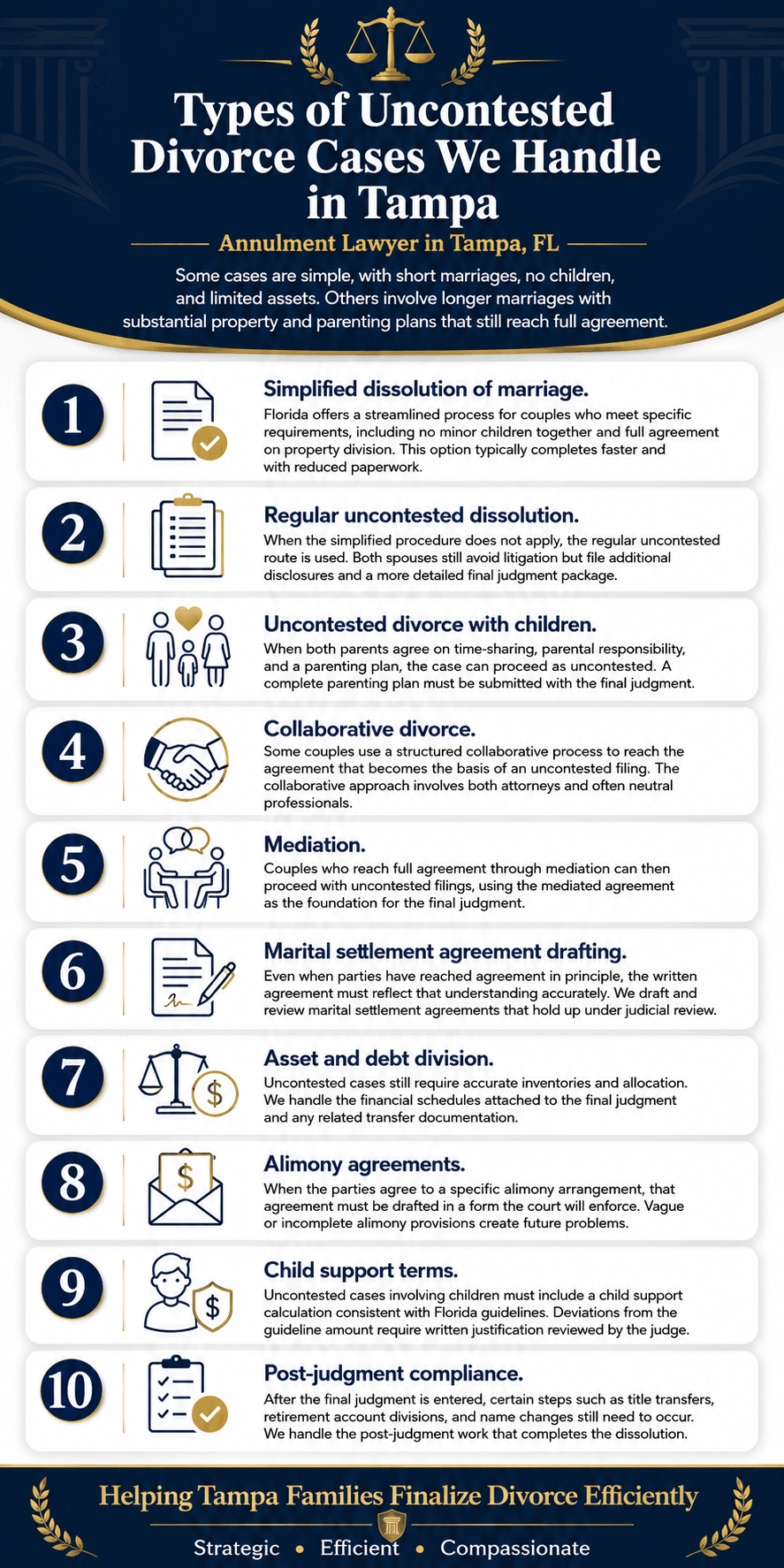
Types of Uncontested Divorce Cases We Handle in Tampa

The McKinney Law Group Family & Divorce Lawyers represents Tampa spouses across the range of uncontested divorce matters. Some cases are simple, with short marriages, no children, and limited assets. Others involve longer marriages with substantial property and parenting plans that still reach full agreement. Our child support attorney in Tampa, FL can help.
- Simplified dissolution of marriage. Florida offers a streamlined process for couples who meet specific requirements, including no minor children together and full agreement on property division. This option typically completes faster and with reduced paperwork.
- Regular uncontested dissolution. When the simplified procedure does not apply, the regular uncontested route is used. Both spouses still avoid litigation but file additional disclosures and a more detailed final judgment package.
- Uncontested divorce with children. When both parents agree on time-sharing, parental responsibility, and a parenting plan, the case can proceed as uncontested. A complete parenting plan must be submitted with the final judgment.
- Collaborative divorce. Some couples use a structured collaborative process to reach the agreement that becomes the basis of an uncontested filing. The collaborative approach involves both attorneys and often neutral professionals.
- Mediation. Couples who reach full agreement through mediation can then proceed with uncontested filings, using the mediated agreement as the foundation for the final judgment.
- Marital settlement agreement drafting. Even when parties have reached agreement in principle, the written agreement must reflect that understanding accurately. We draft and review marital settlement agreements that hold up under judicial review.
- Asset and debt division. Uncontested cases still require accurate inventories and allocation. We handle the financial schedules attached to the final judgment and any related transfer documentation.
- Alimony agreements. When the parties agree to a specific alimony arrangement, that agreement must be drafted in a form the court will enforce. Vague or incomplete alimony provisions create future problems.
- Child support terms. Uncontested cases involving children must include a child support calculation consistent with Florida guidelines. Deviations from the guideline amount require written justification reviewed by the judge.
- Post-judgment compliance. After the final judgment is entered, certain steps such as title transfers, retirement account divisions, and name changes still need to occur. We handle the post-judgment work that completes the dissolution.
Tampa Uncontested Divorce Infographic
Why Choose The McKinney Law Group Family & Divorce Lawyers for Uncontested Divorce in Tampa, FL?

Florida family law background
Damien McKinney was admitted to the Florida Bar in 2006 after earning his Juris Doctor from Stetson University College of Law in 2005. He completed his Bachelor of Arts in Psychology at Florida State University in 2002 and is also admitted in North Carolina. Stephanie Koether was admitted to the Florida Bar in 2017 and earned her Juris Doctor with Honors Distinction from the University of Miami School of Law in 2016. Memberships include the Florida Bar Family Law Section and the Hillsborough County Bar Association Family Law Section. The firm’s uncontested divorce work fits within our broader practice as a family lawyer in Tampa, FL, and the procedural familiarity that comes from handling the full range of family law matters supports efficient resolution of cooperative cases.
Recognition and approach to uncontested matters
Damien has been named a Super Lawyers Rising Star annually since 2012 and received the Super Lawyers Distinction of Excellence in 2016, an honor reserved for the top five percent of Florida lawyers. The firm has resolved a substantial number of family law matters across Tampa, and uncontested proceedings are handled with attention to drafting precision. A well-drafted marital settlement agreement prevents the kind of post-judgment disputes that send former spouses back to court. The savings in an uncontested case come not from cutting corners on the paperwork but from avoiding the litigation overhead that accompanies a contested divorce.
What Is Important To Understand About Uncontested Divorce Cases?

Grounds for Divorce and Property Division in Florida
Florida is a no-fault divorce state. The only grounds required to dissolve a marriage are that the marriage is irretrievably broken or that one party has been mentally incapacitated for a statutorily defined period. Neither spouse must prove wrongdoing, and adultery or other misconduct is generally not required to obtain a dissolution. This structure makes uncontested resolution practical for couples who have decided to part ways amicably.
Several substantive concepts shape an uncontested case:
- Residency requirement: at least one spouse must have resided in Florida for six months before filing
- Marital versus non-marital property classification
- Equitable distribution of marital assets and debts
- Alimony eligibility under the current statutory framework
- Time-sharing and parental responsibility for minor children
- Child support calculated under the Florida guidelines
Both spouses must complete financial disclosures unless certain exceptions apply under the simplified dissolution procedure. The disclosures form part of the record reviewed by the judge before the final judgment is signed.
What Are Important Aspects of an Uncontested Divorce Case?
The defining feature of an uncontested case is genuine agreement on every issue. If even one item remains in dispute, the case is no longer uncontested. Many couples believe they agree until they begin drafting the settlement agreement, at which point unresolved details surface.
Common areas where apparent agreement breaks down include:
- The valuation date for assets such as retirement accounts
- The mechanics of refinancing or selling the marital home
- The handling of joint debts that are titled to only one spouse
- Specific time-sharing dates around holidays and school breaks
- The duration and modifiability of alimony
When disagreement emerges, the case can convert to a contested divorce, or the parties can address the open issues through mediation before continuing with the uncontested filing.
What Is The Uncontested Divorce Case Timeline?
Most uncontested divorces in Tampa resolve faster than contested cases, though the actual pace depends on the type of filing and the responsiveness of both parties. The Florida statute imposes a minimum waiting period after the petition is filed, and the court must still review the final judgment package.
A typical timeline includes:
- Initial consultation and document gathering
- Drafting and signing the marital settlement agreement and parenting plan
- Filing the petition and supporting documents
- Mandatory waiting period under Florida law
- Short final hearing or submission of the package for review
- Entry of the final judgment of dissolution
Simplified dissolutions can complete in approximately one to two months when both parties cooperate. Regular uncontested cases involving children or more complex property typically take two to four months from filing to final judgment.
What Should You Bring to Your Uncontested Divorce Consultation?
Documentation supports an accurate marital settlement agreement and prevents revisions later. Useful materials for the initial meeting include:
- The marriage certificate and any prior divorce decrees
- Recent pay stubs and the most recent tax return for each spouse
- Account statements for bank, retirement, and investment accounts
- Mortgage statements and deeds for any real property
- Vehicle titles and loan documents
- A list of significant personal property and debts
- A draft of any preliminary agreement the spouses have reached
The consultation is used to confirm uncontested status, identify gaps in the proposed agreement, and outline the path to filing.
What Are Important Florida Legal Resources for Uncontested Divorce Cases?

Uncontested divorce procedure in Florida is governed by Chapter 61 of the Florida Statutes and the Florida Family Law Rules of Procedure. The official sources provide the procedural framework and the standardized forms used in many uncontested filings.
- The Florida Statutes Online portal contains the current statutory text governing dissolution of marriage.
- The Florida Courts Family Law Self-Help page provides procedural information and approved forms used in uncontested cases.
- The Florida Department of Children and Families maintains the list of approved parent education providers for divorces involving minor children.
Florida statute of limitations principles apply to certain post-judgment enforcement actions, with timing rules tied to the obligation rather than the date of the original judgment.
Reach Out to The McKinney Law Group Family & Divorce Lawyers to Schedule a Consultation
An uncontested divorce moves faster when the paperwork is correct from the start. Contact us to schedule a consultation with a Tampa uncontested divorce attorney about your situation and the documents needed to finalize the dissolution.
Uncontested Divorce Statistics in Tampa
Florida records hundreds of thousands of marriages and dissolutions each year. The state does not publish official statistics distinguishing contested from uncontested cases, but family law practitioners and court administrators consistently identify uncontested proceedings as a substantial share of total filings. Hillsborough County, with a population estimated above 1.5 million by the U.S. Census Bureau, processes a meaningful share of Florida family law cases.
National data published by the Centers for Disease Control and Prevention tracks broader marriage and divorce trends in the United States, including Florida-specific rates that inform local court resource planning. The 13th Judicial Circuit family law division processes thousands of dissolution filings each year, with uncontested proceedings moving through the docket on a faster track than contested matters.
What Are 10 Important Steps in an Uncontested Divorce Process?

An uncontested divorce in Tampa follows a recognizable procedural arc. The steps below reflect the typical sequence in a regular uncontested dissolution. Simplified dissolutions follow a shorter version of the same path.
- Confirm residency. At least one spouse must have lived in Florida for six months before the petition is filed. Out-of-state spouses who recently moved to Tampa typically must wait to meet this threshold.
- Determine which uncontested procedure applies. The simplified dissolution requires that both spouses agree to use it, have no minor or dependent children, and have already divided their property and debts. Couples who do not meet these criteria proceed under the regular uncontested process.
- Reach full agreement on all issues. Genuine agreement on property, debts, alimony, time-sharing, parental responsibility, and child support is the foundation of any uncontested case. Partial agreement is not enough.
- Complete financial disclosures. Both spouses generally complete a financial affidavit under oath. The simplified dissolution waives some disclosures, but the regular uncontested process requires them. Disclosures must reflect current income, assets, and debts.
- Draft the marital settlement agreement. The written agreement is the document that controls the final judgment. It must address every issue with enough specificity that a judge can enforce it if a dispute arises later. Vague provisions create future litigation.
- Draft the parenting plan. When minor children are involved, Florida requires a parenting plan that addresses time-sharing, decision-making authority, communication between parents, and information exchange. The plan must be specific enough to function without further court intervention.
- Calculate child support under the guidelines. Even in uncontested cases, child support is calculated using the Florida Income Shares Model. Agreed deviations from the guideline amount must be justified in writing for the judge’s review.
- File the petition and supporting documents. The petition for dissolution of marriage, the agreement, the parenting plan, financial affidavits, and other required forms are filed with the Clerk of the Circuit Court. Filing fees apply and are paid at submission.
- Complete the mandatory parent education course. Divorces involving minor children require both parents to complete a court-approved parent education and family stabilization course. Completion certificates are filed with the court before the final judgment is entered.
- Attend the final hearing or submit for in-chambers review. Many uncontested cases are resolved through a brief final hearing where both spouses appear, confirm the agreement, and answer questions from the judge. Some Hillsborough County judges allow uncontested final judgments to be reviewed in chambers without a hearing, depending on the case type and the completeness of the package.
After the final judgment is entered, certain post-judgment steps may still be required, including the execution of deeds, qualified domestic relations orders for retirement accounts, and updates to beneficiary designations on insurance policies and other accounts.
Tampa Uncontested Divorce Lawyer FAQs
What makes a divorce uncontested in Florida?
A divorce is uncontested when both spouses agree on every issue, including division of property and debts, alimony, time-sharing, parental responsibility, and child support. The agreement must be documented in a marital settlement agreement that the court can review and adopt as part of the final judgment. If even one issue remains in dispute, the case is contested rather than uncontested, even when the parties expect to resolve the remaining matter shortly.
How long does an uncontested divorce take in Tampa?
A simplified dissolution can resolve in approximately one to two months when both spouses cooperate. A regular uncontested divorce involving children, alimony, or more complex property typically takes two to four months from filing to final judgment. The pace depends on how quickly both spouses sign and return documents, complete required courses, and clear any administrative requirements imposed by the assigned judge.
What is the difference between simplified and regular uncontested dissolution?
The simplified dissolution is a streamlined procedure available only to couples who meet specific criteria, including no minor or dependent children, agreement on the use of simplified dissolution, and a settled division of property and debts. Couples who do not qualify proceed under the regular uncontested process, which requires additional disclosures and more detailed final judgment documents but still avoids contested litigation.
Do I still need a lawyer for an uncontested divorce?
Florida does not require parties to have attorneys, but a lawyer reviews the marital settlement agreement for enforceability, identifies issues the parties may have overlooked, and ensures the final judgment package meets Hillsborough County filing standards. Uncontested cases that proceed without legal review often produce ambiguous agreements that lead to post-judgment disputes. The cost of legal review is typically far less than the cost of litigating a later disagreement.
Can we use the same lawyer for an uncontested divorce?
One attorney cannot represent both spouses in a Florida divorce, because each spouse has separate legal interests even in an uncontested case. One spouse may retain the attorney to draft the documents while the other spouse proceeds without representation, but the attorney represents only the retaining client. Some couples elect to have each spouse retain separate counsel, particularly when the agreement involves significant assets.
What if we cannot agree on one issue?
If the parties cannot agree on a single issue, the case is not uncontested. Options include resolving the open issue through mediation before filing, proceeding as an uncontested case once the issue is resolved, or filing as a contested case and addressing the disputed issue through the litigation process. Many cases that begin as contested ultimately resolve through settlement after mediation.
What happens at the final hearing?
The final hearing is typically brief. Both spouses appear before the judge, confirm under oath that they have read the marital settlement agreement, understand its terms, and entered into it voluntarily. The judge reviews the agreement, asks any clarifying questions, and signs the final judgment of dissolution. The marriage is legally ended when the final judgment is entered.
Do both spouses have to live in Florida?
Only one spouse must meet the six-month Florida residency requirement at the time the petition is filed. The other spouse may live anywhere. Service of process and consent procedures vary depending on the non-resident spouse’s location, but the residency requirement applies to only one party.
How much does an uncontested divorce cost in Tampa?
Total cost depends on whether the case proceeds as a simplified dissolution or a regular uncontested matter, the complexity of the marital settlement agreement, and any post-judgment work required. Filing fees are set by the Clerk of the Circuit Court and apply in addition to attorney fees. Uncontested cases are generally substantially less expensive than contested divorces because no discovery, no depositions, and no trial are involved.
Can we change our minds after the divorce is final?
The final judgment of dissolution legally ends the marriage and is not reversible by mutual agreement. Spouses who reconcile after a final judgment must remarry if they wish to be legally married again. Certain provisions of the judgment, such as time-sharing schedules or alimony in some circumstances, may be modified later through a post-judgment modification when a substantial change in circumstances occurs.
What if my spouse will not cooperate after we agreed?
When a previously cooperative spouse stops responding or refuses to sign documents, the case may need to convert to a contested filing. Florida law provides procedures for serving an uncooperative spouse and proceeding even without their participation, including default procedures when a properly served spouse fails to respond.
Is mediation required in an uncontested divorce?
Court-ordered mediation is generally required in contested cases, not uncontested ones. Some couples use mediation voluntarily to reach the agreement that then becomes the basis of an uncontested filing. Once full agreement is reached, mediation is not separately required for the uncontested proceeding.
Local Information for Tampa Uncontested Divorce Cases

Tampa Family Court and Local Resources
Uncontested divorces in Tampa are filed in the family law division of the 13th Judicial Circuit, which covers Hillsborough County. Filings are submitted through the Clerk of the Circuit Court’s office in downtown Tampa, with electronic filing available through the Florida Courts e-Filing Portal. The family law division handles divorce, paternity, custody, child support, and related matters, and uncontested cases generally move through the docket on a separate track from contested matters.
What Are Important Local Resources for Tampa Uncontested Divorce?
The following resources are listed for informational purposes only and do not constitute an endorsement.
- Hillsborough County Clerk of Court – (813) 276-8100
- 13th Judicial Circuit Court – (813) 272-5894
- Florida Department of Children and Families – (850) 487-1111
- Hillsborough County Bar Association – (813) 221-7777
About the Attorney
Damien is the founding partner of The McKinney Law Group Family & Divorce Lawyers. His approach to uncontested matters emphasizes drafting precision, because the strength of a marital settlement agreement determines how the final judgment functions years later. Stephanie Koether complements that focus with her family law work since her 2017 Florida Bar admission and her academic distinction at the University of Miami School of Law. Outside the office, Damien is an active member of the Tampa arts community, a recognized artist at the annual Gasparilla Art Festival, and a supporter of local cultural organizations including Tempus Projects and Tampa Bay Businesses for Culture and the Arts.
What Our Clients Say
★★★★★
“Damien and Nathan helped me create a somewhat complex agreement having multiple in-depth revisions within a very tight timeline. They were both extremely professional and knowledgeable. They came very well prepared to calls to ensure we didn’t waste any time and and ultimately were able to get everything done by the deadline. Would definitely recommend them to anyone looking for similar legal services.” – Matt Klooster
Read more reviews on our Google Business Profile.
Contact The McKinney Law Group Family & Divorce Lawyers
An uncontested divorce works only when the paperwork accurately reflects what the parties intended. Sloppy drafting is the leading cause of post-judgment disputes between former spouses who originally separated amicably. Our office prepares marital settlement agreements and final judgment packages built to function as written. To schedule a consultation with a Tampa uncontested divorce lawyer, reach out through our contact page.
Visit Our Tampa Uncontested Divorce Lawyers
1105 W Swann Ave Suite 100, Tampa, FL 33606