


Our Asheville, NC Child Custody Lawyer Helps You Protect Your Child
When parents decide to split up or never lived together to raise the child together in the first place, the child is often caught in the middle of custody and support disputes. Developing a cordial, respectful co-parenting relationship is easier when the child custody schedules are confirmed, respected, and adhered to. Our Asheville, NC child custody lawyer helps you create a compromise with your child’s other parent that is in your child’s best interests and works for your own preferences.
Whether you’re seeking full custody of your child in a divorce, need help finding a compromise with your child’s other parent, or need to change an existing child custody arrangement, the attorneys at The McKinney Law Group Family & Divorce Lawyers are here to help you achieve the best solution for you and your child. Contact us today for a consultation.
When To Hire An Asheville Child Custody Lawyer
There are situations where hiring our custody and timesharing attorney may be beneficial. Our goal is to uphold the best interests of your child while encouraging positive relationships with both parents. Get legal advice for creating, modifying, or challenging a parenting plan. Our attorney will help write a detailed agreement explaining the role each parent will play in raising your child. You may consider hiring our custody and timesharing attorney if:
- You are separating or recently divorced and want legal help with negotiating child custody
- The other parent is not abiding by the parenting plan
- You believe your child will benefit from a modified schedule
- Changes to your or your child’s life have made your parenting plan unrealistic or challenging
- Your child expresses unhappiness with the current agreement, and there is evidence supporting their claims
- You want to request visitation rights after a disruption in parental responsibilities
Elements of a good custody and timesharing agreement focus on the child’s well-being, health, and safety. Our attorneys represent you and your rights as a legal guardian while determining the best situation for your child.
Strong Legal Advocacy For Your Child Custody Dispute
If you struggle to find a custody solution with your child’s other parent, you may have to take the matter to court. As your attorney, we can help by developing a strong argument to support your position. North Carolina family law judges determine child custody based on the child’s best interests. We aim to demonstrate that your proposed custody arrangement is in your child’s best interest. Our attorneys are local and know the family law courtrooms in Buncombe County very well. We can help you feel more at ease in court and speak on your behalf.
We have plenty of experience with contentious child custody disputes and can quickly get through the negative feelings to determine the practical issues that must be addressed. Perhaps you have true doubts about your child’s other parent’s ability to parent and provide a safe, stable home for your child. In these cases, we present evidence of this to the judge to help bolster your claim. And, if you’re worried that your child is in an unsafe environment, we can petition the court for legal protections on your behalf, up to and including removing the child from the other parent’s home.
Creating A Custody Arrangement To Support Your Child’s Needs
Children thrive in a stable environment with a predictable routine. Constant changes in child custody can affect your child’s well-being, so we strive to resolve your custody dispute as soon as possible. However, there may be some negotiations involved. If you and the other parent are ordered to mediation by a judge, we can represent you in these negotiations and help you focus on your goals.
Sometimes, life changes and your child’s custody arrangement needs to change. If you have a plan entered with the court, you must file a petition to change it. Perhaps one parent changes jobs and cannot be physically present to raise the child or takes another job far enough away that split custody isn’t feasible. We can help you change the custody agreement so that your child stays with you, but the other parent retains visitation and access to them.
Whatever your child custody needs, our Asheville child custody lawyer is here to help support them. We can help you. Call The McKinney Law Group Family & Divorce Lawyers today for a free consultation.

Types Of Child Custody Cases We Handle
The legal team at The McKinney Law Group Family & Divorce Lawyers manages a broad range of family law cases, emphasizing effective legal strategy and a solid grasp of North Carolina custody laws. The firm assists parents in contested and uncontested custody cases, relocation issues, parenting plans, and modifications. With extensive experience in both courtroom and settlement-based resolutions, our custody attorneys work to protect the best interests of the child while providing steady legal support. Whether dealing with separation, divorce, or changes in circumstances, the firm offers practical guidance and reliable representation. An Asheville, NC child custody lawyer at the firm is prepared to address a variety of custody-related issues with clarity and purpose.
Legal Custody And Physical Custody Cases
Legal custody refers to a parent’s right to make major decisions regarding the child’s education, healthcare, and upbringing. Physical custody relates to where the child lives and how much time they spend with each parent on a regular basis.
Joint Custody Arrangements
In some cases, both parents share legal and physical custody. These arrangements often involve detailed parenting plans that define schedules, transportation, and communication expectations.
Sole Custody Disputes
When one parent seeks sole legal or physical custody, it typically involves concerns about the other parent’s conduct, stability, or involvement. These matters are often contested and may require court intervention.
Temporary Custody During Separation
Temporary custody arrangements provide stability for the child while divorce proceedings are still in progress. Courts may issue temporary orders to address parenting time and responsibilities while the case is pending.
Modifications Due To Life Changes
Post-judgment modifications can be requested when there is a substantial change in circumstances, such as relocation, a change in work schedules, or shifts in the child’s needs. These cases require demonstrating that the current arrangement no longer supports the child’s best interests.
Enforcement Of Custody Orders
When a parent violates a custody order, enforcement actions may be needed to address missed parenting time or interference. Legal remedies may include motions for contempt or court-ordered modifications.
High-conflict Parenting Disputes
Some custody cases involve ongoing disagreements about rules, discipline, schooling, or decision-making. These disputes often benefit from mediation, evaluations, or court involvement to reduce long-term strain on the child.
Cases Involving Relocation Requests
Our visitation rights lawyer shares that if one parent wishes to move with the child to another city or state, courts will evaluate how the move impacts existing custody rights. These cases often involve reviewing the reasons for relocation and the effect on the child’s relationship with the other parent.
Custody Matters Involving Unmarried Parents
When parents are not married, custody must still be legally established through the court. These cases may also involve establishing paternity and creating formal parenting schedules.
Support From Experienced Legal Counsel
An Asheville child custody attorney can provide focused strategies suited to both uncontested and contested custody situations. Our family law attorneys focus on legal custody, parenting plan development, and post-decree modifications with care and precision. Their approach is centered on long-term solutions that reflect the child’s needs and the realities of each parent’s situation. Attorneys like those at The McKinney Law Group Family & Divorce Lawyers handle custody arrangements thoughtfully and are committed to helping families take meaningful steps forward. Call today to speak with a legal professional about your custody matter.

Common Causes Of Child Custody Cases
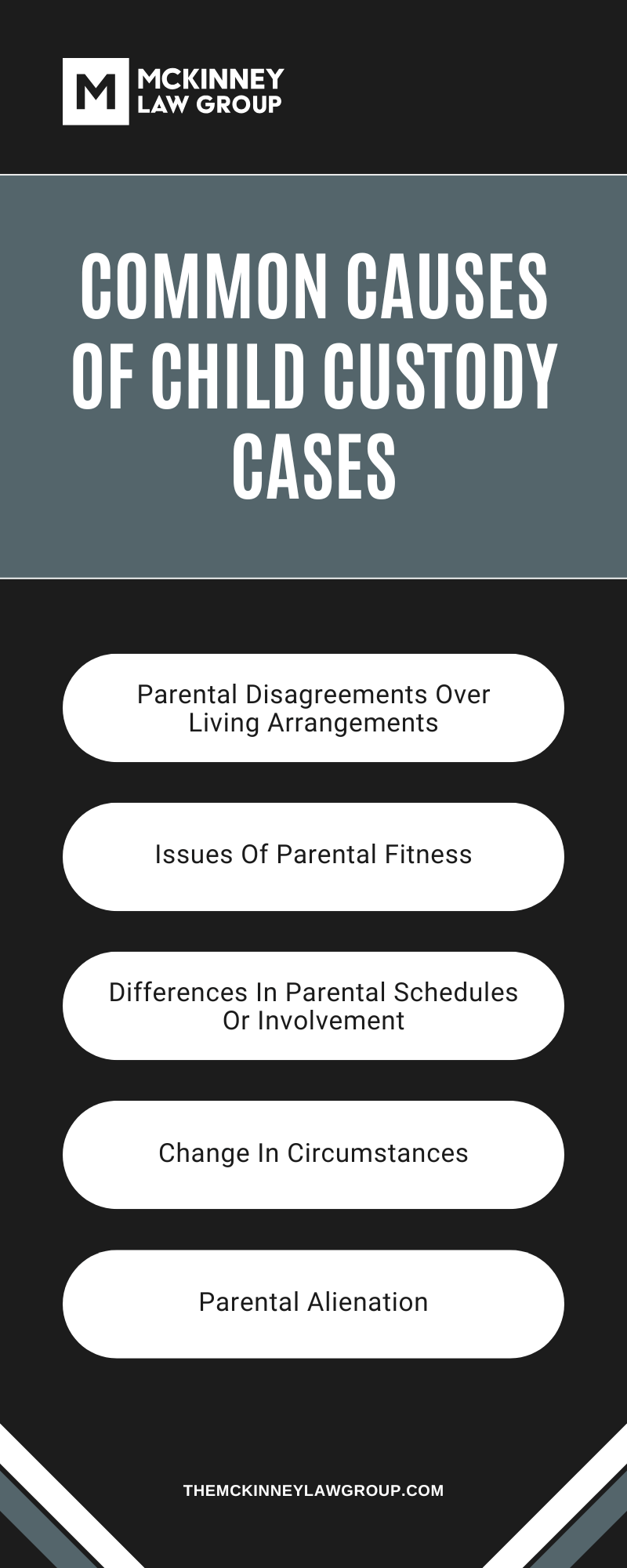
Child custody disputes are often complex and emotionally charged aspects of family law. When parents separate, the primary concern often shifts to the well-being and stability of their children. Several factors can lead to child custody cases, each carrying its own set of considerations. An experienced Asheville, NC child custody lawyer can provide valuable guidance in these situations. Below are some of the most common causes of child custody cases:
Parental Disagreements Over Living Arrangements
One of the primary causes of child custody disputes is disagreement between parents regarding where the child will live. This can arise when one parent seeks sole custody or if both parents want to maintain primary physical custody of the child. These disputes may arise from differing views on what is best for the child or logistical reasons, such as proximity to family, schools, or work. Parents must present their case in a manner that clearly outlines why their preferred living arrangement benefits the child.
Issues Of Parental Fitness
In some custody cases, concerns over a parent’s ability to provide a safe and nurturing environment for their child may come into play. Issues like substance abuse, mental health concerns, or accusations of neglect can all lead to disputes over custody. If there are significant doubts about a parent’s fitness to care for the child, the court will assess these concerns carefully. A detailed assessment of the child’s best interests is the key in these types of cases, and legal representation can help navigate these sensitive situations.
Differences In Parental Schedules Or Involvement
Another frequent cause of child custody disputes is the amount of time each parent spends with the child. When parents have different views on how much time each should spend with the child or how involved they should be in decision-making, it can lead to tension and disagreements. These issues often arise in cases where one parent works long hours or travels frequently, making it difficult for them to spend consistent quality time with the child. A balance must be reached to avoid putting the child in the middle of any conflict.
Change In Circumstances
Our Asheville child custody lawyer shares that life events or changes in circumstances can sometimes spark a custody dispute. For example, if one parent moves to a different state or country, it can lead to questions about how custody should be adjusted. Similarly, a change in a parent’s financial situation or employment status can affect their ability to care for the child, leading to custody modifications. The court will evaluate the changes and decide whether the custody agreement needs to be modified to serve the child’s best interests.
Parental Alienation
In some cases, one parent may try to undermine the other parent’s relationship with the child, leading to accusations of parental alienation. This could involve actions like discouraging the child from spending time with the other parent or making disparaging comments about them. Parental alienation can lead to a situation where the child’s relationship with one parent is severed, and the court may intervene to protect the child’s emotional well-being.
Help From Our Team
A skilled Asheville child custody lawyer can help parents navigate through these disputes. Whether seeking custody, dealing with modifications, or addressing parental alienation, an attorney’s role is to protect the child’s best interests while also working toward a fair and balanced solution for the parents involved. When custody issues arise, consulting an experienced legal professional can greatly impact the outcome of the case.
At The McKinney Law Group Family & Divorce Lawyers, attorneys work diligently to help parents address the concerns surrounding child custody cases and strive to create solutions that benefit the child while respecting the rights of the parents. If you’re facing a child custody dispute, don’t hesitate to contact our office to discuss your case and explore your options.
Asheville Child Custody Infographic

Child Custody Law FAQs
Child custody matters are often among the most challenging issues families encounter during separation or divorce. Courts focus on what best supports the child’s emotional, physical, and developmental well-being. Legal guidance from our custody law firm helps families understand how these decisions are made and what factors are most relevant in each unique case. Working with our experienced Asheville, NC child custody lawyer can provide clear direction and support throughout this process.
What Do Judges Usually Look At When Deciding Child Custody?
When courts make custody decisions, the primary consideration is always the child’s best interests. Judges look at each parent’s ability to meet the child’s basic needs, emotional health, and educational stability. They also consider the child’s relationship with each parent and whether the home environment promotes safety and consistency. While no single factor decides custody, the overall goal is to maintain stability and protect the child’s welfare.
Can A Parent’s Job Schedule Affect Custody Decisions?
Yes, a parent’s work schedule can influence how custody arrangements are structured. Courts look at how a parent’s availability aligns with the child’s daily routine, school schedule, and extracurricular activities. If one parent’s work requires frequent travel or long hours, it might limit the amount of time they can spend providing direct care. However, flexible arrangements and shared custody plans can often be developed to support both parents’ involvement.
How Important Is A Child’s Preference In Custody Cases?
A child’s wishes may be considered, especially if the child is mature enough to express a reasoned opinion. Judges typically weigh the child’s age, emotional maturity, and the reasoning behind their preference. While a child’s voice matters, it is balanced with other factors like stability, safety, and overall well-being. In many cases, courts aim to give the child a sense of input while still prioritizing long-term stability and security.
Does Having A New Partner Affect Custody Decisions?
If a parent begins a new relationship, the court may examine how that change influences the child’s living environment. The focus remains on whether the new environment supports the child’s comfort, safety, and emotional needs. A new partner who contributes positively to the child’s life is generally not an issue. However, if the relationship introduces instability, conflict, or unsafe conditions, the court may reconsider custody terms. An experienced child custody attorney can help address these concerns in court proceedings.
What Role Does A Parent’s Past Behavior Play In Custody Cases?
Past conduct can significantly influence a judge’s decision, especially if it reflects a pattern affecting parenting ability. Courts often look at the history of caregiving, reliability, and any incidents of neglect, abuse, or substance misuse. Positive involvement in the child’s life, such as maintaining steady communication and providing consistent care, can strengthen a parent’s position. Our family law attorney can help present evidence that demonstrates a parent’s ongoing commitment to their child’s well-being.
Asheville Child Custody Glossary

When working with a child custody lawyer in Asheville, NC, it helps to understand the legal terms that come up throughout your case. Family law involves specific language, and knowing what these terms mean allows you to follow what is happening and participate more actively in decisions that affect your children.
- Legal Custody: The authority to make major decisions about a child’s life, such as choices related to schooling, healthcare, and religious practices. Legal custody can be awarded to one parent (sole) or shared between both parents (joint).
- Physical Custody: Determines where the child lives on a regular basis. The parent with primary physical custody has the child in their home most of the time, and the other parent typically has a set schedule for parenting time.
- Joint Custody: An arrangement in which both parents share legal custody, physical custody, or both. North Carolina courts tend to support joint arrangements when they serve the child’s best interests and allow a meaningful relationship with each parent.
- Parenting Plan: A written agreement or court order that details each parent’s schedule, responsibilities, and rights. It typically covers everyday routines, holiday schedules, and procedures for making major decisions about the child.
- Best Interests of the Child: The standard that guides all custody decisions in North Carolina courts. Judges weigh factors including each parent’s relationship with the child, the stability of each home, and the child’s own preferences depending on their age.
- Guardian ad Litem: An individual appointed by the court to represent the child’s interests in a custody case, rather than the interests of either parent. This person acts independently from the attorneys on each side.
- Modification: A legal proceeding used to change an existing custody order. To succeed, the parent requesting a modification must show that a substantial change in circumstances has occurred since the original order was issued.
- Mediation: A structured process where both parents work with a neutral third party to reach a custody arrangement without going to trial. Many courts in Asheville encourage or require mediation before a contested hearing is scheduled.
- Contempt of Court: A finding that one parent has willfully failed to follow the terms of a custody order. An Asheville child custody attorney can file a motion for contempt if the opposing party is not complying with court directives.
- Visitation: The time a non-custodial parent is scheduled to spend with their child, as set by a parenting agreement or court order. These schedules are determined based on what best serves the child’s needs.
Having a working knowledge of these terms can help you communicate more clearly with your child custody attorney in Asheville and stay informed at every stage of your case. For more on this topic, visit our page on Asheville child custody modification to see how North Carolina courts handle requests to change existing orders. We are here to answer your questions about child custody in Asheville. Reach out today to get the information you need and take a well-informed next step.
Supporting Families Through Custody Challenges
Child custody cases call for a fair and thoughtful approach that safeguards children while helping parents achieve workable and just solutions. Each decision carries emotional and legal weight, and having professional guidance makes a difference when working through disputes or modifications. For families seeking support, our Asheville, NC child custody lawyer can explain local custody laws, court procedures, and possible outcomes. Attorneys at The McKinney Law Group Family & Divorce Lawyers are committed to helping families move forward with clarity and compassion.
Child Custody Statistics In Asheville, NC

Custody cases filed in Asheville are heard in Buncombe County District Court. Parents in a contested case usually attend the state’s Child Custody and Visitation Mediation Program before a judge hears the case. North Carolina reports the program’s results as statewide totals, so the figures below include Buncombe County along with every other county. The most recent court programs data covers fiscal year 2023-24.
- 18,013 people attended a custody mediation orientation class.
- Mediators handled 8,653 child custody cases.
- The program held 9,265 mediation sessions.
- Mediators drafted 3,967 parenting agreements.
These figures show that mediators drafted a parenting agreement in fewer than half of the cases they handled. A case that leaves mediation without an agreement is scheduled for court. Parents in Asheville should therefore prepare for mediation and for a hearing at the same time. Our Asheville child custody attorney helps you prepare a proposed schedule before your mediation session and reviews any draft agreement with you before you sign it. We also organize your evidence during this period, so you are ready if a judge has to decide the case.
Types Of Evidence Used In Asheville Child Custody Cases
A judge who decides custody relies on the evidence that each parent presents at the hearing. The same evidence is useful earlier in the case, because a parent with organized records can propose a realistic schedule in mediation. A child custody lawyer in Asheville can tell you which records to collect first. The list below begins with records of your child’s routine and ends with information from other people.
- Parenting calendars. A calendar that shows where your child has slept each night gives the judge a record of the current schedule. We ask clients to keep this calendar from the date of separation and to include holidays and school breaks.
- School records. Attendance reports and report cards show how your child is doing under that schedule. Emails from teachers add to this picture because they show which parent attends conferences.
- Medical records. Appointment histories show which parent schedules care and takes the child to appointments. These records are especially useful when a child has ongoing medical needs.
- Work schedules. Pay stubs and shift schedules show when each parent is available to care for the child. Parents who work from home should document their actual hours, because remote work does not always mean that a parent is free during the day.
- Messages between parents. Texts and emails show how each parent communicates about schedules and decisions. The other parent can present your messages too, so we advise clients to write every message as if the judge will read it.
- Social media posts. The same caution applies to social media. Photos and comments can contradict what a parent says in court, and posts that criticize the other parent can hurt the parent who wrote them.
- Records of missed visits. Notes on late pickups and cancelled visits show whether each parent follows the schedule.
- Witness testimony. Teachers, coaches, and relatives can describe what they have seen of each parent’s involvement. A witness who knows your daily routine is more useful than a witness who can only describe your character.
- Professional reports. The court also receives a report from a custody evaluator or another professional in some cases. We explain how these reports are prepared and how you can respond to them.
Some parents overlook records of their daily involvement because they assume that judges favor mothers, and custody misconceptions like this one lead parents to collect the wrong material. Our child custody attorney in Asheville reviews what you have collected and organizes it by date before mediation and before any hearing.
Asheville Child Custody Lawyer FAQs
Where Are Asheville Child Custody Cases Heard?
Custody cases filed in Asheville are heard in Buncombe County District Court. Our Asheville custody lawyer knows this court well and can tell you what to expect on your hearing date.
How Should I Prepare For Custody Mediation?
Start with a written schedule that you would accept, including weekdays, holidays, and summer break. Then list the points where you can compromise and the points where you cannot. We go over this proposal with you before the session, because attorneys do not attend court-run custody mediation.
Does Court-Run Custody Mediation Cost Anything?
The North Carolina courts provide custody mediation free of charge. Private mediation is a separate option that parents arrange and pay for themselves. We can explain the differences between the two options before you choose one.
What Happens If We Do Not Reach An Agreement In Mediation?
The case is scheduled for a hearing in district court. Both parents can testify and call witnesses at that hearing, and the judge then enters a custody order. Parents can still settle at any point before the judge rules, so we continue to negotiate while we prepare for the hearing.
How Long Does A Child Custody Case Take?
The timeline depends mainly on whether the parents reach an agreement. A case that settles in mediation ends sooner than a case that goes to a hearing, because a hearing has to be placed on the court’s calendar. We give you a realistic estimate after we review the facts and the other parent’s position.
Should I Keep Following The Current Schedule While The Case Is Pending?
You should keep following it in most situations. A consistent routine helps your child, and your conduct during the case becomes part of the evidence. Tell us right away if you believe the current arrangement puts your child at risk, so our Asheville, NC child custody lawyer can ask the court for a temporary order.
How Does Child Support Relate To Custody?
Custody and child support are separate issues, but they are closely connected. The parenting schedule is one of the factors used to calculate support, so a change to one often affects the other. We usually address both issues in the same case for that reason.
Can I Move Out Of Asheville With My Child?
A parent who wants to relocate with children should read the existing custody order first, because many orders limit how far a parent can move. A move can still lead to a dispute when no order exists. Our Asheville child custody attorney advises parents to get a written agreement or a court order before they move.
How Should I Talk To My Child About The Custody Case?
Parents should talk to their kids about the changes at home in terms that fit the child’s age. That conversation should cover the new routine and leave out the details of the court case. A child should never be asked to choose between parents or to carry messages between them.
What Should I Bring To A Consultation With An Asheville Child Custody Lawyer?
Bring any existing custody order or separation agreement, along with a calendar of the current schedule. Recent messages with the other parent are also useful. We use these records to explain your options and to identify the evidence you still need to collect.
Important Resources For Asheville, NC Child Custody Cases
What Are Important North Carolina Legal Resources For Child Custody Cases?
North Carolina publishes its custody laws and court procedures online. Parents can use the following resources to read the law and to check the procedures that apply in Buncombe County.
- The North Carolina General Assembly publishes the state’s custody statutes in Chapter 50 of the General Statutes.
- The North Carolina Judicial Branch answers common questions about those statutes in its child custody guidance.
- Buncombe County’s local family court rules set the procedures and forms for domestic cases filed in Asheville.
What Are Important Local Resources For Asheville Child Custody Cases?
Parents in a custody case often need help outside the courtroom as well. The following organizations serve families in Asheville and Buncombe County, and an Asheville, NC custody attorney can tell you which ones fit your situation.
- Buncombe County Family Court manages the scheduling of domestic cases, including custody hearings. The phone number is (828) 259-3415.
- The Mediation Center offers family mediation and a Family Visitation Program for supervised visits and safe exchanges. The phone number is (828) 251-6089.
- Helpmate provides emergency shelter and counseling for domestic violence survivors in Buncombe County. The 24-hour hotline is (828) 254-0516.
We list these resources for your convenience. The McKinney Law Group Family & Divorce Lawyers does not endorse these organizations and is not affiliated with them.
About The McKinney Law Group Family & Divorce Lawyers
Founding partner Damien McKinney has practiced marital and family law for nearly 20 years. He earned his law degree from Stetson University College of Law in 2005 after completing a bachelor’s degree in psychology at Florida State University. His professional memberships include the Buncombe County Bar Association, and Super Lawyers has recognized him as a Rising Star. His practice covers custody, support, and divorce, so parents who need a family lawyer in Asheville can resolve these related issues with us.
What Our Clients Say
★★★★★
“I cannot recommend McKinley Law enough. From start to finish, the process was incredibly smooth with clear, easy communication. The staff is not only professional but deeply compassionate and attentive to every small detail.
My case had several complexities, including securing specific custody agreements for my child with complex medical needs. They handled these challenges with such grace and expertise, ensuring my family’s future was secure. As a stay-at-home mom re-entering the workforce, I walked away feeling empowered and supported. If you need a firm that truly cares, this is it.” — Elizabeth Douglas
Read more reviews on our Google Business Profile.
Additional Resources For Asheville, NC Child Custody Cases
- Understanding Legal vs. Physical Custody: Key Differences Explained by an Asheville Divorce Lawyer
- How Child Custody Is Handled in an Asheville Uncontested Divorce
- Can a Parenting Plan Be Changed After an Asheville Uncontested Divorce Is Final?
- Uncontested Divorce and Parenting Plans in Asheville: How to Draft Custody Provisions That Prevent Future Litigation
- Co-Parenting in Asheville: Creating a Holiday Schedule That Works for Everyone
Contact The McKinney Law Group Family & Divorce Lawyers
A child custody attorney in Asheville, NC can tell you where your case stands before you file, respond, or attend mediation. At your consultation, we ask about your child’s routine and review any existing order. We then explain the steps ahead in Buncombe County District Court and the evidence you will need at each one. We reply to consultation requests as soon as we can. Contact us to schedule your child custody consultation with The McKinney Law Group Family & Divorce Lawyers.