

Trusted fathers’ rights lawyers serving clients across Tampa and the surrounding area for nearly two decades.
If you are a father facing a custody dispute, paternity action, or time-sharing modification in Tampa, the outcome will define your role in your children’s lives for years. Our office represents fathers across the full range of family law matters and approaches these cases with the documentation, preparation, and credibility that drive favorable outcomes. Founding attorney Damien McKinney represent fathers throughout Hillsborough County as a Tampa, FL fathers’ right lawyer focuses on protecting parenting roles under Florida law.
Fathers’ Rights Lawyer Tampa, FL
What is a fathers’ rights case, and how is it different from a standard custody dispute? Fathers’ rights cases are family law matters in which the legal issues, evidentiary themes, or procedural posture create specific challenges for the father involved. The substantive law applies the same way to both parents under Florida’s gender-neutral framework, but the practical reality is that fathers often need to establish their parenting credentials more deliberately than mothers, particularly when the case involves an unmarried father, a long-standing primary-caretaker mother, or allegations that require careful rebuttal.
The cases that fall under the fathers’ rights label include initial custody determinations, paternity establishment, time-sharing modifications, relocation disputes, child support matters, and enforcement of parenting plans. Our Tampa child support lawyer builds the case on the documented parenting history, credible testimony, and a presentation that aligns with the statutory factors Florida courts apply when deciding parental responsibility and time-sharing.
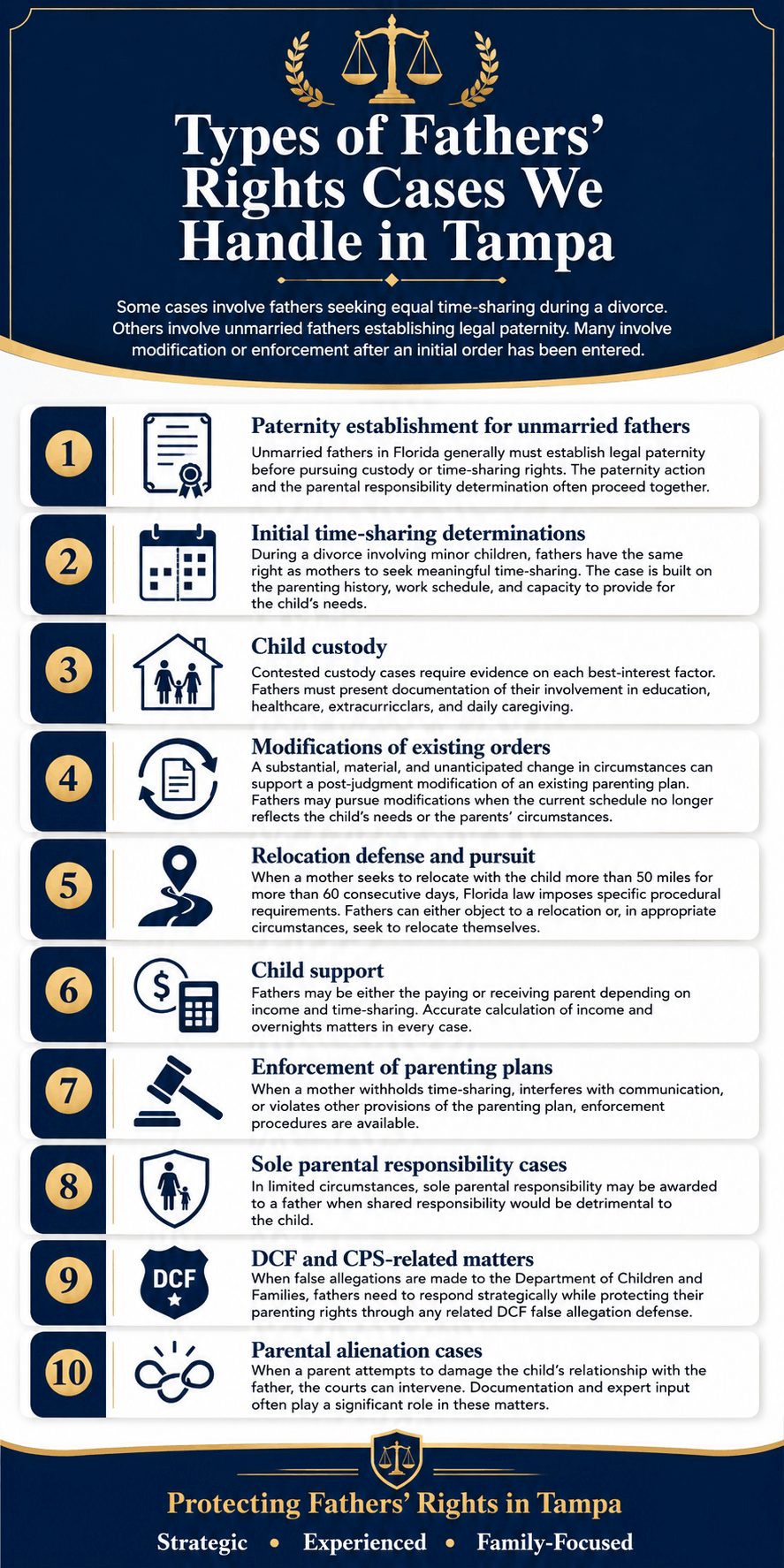
Types of Fathers’ Rights Cases We Handle in Tampa
The McKinney Law Group Family & Divorce Lawyers represents Tampa fathers across the range of family law matters. Some cases involve fathers seeking equal time-sharing during a divorce. Others involve unmarried fathers establishing legal paternity. Many involve modification or enforcement after an initial order has been entered.
- Paternity establishment for unmarried fathers. Unmarried fathers in Florida generally must establish legal paternity before pursuing custody or time-sharing rights. The paternity action and the parental responsibility determination often proceed together.
- Initial time-sharing determinations. During a divorce involving minor children, fathers have the same right as mothers to seek meaningful time-sharing. The case is built on the parenting history, work schedule, and capacity to provide for the child’s needs.
- Child custody. Contested custody cases require evidence on each best-interest factor. Fathers must present documentation of their involvement in education, healthcare, extracurriculars, and daily caregiving.
- Modifications of existing orders. A substantial, material, and unanticipated change in circumstances can support a post-judgment modification of an existing parenting plan. Fathers may pursue modifications when the current schedule no longer reflects the child’s needs or the parents’ circumstances.
- Relocation defense and pursuit. When a mother seeks to relocate with the child more than 50 miles for more than 60 consecutive days, Florida law imposes specific procedural requirements. Fathers can either object to a relocation or, in appropriate circumstances, seek to relocate themselves.
- Child support. Fathers may be either the paying or receiving parent depending on income and time-sharing. Accurate calculation of income and overnights matters in every case.
- Enforcement of parenting plans. When a mother withholds time-sharing, interferes with communication, or violates other provisions of the parenting plan, enforcement procedures are available.
- Sole parental responsibility cases. In limited circumstances, sole parental responsibility may be awarded to a father when shared responsibility would be detrimental to the child.
- DCF and CPS-related matters. When false allegations are made to the Department of Children and Families, fathers need to respond strategically while protecting their parenting rights through any related DCF false allegation defense.
- Parental alienation cases. When a parent attempts to damage the child’s relationship with the father, the courts can intervene. Documentation and expert input often play a significant role in these matters.
Tampa Fathers’ Rights Infographic
Why Choose The McKinney Law Group Family & Divorce Lawyers for Fathers’ Rights in Tampa, FL?
Florida family law experience
Founding attorney Damien McKinney was admitted to the Florida Bar in 2006 and has practiced marital and family law for nearly two decades. He earned his Juris Doctor from Stetson University College of Law in 2005 and his Bachelor of Arts in Psychology from Florida State University in 2002. He is also admitted in North Carolina. Memberships include the Florida Bar Family Law Section and the Hillsborough County Bar Association Family Law Section. Fathers’ rights cases form a meaningful part of the firm’s broader work as a child custody lawyer in Tampa, FL, and the team handles the procedural and evidentiary issues that arise across the spectrum of custody-related matters.
Recognition and approach to fathers’ rights matters
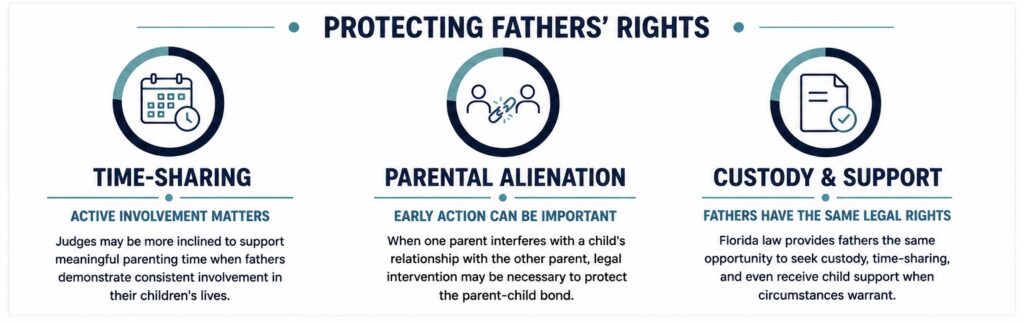
Damien has been named a Super Lawyers Rising Star annually since 2012 and received the Super Lawyers Distinction of Excellence in 2016, an honor reserved for the top five percent of Florida lawyers. The firm has represented fathers across Tampa in cases ranging from cooperative parenting plan negotiations to contested time-sharing battles. Fathers’ rights cases turn on documentation, presentation, and credibility. A father who can demonstrate involvement, consistency, and willingness to support the child’s relationship with the other parent strengthens his position substantially under the Florida best interests framework.
What Is Important To Understand About Fathers’ Rights Cases?

Types of Custody and Best Interest Factors
Florida law uses two primary concepts to govern parenting issues: parental responsibility and time-sharing. Parental responsibility refers to decision-making authority over major issues such as education, healthcare, and religious upbringing. Time-sharing refers to the schedule under which the child spends time with each parent. Both apply equally to fathers and mothers.
The statutory best interests factors include:
- Each parent’s capacity to facilitate a close relationship between the child and the other parent
- The demonstrated capacity and disposition to determine, consider, and act on the child’s needs
- The length of time the child has lived in a stable environment and the desirability of maintaining continuity
- The mental and physical health of each parent
- The home, school, and community record of the child
- The reasonable preference of the child when the child is of sufficient maturity
- Each parent’s moral fitness as it affects the child
- The capacity to provide a consistent routine for the child
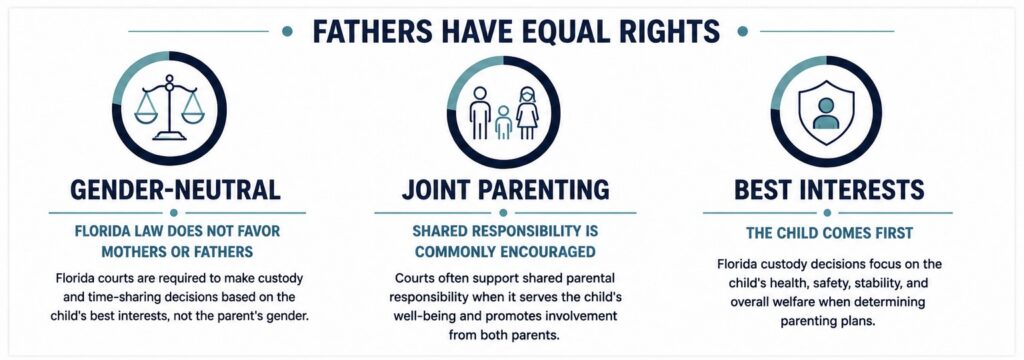
Florida law does not include any factor based on the parent’s gender. The statutory framework is gender-neutral, and courts apply the factors based on the specific evidence in each case. Fathers who present credible evidence on the relevant factors are positioned the same as mothers with comparable evidence.
What Are Important Aspects of a Fathers’ Rights Case?
The most damaging assumption fathers make is that the legal system favors mothers. Florida law does not, but presentation and preparation matter enormously. A father who walks into court without documented involvement in the child’s school, medical, and daily life undermines his own case. A father who has consistently been engaged and can document that involvement is in a strong position regardless of which parent files first.
Several practical factors shape outcomes:
- Documentation of the historical parenting relationship and division of caregiving responsibilities
- Work schedule and realistic availability for time-sharing
- The father’s relationship with the child’s school, doctors, and activities
- Communication patterns between the parents and the willingness to co-parent constructively
- Any allegations raised by the other parent and the evidence available to respond
- The proposed time-sharing schedule and its practical workability
A father who builds his case on the documentary record rather than on emotion is the father whose position translates effectively to a courtroom or a settlement negotiation.
What Is The Fathers’ Rights Case Timeline?
Most contested fathers’ rights cases in Tampa take six months to over a year to resolve, depending on case complexity, court scheduling, and the involvement of third-party professionals such as guardians ad litem or parenting evaluators. Cooperative cases or those resolved through mediation move faster.
A typical case progression includes:
- Initial petition, motion, or paternity action filed and served
- Temporary parenting plan hearing if immediate relief is needed
- Discovery on parenting history, finances, and any allegations
- Court-ordered mediation in most contested cases
- Appointment of a guardian ad litem or evaluator when warranted
- Final hearing or settlement
- Entry of the final parenting plan and time-sharing order
The 13th Judicial Circuit handles Hillsborough County family law matters, including paternity actions, parental responsibility disputes, and modifications.
What Should You Bring to Your Fathers’ Rights Consultation?

Documentation strengthens a father’s position from the first meeting. Useful materials include:
- A summary of the historical parenting schedule and division of caregiving responsibilities
- The child’s school records, medical records, and any therapy or counseling records
- Communication records with the mother, including emails and texts
- Photographs and documentation of involvement in the child’s activities
- Pay stubs, tax returns, and a list of significant assets and debts
- Any prior court orders, including divorce judgments or paternity findings
- Information about third-party witnesses such as teachers, coaches, or family members
The consultation is used to identify the strengths of the case, address any vulnerabilities, and outline a strategic approach to the proceedings ahead.
What Are Important Florida Legal Resources for Fathers’ Rights Cases?
Florida family law governing fathers’ rights is primarily located in Chapter 61 of the Florida Statutes, which addresses parental responsibility and time-sharing, and Chapter 742, which governs paternity actions. Procedural rules appear in the Florida Family Law Rules of Procedure.
- The Florida Statutes Online portal contains the current statutory text covering parental responsibility, time-sharing, and paternity.
- The Florida Courts Family Law Self-Help page provides procedural information and approved forms used in custody and paternity filings.
- The Florida Department of Children and Families maintains the list of court-approved parent education providers and offers resources for parents navigating custody and time-sharing changes.
Florida applies general statute of limitations principles to certain enforcement actions, with timing rules tied to the obligation rather than to the date of the original order.
Reach Out to The McKinney Law Group Family & Divorce Lawyers to Schedule a Consultation
Fathers’ rights cases depend on documented facts and disciplined presentation. Contact us to schedule a consultation with a Tampa fathers’ rights attorney about your situation and the strategic options available under Florida law.
Fathers’ Rights Statistics in Tampa
Hillsborough County, with a population estimated above 1.5 million by the U.S. Census Bureau, generates a significant volume of family law filings each year. The 13th Judicial Circuit handles thousands of paternity, dissolution, and parental responsibility cases, a substantial percentage of which involve fathers seeking expanded time-sharing or modification of existing arrangements.
National data published by the U.S. Census Bureau Current Population Survey tracks living arrangements of children and custodial parent demographics, including the steady rise in father involvement in custody arrangements. Florida’s statutory framework, which presumes shared parental responsibility and increasingly recognizes the value of substantial time-sharing for both parents, parallels national trends. Tampa courts process both contested paternity matters and uncontested parenting plan filings, with the family law division handling cases across the spectrum of fathers’ rights issues.
Questions to Ask a Fathers’ Rights Lawyer Before Hiring

Choosing the right attorney for a fathers’ rights case affects every aspect of the outcome. The questions below are the ones that produce the most useful information during a consultation.
- How long have you practiced family law in Florida, and what portion of your caseload involves fathers’ rights matters? Florida family law has evolved significantly, particularly in the past decade. An attorney whose practice has consistently included father-focused custody work understands both the substantive law and the practical considerations that affect fathers in Hillsborough County courtrooms.
- Have you handled cases similar to mine? Custody disputes involve recurring fact patterns, including unmarried-father paternity cases, work-schedule disputes, relocation defenses, allegations of substance use or unfitness, and parental alienation claims. An attorney’s experience with the specific pattern in your case matters.
- What is your assessment of my case based on the facts I have described? A useful answer is honest about both the strengths and the vulnerabilities. An attorney who promises a particular outcome without seeing the evidence is offering a sales pitch, not legal analysis.
- What evidence and documentation do you recommend I begin gathering? The answer should be specific to your case. Generic responses suggest the attorney has not engaged with the particular facts. Useful answers identify the school, medical, communication, and financial records most likely to be relevant.
- What is the realistic range of outcomes given my circumstances? Custody outcomes vary based on time-sharing percentage, parental responsibility allocation, and specific provisions of the parenting plan. A useful attorney can describe what a strong outcome looks like, what an acceptable outcome looks like, and what a weak outcome looks like.
- How do you communicate with clients, and what is your typical response time? Family law cases involve unpredictable developments. Understanding how the attorney handles communication, who on the team responds to client questions, and how quickly you can expect a substantive response helps you anticipate the working relationship.
- What is your fee structure for a case like mine? Most family law cases are billed hourly with a retainer, but the specifics vary. Understanding the rate, the billing increments, the retainer amount, and how expenses for items such as guardian ad litem fees or expert witnesses are handled prevents surprises.
- How do you approach mediation and settlement versus litigation? Most family law cases settle. An attorney who understands when settlement is the right path and when it is not is more valuable than one who pushes either approach reflexively. Ask about the attorney’s mediation philosophy and track record.
- What is your relationship with the local family court and judges? Hillsborough County family law judges have known preferences for how cases are presented, what evidence carries weight, and what procedural conventions they expect. An attorney who regularly appears in front of these judges brings practical knowledge that an out-of-area attorney does not.
- How will you handle allegations from my ex if they arise? Allegations of substance use, mental health issues, or unfitness are common in contested custody cases. A useful attorney has a clear plan for responding to allegations strategically, gathering rebuttal evidence, and presenting your case credibly despite the noise.
- What is the expected timeline for my case? Custody cases involve discovery, mediation, hearings, and final disposition. A realistic timeline depends on case complexity and court scheduling, but an attorney should be able to provide a general range based on similar cases.
- What should I avoid doing while my case is pending? Self-inflicted damage is one of the leading causes of poor custody outcomes. Posting about the case on social media, dating publicly, missing visitation, engaging in inflammatory communication with the other parent, and other avoidable conduct all affect the case. An attorney should provide clear guidance on what conduct to avoid.
A consultation is useful when both parties leave with a clearer picture of the case and the path forward. The questions above produce that kind of conversation.
Tampa Father’s Rights Lawyer FAQs
Does Florida law favor mothers over fathers in custody cases?

No. Florida law is gender-neutral. The best interests of the child standard governs custody determinations, and the statutory factors do not include any preference for mothers. Fathers who present credible documentation of involvement, stability, and willingness to support the child’s relationship with the other parent receive the same consideration as mothers with comparable records. Perceived bias often reflects differences in the parents’ documented involvement rather than any legal preference.
Do I have rights as an unmarried father in Florida?
Unmarried fathers in Florida generally must establish legal paternity before they can pursue custody or time-sharing rights. Signing the birth certificate alone does not always establish full legal rights for purposes of parental responsibility and time-sharing. A paternity action, often combined with a petition to establish a parenting plan, is the standard path. Once paternity is established, the unmarried father has the same legal rights as a divorced father.
How can I get equal time-sharing as a father?
Florida has moved toward presuming that equal time-sharing is in the child’s best interests when it is practical and consistent with the statutory factors. Fathers seeking equal time-sharing should document their involvement, propose a workable schedule, and demonstrate the capacity to provide stable care. Equal time-sharing is not guaranteed, but a well-prepared case improves the likelihood significantly.
What if my ex is interfering with my time with the kids?
Time-sharing interference can be addressed through enforcement procedures. Documented violations, including missed exchanges, communication interference, and refusal to follow the parenting plan, support enforcement motions. Remedies include make-up time, modification of the parenting plan, contempt of court, and in serious cases, modification of the time-sharing arrangement itself.
Can I get custody of my child if the mother has substance abuse problems?
Substantiated substance abuse that affects the mother’s parenting capacity is a significant factor in custody decisions. Documentation matters, including police reports, treatment records, drug test results, and witness statements. The court does not strip a parent of all time-sharing automatically, but it can impose conditions, require supervised visitation, and award primary residential time-sharing to the other parent when warranted by the evidence.
What is the best way to prepare for a fathers’ rights case?
Preparation centers on documentation, consistency, and credibility. Begin documenting your involvement immediately, including school events, medical appointments, extracurricular activities, and daily care. Maintain civil communication with the other parent in writing, since text and email records often become evidence. Avoid social media posts about the case or the other parent. Engage a Tampa fathers’ rights attorney early so the strategic positioning of the case is established from the start.
What is parental alienation and how is it addressed?
Parental alienation refers to conduct by one parent that damages the child’s relationship with the other parent, often through disparaging comments, interference with communication, or efforts to turn the child against the other parent. Florida courts take alienation seriously, but proving it requires substantial documentation and often expert input. Effective response includes documenting the conduct, maintaining the father’s own positive relationship with the child, and bringing the issue to the court’s attention with credible evidence.
Can I stop my ex from relocating with our child?
Florida requires specific procedures for parental relocation that involves moving more than 50 miles from the current residence for more than 60 consecutive days. The relocating parent must either obtain written consent from the other parent or petition the court for approval. Fathers can object to the relocation by filing a response and presenting evidence that the move is not in the child’s best interests. Relocation without compliance can result in serious consequences, including a contempt finding.
What if false allegations are made against me?
False allegations of abuse, neglect, or unfitness are unfortunately common in contested cases. The response requires careful documentation, prompt action, and strategic management of any DCF investigation or related proceedings. Fathers should avoid reacting emotionally, document the truth, gather witness statements, and engage counsel experienced with false allegation defense as part of the broader custody strategy.
How much does a Tampa fathers’ rights case cost?
Costs depend on whether the case is contested, the complexity of the issues, the involvement of experts, and the length of any final hearing. Uncontested matters resolved through agreement are substantially less expensive than contested cases that proceed through extensive discovery and trial. Fee structure is discussed during the initial consultation so clients can make informed decisions before retaining counsel.
Can I reduce my child support if I get more time-sharing?
Possibly. Florida calculates child support partly based on the number of overnights each parent has with the child annually. Substantial time-sharing thresholds can shift the calculation under a separate formula. A modification motion is the procedural mechanism for adjusting support when time-sharing changes substantially. Income changes, both yours and the mother’s, also factor into modification analysis.
Should fathers consider mediation in custody cases?
Mediation can produce more durable outcomes than contested hearings because both parents have ownership of the terms. Fathers who enter mediation prepared, with clear priorities and supporting documentation, often achieve outcomes superior to what a contested hearing would produce. Mediation is not appropriate in every case, particularly those involving documented domestic violence or extreme power imbalances.
Local Information for Tampa Fathers’ Rights Cases

Tampa Family Court and Local Resources
Tampa fathers’ rights cases are heard in the family law division of the 13th Judicial Circuit, which covers Hillsborough County. Filings move through the Clerk of the Circuit Court’s office in downtown Tampa, with electronic filing available through the Florida Courts e-Filing Portal. The family law division handles paternity, parental responsibility, time-sharing, child support, and related matters, with certain judges handling dedicated family law dockets.
What Are Important Local Resources for Tampa Fathers’ Rights?
The following resources are listed for informational purposes only and do not constitute an endorsement.
- Hillsborough County Clerk of Court – (813) 276-8100
- 13th Judicial Circuit Court – (813) 272-5894
- Florida Department of Children and Families – (850) 487-1111
- Hillsborough County Bar Association – (813) 221-7777
About the Attorney
Damien is the founding partner of The McKinney Law Group Family & Divorce Lawyers. His undergraduate background in psychology informs how the firm handles fathers’ rights matters, particularly cases involving allegations, co-parenting communication breakdowns, and parental alienation claims.
What Our Clients Say
★★★★★
“Mr. McKinney is not only great at what he does, but he’s also a genuine, good person. He’s easy to talk to, explains things clearly, and really takes the time to make sure you feel informed and comfortable. You can tell he truly cares about the people he works with, and that kind of support makes a big difference. I highly recommend him to anyone looking for a family lawyer who really goes the extra mile!!” – Kennedy Koonce
Read more reviews on our Google Business Profile.
Contact The McKinney Law Group Family & Divorce Lawyers
Fathers’ rights cases are won on documentation, preparation, and credibility. The way a father’s involvement is presented, the consistency of testimony with the documentary record, and the strategic management of allegations all shape the outcome. Our office prepares fathers’ rights cases with attention to those details and represents fathers throughout Tampa and Hillsborough County. To schedule a consultation with a Tampa fathers’ rights lawyer, contact us today.
Visit Our Tampa Fathers’ Rights Lawyers
1105 W Swann Ave Suite 100, Tampa, FL 33606