

Schedule a confidential consultation with an experienced Tampa prenup lawyer backed by nearly two decades of Florida family law practice.
If you are considering a prenuptial agreement before your wedding in Tampa, the document you sign will function as the financial framework for your marriage and as the protection plan if the marriage ever ends. Florida law sets specific requirements for prenups to be valid and enforceable, and an agreement that fails those requirements is worth less than the paper it is written on. Our office drafts and reviews prenuptial agreements for couples across Hillsborough County. Founding attorney Damien McKinney represent clients throughout the region as a Tampa, FL prenup lawyer team focused on agreements that hold up under Florida law.
Prenup Lawyer Tampa, FL
What is a prenup, and what does Florida law require for it to be enforceable? A prenuptial agreement, commonly called a prenup, is a written contract entered into by two people before marriage that addresses what happens to property, debts, alimony, and other financial matters in the event of divorce or death. Florida adopted the Uniform Premarital Agreement Act, which sets the framework for what makes a prenup valid, when courts will enforce it, and what specific issues an agreement can and cannot address.
A properly drafted prenup is the most reliable tool available for protecting separate property, addressing the disposition of premarital business interests, planning for inheritances, and reducing the financial uncertainty of a future divorce. A Tampa prenup attorney works through these issues with each client to produce an agreement that reflects the couple’s intentions and meets the statutory standards Florida courts apply when reviewing prenups years later.
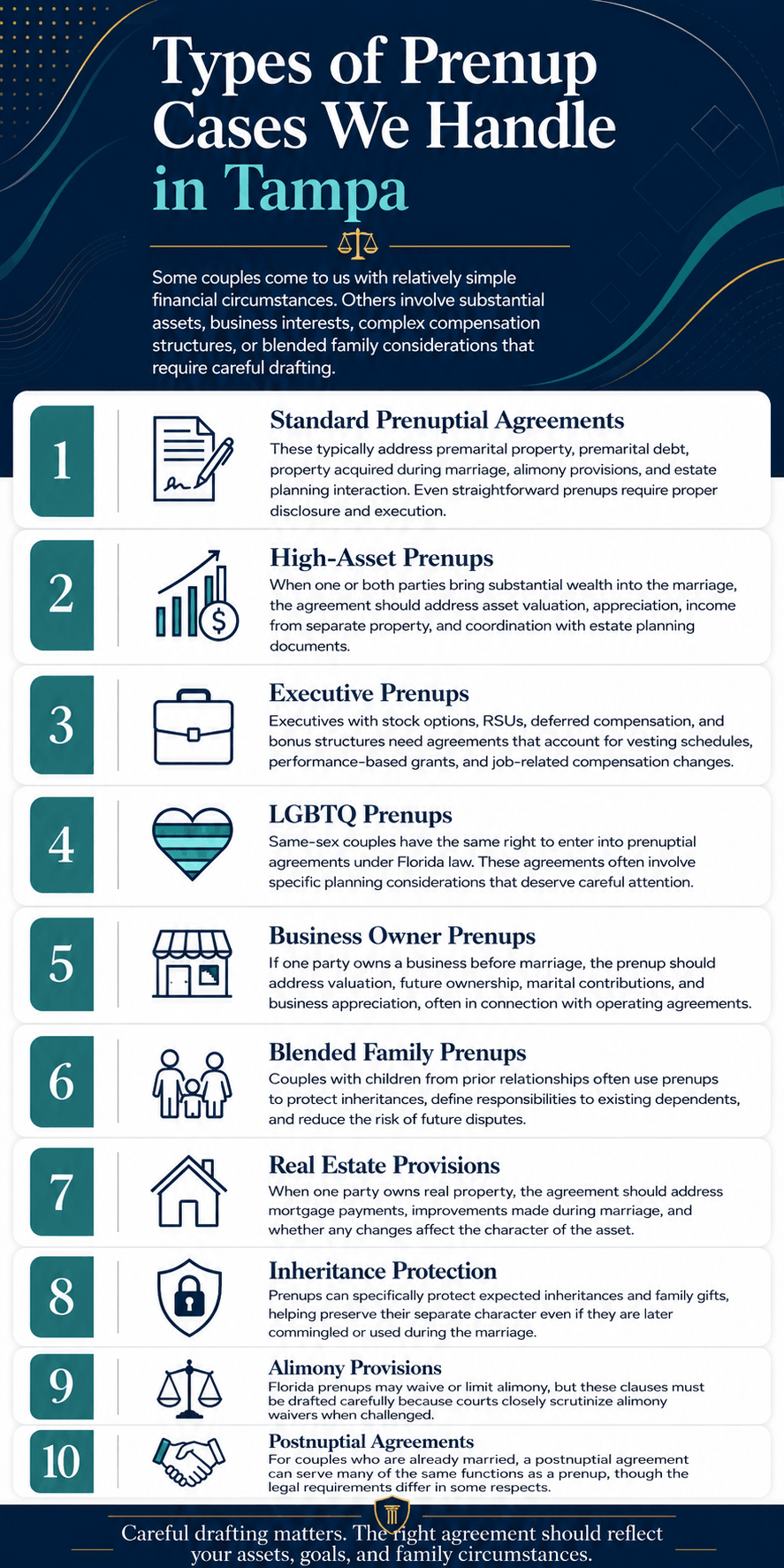
Types of Prenup Cases We Handle in Tampa
The McKinney Law Group Family & Divorce Lawyers represents Tampa clients across the full range of prenuptial agreement matters. Some couples come to us with relatively simple financial circumstances. Others involve substantial assets, business interests, complex compensation structures, or blended family considerations that require careful drafting.
- Standard prenuptial agreements. Most prenups address the basic elements: separation of premarital property, treatment of premarital debt, allocation of property acquired during marriage, alimony provisions, and estate planning interaction. Even straightforward cases require attention to disclosure and execution requirements.
- High-asset prenups. When one or both parties bring significant wealth to the marriage, the agreement must account for asset valuation, future appreciation, income from separate property, and the interaction between the prenup and estate planning documents.
- Executive prenups. Executives with stock options, restricted stock units, deferred compensation, and bonus structures require agreements that anticipate vesting schedules, performance-based grants, and changes in compensation tied to job mobility.
- LGBTQ prenups. Same-sex couples have the same legal rights to enter prenuptial agreements as any other couples under Florida law, and our office handles these matters with attention to the specific planning considerations many same-sex couples raise.
- Business owner prenups. When one party owns a business going into the marriage, the agreement should address valuation, future ownership, contributions made during the marriage, and the treatment of business appreciation. These provisions interact closely with the business’s operating agreements.
- Blended family prenups. Couples with children from prior relationships often use prenups to protect inheritances for those children, define financial responsibilities to existing dependents, and avoid disputes between the children and the new spouse later.
- Real estate provisions. When one party owns real property, the agreement should address treatment of the property, mortgage payments made during marriage, and any improvements that may shift the character of the asset.
- Inheritance protection. Expected inheritances and gifts from family members can be specifically addressed in the prenup, preserving their separate character even when commingled or used during the marriage.
- Alimony provisions. Florida allows prenups to waive or limit alimony, subject to certain constraints. The drafting of these provisions is critical because Florida courts scrutinize alimony waivers carefully when challenged at divorce.
- Postnuptial agreements. When couples have already married without a prenup, a postnuptial agreement can serve similar functions. The legal requirements differ in some respects from prenups, and we counsel couples on when each option fits the circumstances.
Tampa Prenup Infographic
Why Choose The McKinney Law Group Family & Divorce Lawyers for Prenup Representation in Tampa, FL?
Florida family law experience
Founding attorney Damien McKinney was admitted to the Florida Bar in 2006 and has practiced marital and family law for nearly two decades. He earned his Juris Doctor from Stetson University College of Law in 2005 and his Bachelor of Arts in Psychology from Florida State University in 2002. He is also admitted in North Carolina. Memberships include the Florida Bar Family Law Section and the Hillsborough County Bar Association Family Law Section. The firm’s prenup practice operates alongside our broader work as a family lawyer in Tampa, FL, and the depth of experience handling both planning and litigation matters informs how each prenup is drafted.
Recognition and approach to prenup drafting
Damien has been named a Super Lawyers Rising Star annually since 2012 and received the Super Lawyers Distinction of Excellence in 2016, an honor reserved for the top five percent of Florida lawyers. The firm has handled the full range of prenup matters across Tampa, from straightforward agreements for first-time marriages to complex documents involving multiple business interests and substantial inherited wealth. A prenup is a defensive document. The work that goes into drafting determines whether the agreement survives scrutiny if it is ever challenged years later under conditions of marital breakdown.

What Is Important To Understand About Prenup Cases?

Enforceability and Key Provisions of Florida Prenuptial Agreements
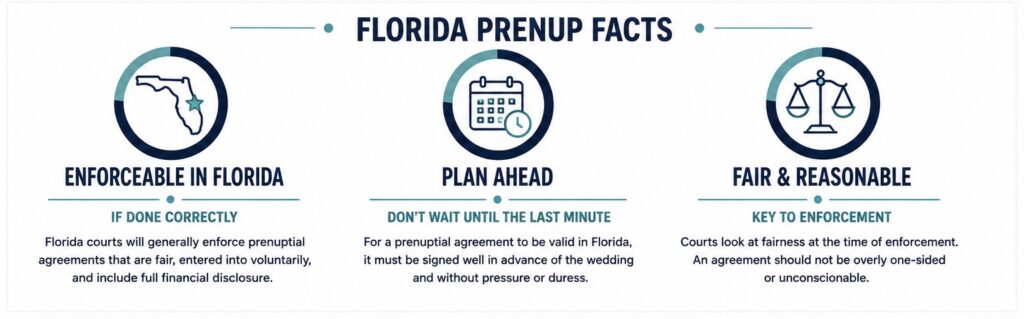
Florida applies the Uniform Premarital Agreement Act to determine whether a prenup is valid and enforceable. The basic requirements involve voluntary execution by both parties, fair and reasonable disclosure of each party’s financial circumstances, and an agreement that is not unconscionable when executed. A prenup that lacks any of these elements faces a real risk of being set aside when challenged.
Several substantive elements appear in most Florida prenups:
- Identification of separate property each party brings to the marriage
- Treatment of debts each party brings to the marriage
- Allocation of property acquired during the marriage
- Provisions for alimony, including waivers when permitted
- Treatment of business interests and professional practices
- Estate planning and inheritance considerations
- Treatment of marital home and other real property
- Mechanisms for amending or revoking the agreement
What a prenup cannot do under Florida law is equally important. Provisions purporting to affect child custody or child support are unenforceable, because those issues are determined by the court based on the best interests of the child at the time of any future proceeding, not by parental contract.
What Are Important Aspects of a Prenup Case?
The single most important factor in prenup enforceability is timing. An agreement signed days before the wedding under time pressure looks materially different to a reviewing court than one signed weeks or months in advance. Florida courts examine the circumstances surrounding execution carefully, including the time available to review the agreement, the opportunity to consult independent counsel, and any evidence of pressure or coercion.
Several practical aspects shape the strength of a prenup:
- Whether both parties had independent legal representation
- The completeness and accuracy of the financial disclosure
- The amount of time between execution and the wedding date
- The reasonableness of the terms relative to the circumstances
- The clarity and specificity of the drafting itself
- Whether the agreement was amended or signed under unusual circumstances
A well-drafted prenup anticipates the conditions under which it may be reviewed years later and is built to function under those conditions.

What Is The Prenup Case Timeline?
Most Tampa prenup matters move on a timeline driven by the wedding date rather than by court scheduling. Beginning the process well in advance produces a stronger agreement and reduces the risk of timing-based challenges later.
A typical timeline looks like this:
- Initial consultation and identification of the issues to address
- Exchange of financial disclosures between the parties
- Drafting of the initial agreement and exchange between counsel
- Negotiation and revisions
- Final execution by both parties
- Storage of the agreement for future reference
We generally recommend beginning the prenup process several months before the wedding. Last-minute prenups are not categorically unenforceable, but they create risk that a court may find the agreement was signed under duress or without adequate opportunity to review the terms.
What Should You Bring to Your Prenup Consultation?
Documentation supports an accurate financial picture from the start of the prenup process. Useful materials include:
- A summary of premarital assets, including real estate, investment accounts, retirement accounts, and business interests
- Recent tax returns and pay stubs
- Documentation of expected inheritances or family gifts
- Information about premarital debts and outstanding obligations
- Any existing trust documents that affect financial planning
- Information about the proposed wedding date
The consultation is used to identify what the prenup needs to address, what realistic terms look like in the couple’s specific circumstances, and what the process and timeline look like going forward.
What Are Important Florida Legal Resources for Prenup Cases?

Florida prenuptial agreement law is located primarily in Chapter 61 of the Florida Statutes, which includes Florida’s adoption of the Uniform Premarital Agreement Act. Related provisions appear in the probate code where prenups intersect with estate planning.
- The Florida Statutes Online portal contains the current statutory text governing premarital agreements.
- The Florida Courts Family Law Self-Help page provides procedural information for related family law filings.
- The Florida Bar Family Law Section publishes resources and continuing legal education materials that inform practitioner standards in family law matters including prenups.
Florida applies general contract law principles to prenup enforcement, with statute of limitations issues most often arising in challenges to enforceability after a marriage ends in divorce.
Reach Out to The McKinney Law Group Family & Divorce Lawyers to Schedule a Consultation
A prenup signed without careful attention to Florida’s enforceability requirements is not worth the time it took to draft. Contact us to schedule a consultation with a Tampa prenup attorney about your situation and the agreement that fits your circumstances.
Prenup Statistics in Tampa
National prenup adoption has grown significantly over the past decade, particularly among younger couples entering first marriages with established careers, business interests, or student loan debt. Data published by the U.S. Census Bureau shows Hillsborough County’s population above 1.5 million, with Tampa representing a meaningful share of the state’s marriage and family law activity. The 13th Judicial Circuit handles thousands of family law filings annually, and a growing share of divorce cases involve enforcement or interpretation of prenuptial agreements signed years earlier.
Our office maintains prenup statistics covering national and Florida trends in prenup adoption, the demographics of couples who sign them, and how prenup enforcement issues play out in modern divorce litigation. Broader trends in marriage and divorce tracked by the Centers for Disease Control and Prevention inform the planning many Tampa couples bring to their prenup discussions.
What Should You Expect During a Prenup Case

Prenup work follows a recognizable path from first consultation to executed agreement. The steps below reflect what most Tampa couples encounter when working with our office on a prenuptial agreement.
- Initial consultation with each party. The first meeting is used to identify what the prenup needs to address, including separate property, expected inheritances, business interests, debt, alimony, and any provisions specific to the couple’s circumstances. Each party generally meets with counsel separately when both are represented.
- Independent legal representation for both parties. Florida courts give substantial weight to whether both parties had independent counsel. Agreements where one party was unrepresented face heightened scrutiny. Our office represents one party in any given prenup and the other party is encouraged to retain separate counsel.
- Financial disclosure preparation. Both parties prepare detailed financial disclosures listing assets, liabilities, income sources, and significant financial obligations. The disclosures attach to the prenup as exhibits and become part of the agreement record.
- Identification of substantive issues. The drafting team and the parties work through each issue the prenup will address. Common categories include premarital property, alimony, business interests, retirement accounts, inheritances, and estate planning interaction. Prenup provisions specific to executives often address stock options, restricted stock units, and deferred compensation.
- Initial drafting. Counsel for one party prepares the first draft based on the issues identified and the terms agreed in principle. The draft addresses each issue with specificity sufficient for enforcement years later.
- Exchange and review. The draft is exchanged with the other party’s counsel for review. The other party’s counsel reviews each provision, identifies concerns, and proposes revisions where appropriate. The exchange typically involves several rounds of revisions.
- Negotiation of disputed provisions. When the parties disagree on specific terms, counsel negotiates the language. Most prenup negotiations resolve through discussion between counsel rather than direct negotiations between the parties, which preserves the relationship during the planning process.
- Cost considerations and fee discussion. Total fees vary based on case complexity and the number of issues to address. Our office discusses prenup costs with each client during the initial consultation, including how factors such as asset complexity, the number of negotiation rounds, and the involvement of business valuation experts affect the overall cost.
- Final review by both parties. Once counsel reach agreement on the language, both parties review the final document independently. Each party should understand every provision and be confident in their consent to the terms.
- Execution. The agreement is signed by both parties, typically in the presence of witnesses or a notary. Florida law requires the agreement to be in writing and signed by both parties to be enforceable. Execution should occur well in advance of the wedding to avoid timing-based challenges.
- Storage and access. The executed agreement is stored securely with each party retaining a copy. The original is typically retained by counsel or in a secure location accessible if the agreement is ever needed.
- Periodic review. Major life events such as the birth of children, significant career changes, business sales, or large inheritances may warrant review of the existing prenup. A postnuptial agreement can amend the prenup when circumstances change substantially.
The investment in a thoughtful prenup process produces an agreement that functions reliably under conditions of stress years later. Rushed or one-sided prenups face significantly higher risks of being challenged successfully.
Tampa Prenup Lawyer FAQs
Is a prenup enforceable in Florida?
Yes, prenups are enforceable in Florida when they meet the statutory requirements under the Uniform Premarital Agreement Act. The basic requirements include voluntary execution by both parties, fair and reasonable disclosure of financial circumstances, and terms that are not unconscionable when the agreement is executed. Most prenups that fail enforcement do so because of defects in one of these areas, not because Florida courts are hostile to prenups generally.
When should we sign our prenup?
The further in advance of the wedding, the better. There is no specific statutory deadline, but signing a prenup days before the wedding creates a real risk that a court will find the agreement was executed under duress or without adequate time for review. Beginning the process several months before the wedding produces a stronger agreement and reduces timing-based vulnerabilities.
Does each party need a lawyer?
Florida law does not require both parties to have independent counsel, but agreements signed with both parties represented are substantially more durable than agreements signed with only one party represented. Courts give significant weight to independent representation when evaluating challenges. Our office represents one party in any given prenup, and the other party is strongly encouraged to retain separate counsel.
What can a prenup not address in Florida?

A prenup cannot dictate child custody or child support, which are determined by the court at the time of any future proceeding based on the best interests of the child at that time. Agreements purporting to set custody arrangements or fix child support are unenforceable to that extent. Other limitations exist around certain alimony provisions in specific circumstances and any provision that would be unconscionable.
Can a prenup be challenged later?
Yes. The most common challenges allege inadequate financial disclosure, lack of voluntary execution, unconscionability, or fraud in the procurement of the agreement. A well-drafted prenup signed with both parties represented, with complete disclosure, and well in advance of the wedding withstands these challenges far more reliably than a hastily prepared agreement.
How much does a prenup cost in Tampa?
Total cost depends on the complexity of the assets, the number of issues the agreement must address, and the extent of negotiation between counsel. Straightforward prenups for couples with limited assets cost meaningfully less than agreements involving multiple business interests, executive compensation, or substantial inherited wealth. Fee structure is discussed during the initial consultation.
Can we modify our prenup after we are married?
Yes, through a postnuptial agreement or an amendment to the existing prenup. Both spouses must consent in writing and meet the procedural requirements that apply to the modification. Postnups are useful when circumstances have changed significantly since the prenup was signed, such as the birth of children or substantial changes in either spouse’s financial situation.
Do we need a prenup if we are not wealthy?
Prenups are useful for couples at many income and asset levels, not just for high-net-worth marriages. Common reasons less wealthy couples use prenups include protecting expected inheritances, addressing significant student loan or business debt, providing for children from prior relationships, and clarifying expectations about how finances will be managed during the marriage. The complexity and cost of the agreement scale with the issues, not necessarily with the asset level.
Can a prenup address debt?
Yes. Prenups commonly address treatment of premarital debt and allocation of debts that may be incurred during the marriage. Student loans, business debt, mortgage obligations, and credit card debt all appear in prenup discussions. Specific drafting determines how the debt is treated if the marriage ends, including whether each spouse remains responsible only for their separate debts.
What about expected inheritances?
A prenup can specifically address expected inheritances and gifts from family members, preserving their character as separate property even when commingled or used during the marriage. This is one of the most common uses of prenups in families where one party expects to receive significant inheritance or where parents want assurance that family wealth will remain protected.
Does a prenup affect estate planning?
Yes, and the interaction between prenups and estate planning is important to address. A prenup can waive certain spousal inheritance rights under Florida law, which then must be coordinated with wills, trusts, and other estate planning documents. Couples should not have a prenup and estate plan that contradict each other.
Should we sign our prenup in front of witnesses?
Florida law does not require witnesses for prenups, but signing in front of witnesses or before a notary adds an additional layer of protection against later claims of forgery or non-consent. Our office typically arranges signing with appropriate procedural safeguards.
Local Information for Tampa Prenup Cases

Tampa Family Court and Local Resources
Tampa prenup disputes that arise during divorce proceedings are heard in the family law division of the 13th Judicial Circuit, which covers Hillsborough County. Most prenups never see a courtroom because the marriages they govern do not end in divorce, but agreements that are challenged at divorce are subject to the same procedural framework that governs other family law matters.
What Are Important Local Resources for Tampa Prenup?
The following resources are listed for informational purposes only and do not constitute an endorsement.
- Hillsborough County Clerk of Court – (813) 276-8100
- 13th Judicial Circuit Court – (813) 272-5894
- Florida Bar Family Law Section – (850) 561-5650
- Hillsborough County Bar Association – (813) 221-7777
About the Attorney
Damien is the founding partner of The McKinney Law Group Family & Divorce Lawyers. His background in psychology shapes how the firm approaches prenup conversations, particularly with couples managing the emotional dynamics that often accompany financial planning before marriage.
What Our Clients Say
★★★★★
“I have had the pleasure of working with Mr. McKinney, and I am very impressed. He took the time to thoroughly explain his practice and was very patient in answering all my questions. Mr. McKinney explains things in a way that makes even the most complex legal issues easy to understand. He listened and was very supportive. I highly recommend Mr. McKinney to anyone in need of knowledgeable and caring legal advice.” – Ruhi Mirpuri
Read more reviews on our Google Business Profile.
Contact The McKinney Law Group Family & Divorce Lawyers
Prenups protect what matters most when the unexpected happens. The work that goes into drafting determines whether the agreement functions as intended years later, and the time invested in producing a strong prenup is far less costly than the disputes that follow weak ones. Our office represents Tampa clients in prenup drafting, review, and related family law matters. To schedule a consultation with a Tampa prenup lawyer, contact our firm today.
Visit Our Tampa Prenup Lawyers
1105 W Swann Ave Suite 100, Tampa, FL 33606