

Mediation representation guided by nearly 20 years of experience in Tampa and the surrounding area.
If you are involved in a divorce, a custody dispute, or another family law matter in Tampa, mediation may offer a more efficient path forward. Not every dispute has to end up in front of a judge. For many families, a structured mediation process gives both parties greater control over the outcome while reducing the financial and emotional toll of litigation.
Our Tampa, FL mediation lawyer has been handling family law disputes across Hillsborough County and the surrounding area for nearly two decades. The McKinney Law Group Family & Divorce Lawyers is prepared to represent your interests at the mediation table and work toward a resolution that protects what matters most to you. If you are considering mediation, we encourage you to schedule a consultation with our Tampa child support law office.
Mediation Lawyer Tampa, FL
A mediation lawyer is an attorney who represents you during mediation, a form of alternative dispute resolution in which a neutral third party facilitates negotiations between the parties on contested issues. The mediator does not make binding decisions. Instead, the mediator guides conversation so the parties can reach an agreement on their own terms.
In Florida, courts frequently require mediation before allowing family law matters to proceed to trial. A mediation attorney in Tampa, FL protects your legal interests throughout this process, advising you on what to accept, what to counter, and what to take back to court if necessary. The end goal is a written agreement both parties sign voluntarily, which a judge can then approve and make enforceable.
Types of Mediation Cases We Handle in Tampa
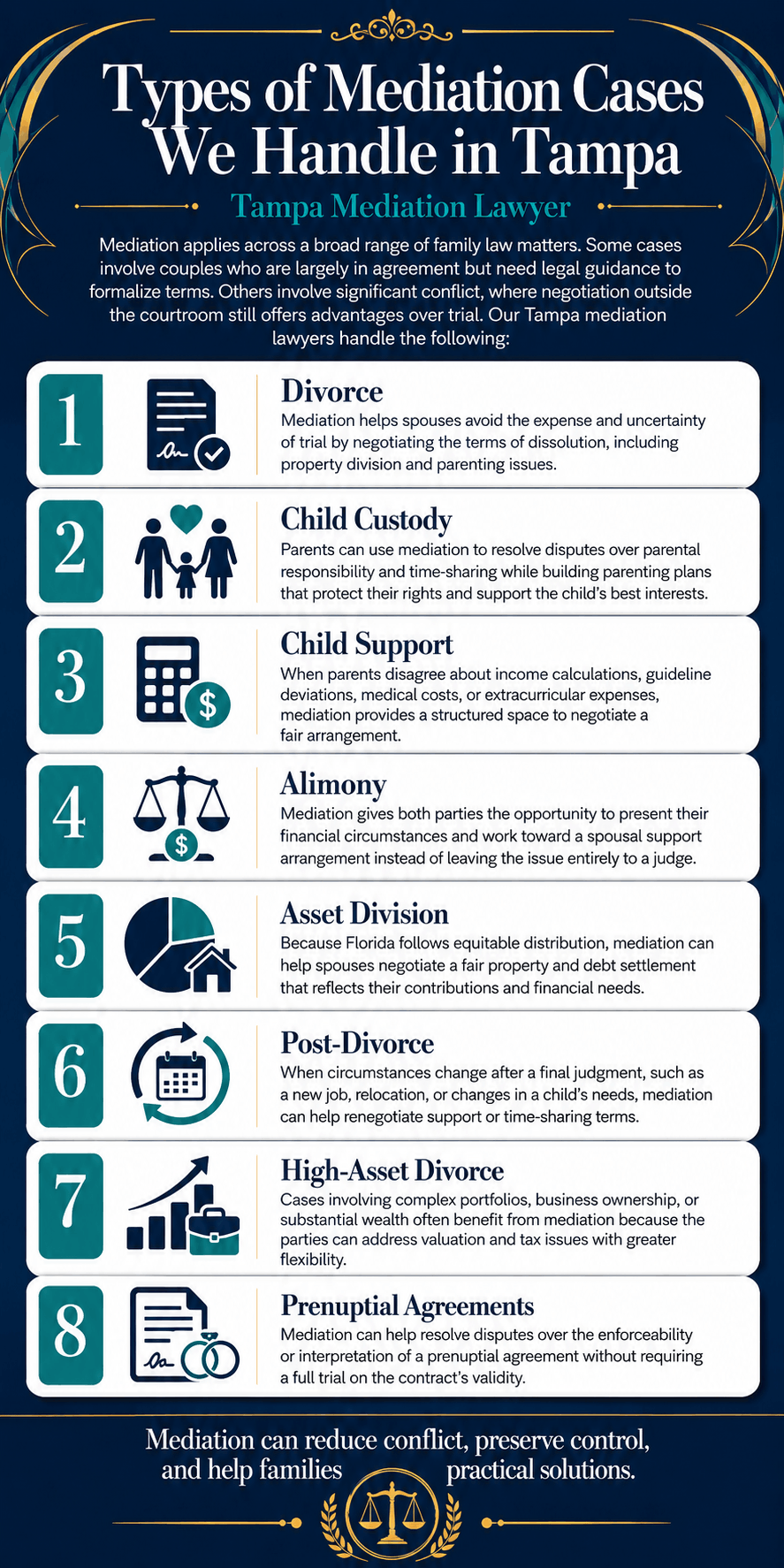
Mediation applies across a broad range of family law matters. Some cases involve couples who are largely in agreement but need legal guidance to formalize terms. Others involve significant conflict, where negotiation outside the courtroom still offers advantages over trial. Our Tampa mediation lawyers handle the following:
- Divorce. Spouses who want to avoid the expense and uncertainty of a trial can use mediation to negotiate the terms of their dissolution of marriage. We assist clients in reaching settlement agreements that address all necessary issues, from property to parenting.
- Child custody. Disputes over parental responsibility and time-sharing schedules are among the most common reasons families enter mediation in Hillsborough County. We work with clients to develop parenting plans that protect each parent’s rights while serving the child’s best interests.
- Child support. When parents disagree about income calculations, deviations from guidelines, or who covers expenses such as medical costs and extracurricular activities, mediation provides both sides with a structured space to negotiate a fair arrangement.
- Alimony. Spousal support remains one of the most contentious issues in Florida divorce. Mediation allows both parties to present financial circumstances and work toward an alimony arrangement instead of leaving the decision entirely in a judge’s hands.
- Asset division. Florida follows equitable distribution principles, meaning marital property and debts are divided fairly but not necessarily down the middle. A mediation attorney helps you understand what you may be entitled to and negotiate a property settlement that reflects your contributions and financial needs.
- Post-divorce. Circumstances change. A new job, a relocation, a shift in a child’s needs. When life looks meaningfully different after a final judgment, mediation provides a path to renegotiate support or time-sharing terms without returning to trial.
- High-asset divorce. Cases involving complex portfolios, business ownership, or substantial wealth often benefit from mediation because the parties can address valuation questions and tax implications with more flexibility than a courtroom proceeding allows.
- Prenuptial agreements. Disputes sometimes arise over the enforceability or interpretation of a prenuptial agreement during a divorce. Mediation can resolve those disagreements without a full trial on the contract’s validity.
Tampa Mediation Infographic
Why Choose The McKinney Law Group Family & Divorce Lawyers as My Mediation Lawyer in Tampa, FL?
Nearly Two Decades of Family Law Experience
Damien McKinney founded The McKinney Law Group Family & Divorce Lawyers and has practiced family law for close to 20 years. He earned his Bachelor of Arts in Psychology from Florida State University in 2002 and his Juris Doctor from Stetson University College of Law in 2005. He was admitted to the Florida Bar in 2006 and is licensed in North Carolina. Since 2012, Damien has been recognized annually as a Rising Star by Super Lawyers, and in 2016 he received the Super Lawyers Distinction of Excellence, a recognition given to the top 5% of attorneys in Florida. He is also a Florida Supreme Court certified family law mediator, which means he understands mediation from both the attorney’s and the mediator’s perspective.
As a family lawyer in Tampa, FL, Damien represents clients in mediation involving divorce, custody, support, and property division. He is a member of the Florida Bar Family Law Section and the Hillsborough County Bar Association Family Law Section.
A Proven Record of Resolving Disputes
The McKinney Law Group Family & Divorce Lawyers has helped families across Tampa, FL reach favorable outcomes through mediation and other forms of alternative dispute resolution. We have guided clients through contested divorces that ultimately settled at the mediation table, as well as custody and support modifications that never required a judge’s final ruling. Our approach prioritizes preparation, which is often what separates a productive mediation from one that stalls.
What Is Important to Understand About Mediation Cases?
How Mediation Works in Florida Family Law
Florida courts routinely order mediation in family law cases before allowing the parties to proceed to trial. The process reduces court congestion and gives families a chance to resolve disputes privately. Several core principles define mediation:
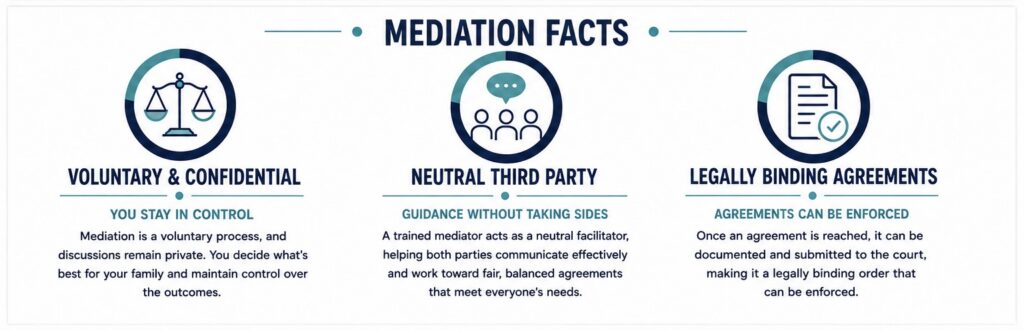
- Confidentiality protects both sides. Statements made during mediation generally cannot be introduced as evidence if the process does not produce an agreement.
- Agreement is always voluntary. The mediator cannot impose terms on either party. If no consensus is reached, the case proceeds to trial.
- The mediator is a neutral facilitator. Certified family mediators in Florida must meet training and ethical standards established by the Florida Supreme Court.
- Once signed, the agreement is enforceable. After both parties execute a mediation agreement and a judge approves it, the terms carry the force of law.
- Each party can have their own attorney present during sessions to provide real-time legal advice and review proposed terms before anything is signed.
What Are Important Aspects of a Mediation Case?
Mediation works best when both sides arrive prepared and willing to negotiate in good faith. That does not mean conceding on everything. It means being open to hearing the other party’s position and evaluating options before making decisions.
- Full financial transparency is required. Both parties must exchange relevant financial records before mediation begins. Florida’s mandatory disclosure rules apply even outside of the courtroom.
- Emotional readiness makes a difference. Mediation involves difficult conversations about money, children, and shared history. Clients who have a support system or have worked with a counselor tend to stay more focused.
- Realistic expectations lead to better outcomes. A mediation attorney in Tampa can explain what a court might order if mediation fails, giving you a reference point for evaluating proposed settlements.
- Courts notice how you participate. A judge may consider whether a party negotiated in good faith if the case later goes to trial.
What Is the Mediation Case Timeline?
The timeline for a mediation case in Tampa depends on how complex the issues are and how ready both parties are to negotiate. Here is the general sequence:
- Filing and case initiation. One party files a petition with the Hillsborough County court, and the other party is served. The court typically orders mediation early in the process.
- Selection of a mediator. The parties either agree on a certified family mediator or the court appoints one. Family mediators in Florida must hold a certification from the Florida Supreme Court.
- Pre-mediation preparation. Both sides gather financial documents, identify the issues in dispute, and consult with their attorneys on priorities and strategy.
- Mediation session. A session can run anywhere from a few hours to an entire day. Complex cases may require more than one session spread across several weeks.
- Drafting the agreement. If the parties reach resolution, the attorneys draft a written agreement at the table. Both sides sign it before leaving the session.
- Court approval. The signed agreement is filed with the court for review and incorporation into a final order.
What Should You Bring to Your Mediation Consultation?
Walking into mediation unprepared weakens your position. Before the first session, your mediation lawyer in Tampa will help you assemble the documentation you need.
- Recent pay stubs and two to three years of tax returns that reflect current and historical income
- Statements from all bank accounts, investment portfolios, and retirement accounts
- A detailed list of marital assets and debts, including real property, vehicles, and open credit accounts
- Any existing court orders, parenting plans, or prior settlement proposals that are relevant to the dispute
During your initial consultation with The McKinney Law Group Family & Divorce Lawyers, we review your financial picture, identify the central issues, and outline realistic outcomes you can pursue. This meeting gives you a clear understanding of your next steps.
What Are Important Florida Legal Resources for Mediation Cases?
Florida provides several publicly accessible resources for people involved in family law mediation. These are useful starting points for understanding how the process is structured at the state and local levels.
- The Florida Courts mediation page provides information on mediator certification, ethical standards, and ADR programs throughout the state.
- The Florida Senate statutes site offers the full text of Chapter 44, which governs mediation alternatives to judicial action.
- The Thirteenth Judicial Circuit publishes information about family mediation services specific to Hillsborough County, including eligibility and fee schedules.
- The American Bar Association maintains articles and resources on mediation best practices through its Dispute Resolution Section.
Reach Out to The McKinney Law Group Family & Divorce Lawyers to Schedule a Consultation
If you are dealing with a family law dispute in Tampa, FL, a mediation attorney can help you evaluate your options and work toward a resolution without the cost and unpredictability of trial. The McKinney Law Group Family & Divorce Lawyers is ready to guide you through the process from preparation to final agreement. We work on an hourly basis with a retainer and will explain all fees during our initial meeting. Contact us to schedule a consultation and take the first step toward resolving your case.