

A guardianship practice built on nearly 20 years of client representation in Tampa and the surrounding area.
If you need to establish legal guardianship over a minor child or an incapacitated adult in Tampa, the process involves more than filling out court forms. It requires petitions, medical evaluations, background checks, court hearings, and ongoing reporting obligations.
Our Tampa, FL guardianship lawyer can walk you through each step and advocate for the proposed ward’s best interests at every stage. The McKinney Law Group Family & Divorce Lawyers has been representing families in Hillsborough County and the broader Tampa Bay region for nearly two decades. If you are considering filing for guardianship or have been asked to serve as a guardian, we encourage you to schedule a consultation with our office.
Guardianship Lawyer Tampa, FL
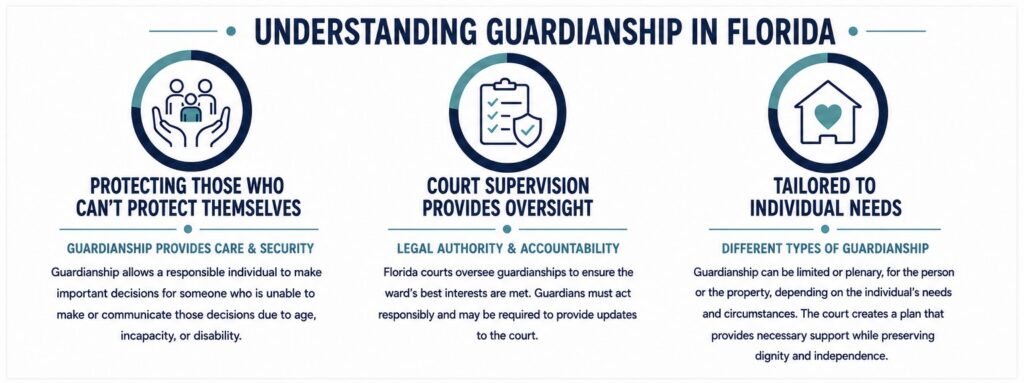
Guardianship is a court proceeding in which a judge appoints one person to make legal, financial, or personal decisions on behalf of another person who cannot make those decisions independently. In Florida, that person is referred to as the “ward.” The guardian may be responsible for the ward’s personal care, property, or both, depending on the scope of the court’s order.
A guardianship attorney in Tampa, FL helps you file the necessary petitions, navigate the incapacity determination process, and present your case to the court. Whether the situation involves a child who has lost both parents or an aging relative who can no longer manage daily affairs, legal representation is critical to protecting the ward’s rights and your own.
Types of Guardianship Cases We Handle in Tampa
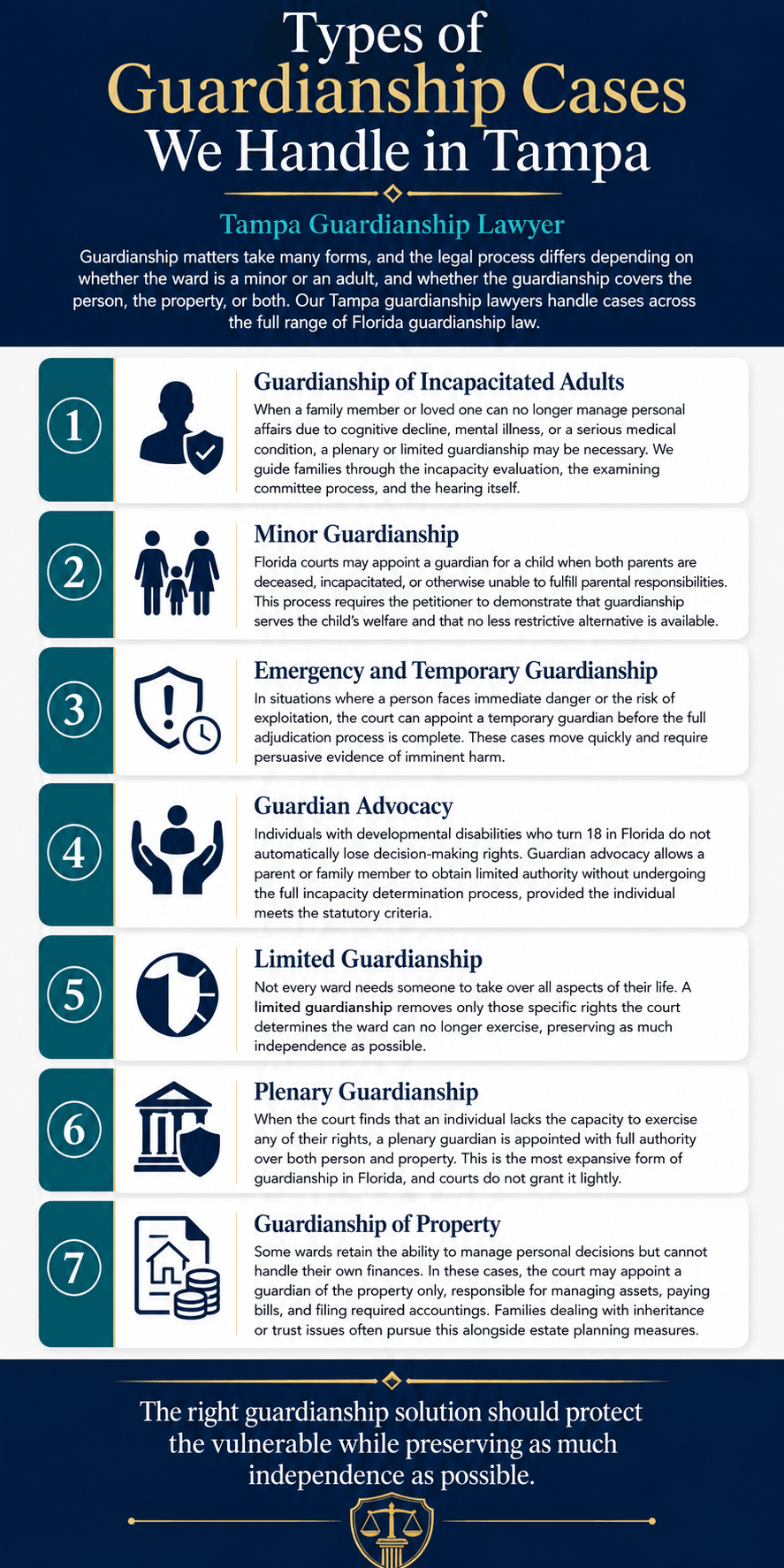
Guardianship matters take many forms, and the legal process differs depending on whether the ward is a minor or an adult, and whether the guardianship covers the person, the property, or both. Our Tampa guardianship lawyers handle cases across the full range of Florida guardianship law:
- Guardianship of incapacitated adults. When a family member or loved one can no longer manage personal affairs due to cognitive decline, mental illness, or a serious medical condition, a plenary or limited guardianship may be necessary. We guide families through the incapacity evaluation, the examining committee process, and the hearing itself.
- Minor guardianship. Florida courts may appoint a guardian for a child when both parents are deceased, incapacitated, or otherwise unable to fulfill parental responsibilities. This process requires the petitioner to demonstrate that guardianship serves the child’s welfare and that no less restrictive alternative is available.
- Emergency and temporary guardianship. In situations where a person faces immediate danger or the risk of exploitation, the court can appoint a temporary guardian before the full adjudication process is complete. These cases move quickly and require persuasive evidence of imminent harm.
- Guardian advocacy. Individuals with developmental disabilities who turn 18 in Florida do not automatically lose decision-making rights. Guardian advocacy allows a parent or family member to obtain limited authority without undergoing the full incapacity determination process, provided the individual meets the statutory criteria.
- Limited guardianship. Not every ward needs someone to take over all aspects of their life. A limited guardianship removes only those specific rights the court determines the ward can no longer exercise, preserving as much independence as possible.
- Plenary guardianship. When the court finds that an individual lacks the capacity to exercise any of their rights, a plenary guardian is appointed with full authority over both person and property. This is the most expansive form of guardianship in Florida, and courts do not grant it lightly.
- Guardianship of property. Some wards retain the ability to manage personal decisions but cannot handle their own finances. In these cases, the court may appoint a guardian of the property only, responsible for managing assets, paying bills, and filing required accountings. Families dealing with inheritance or trust issues often pursue this alongside estate planning measures.
Tampa Guardianship Infographic
Why Choose The McKinney Law Group Family & Divorce Lawyers as My Guardianship Lawyer in Tampa, FL?
Recognized Credentials in Florida Family Law
Damien McKinney founded The McKinney Law Group Family & Divorce Lawyers and has been practicing family law for nearly 20 years. He earned his Bachelor of Arts in Psychology from Florida State University in 2002 and his Juris Doctor from Stetson University College of Law in 2005. He was admitted to the Florida Bar in 2006 and is also licensed in North Carolina. Damien has been recognized as a Rising Star by Super Lawyers every year since 2012, and in 2016 he received the Super Lawyers Distinction of Excellence, awarded to the top 5% of attorneys in Florida. He also serves as a Guardian Ad Litem, which gives him firsthand insight into how courts evaluate the needs and welfare of vulnerable individuals.
As a family lawyer in Tampa, FL, Damien handles guardianship matters for minors, incapacitated adults, and families navigating related custody proceedings. He is a member of the Florida Bar Family Law Section and the Hillsborough County Bar Association Family Law Section.
Practical Knowledge of Hillsborough County Guardianship Proceedings
Guardianship cases in Hillsborough County are assigned to the Probate, Guardianship, and Mental Health Division of the Thirteenth Judicial Circuit. We understand the local filing procedures, the judges who preside over these matters, and the administrative requirements imposed by the clerk’s office. That local knowledge matters in contested cases where timing and procedure can affect the outcome.
What Is Important to Understand About Guardianship Cases?
Key Legal Concepts in Florida Guardianship
Florida’s guardianship framework is governed by Chapter 744 of the Florida Statutes. The law favors the least restrictive form of intervention, meaning the court will consider alternatives to full guardianship before appointing a guardian with plenary authority. A few foundational concepts are important:
- A ward is the person over whom guardianship is established, whether a minor or an incapacitated adult.
- An examining committee is a group of three professionals appointed by the court to evaluate the alleged incapacitated person and report findings to the judge.
- Guardian of the person manages the ward’s personal and medical decisions, while guardian of the property manages the ward’s finances and assets.
- Less restrictive alternatives include durable powers of attorney, health care surrogates, and trusts, all of which may satisfy the ward’s needs without full guardianship.
- A guardian must file an initial guardianship plan and annual reports with the court, including detailed financial accountings.
What are Important Aspects of a Guardianship Case?
The court’s primary concern in every guardianship matter is the welfare of the proposed ward. That focus shapes the entire proceeding, from the initial petition through ongoing court oversight.
- Who qualifies to serve as a guardian matters significantly. Florida law requires the proposed guardian to pass a background check, complete a court-approved guardian education course, and demonstrate the ability to manage the ward’s affairs responsibly.
- Contested guardianship cases are not uncommon. Multiple family members may seek appointment, or a ward’s relatives may challenge the petition. These disputes can involve allegations of undue influence, exploitation, or incompetence.
- Ongoing compliance is a condition of serving. Guardians must submit annual plans and financial reports. The court can remove a guardian who fails to meet these obligations.
- Grandparents, stepparents, and other extended family members often play a role, particularly when biological parents are unable to care for a child.
What Is the Guardianship Case Timeline?
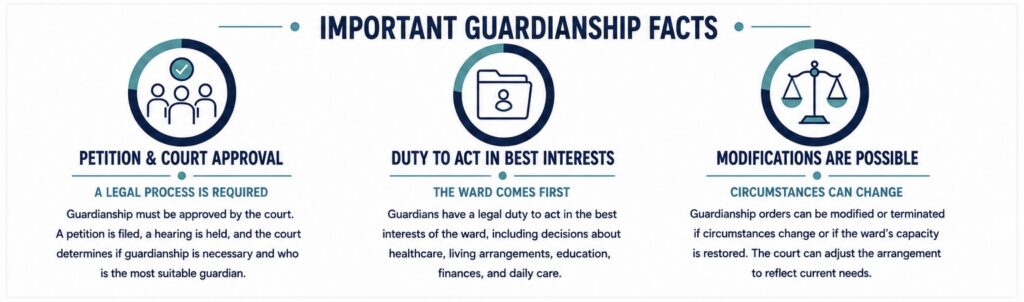
The timeline for a guardianship case in Tampa varies depending on whether the petition is contested and whether the case involves a minor or an incapacitated adult. The following is a general sequence:
- Filing the petition. The proposed guardian files a petition with the Hillsborough County Clerk of Court, identifying the ward, the type of guardianship sought, and the reasons for it.
- Appointment of the examining committee. For adult incapacity cases, the court appoints a three-member committee to evaluate the alleged incapacitated person. The committee has a set period to complete its report.
- Service and notice. The proposed ward, their attorney, and all interested parties must be notified of the petition and hearing date.
- Adjudicatory hearing. The court holds a hearing to review the committee’s findings, hear testimony, and determine whether guardianship is warranted. The judge will also appoint the guardian at this stage if appropriate.
- Issuance of Letters of Guardianship. Once appointed, the guardian receives official letters authorizing them to act on the ward’s behalf. The guardian must then file an initial guardianship report.
- Ongoing reporting. The guardian files annual plans and accountings with the court for the duration of the guardianship.
What Should You Bring to Your Guardianship Consultation?
Gathering the right documents before meeting with a guardianship attorney in Tampa can make your initial consultation far more productive.
- Any existing powers of attorney, advance directives, or health care surrogate designations for the proposed ward
- Medical records, psychiatric evaluations, or physician letters that describe the ward’s condition and functional limitations
- Financial records for the proposed ward, including bank statements, property deeds, and retirement or investment account summaries
- Identification for both yourself and the proposed ward, along with proof of your relationship
We will review this information during the consultation and explain whether guardianship is the right course of action or whether a less restrictive arrangement may accomplish your goals. You will leave with a clear understanding of the process, costs, and expected timeline.
What Are Important Florida Legal Resources for Guardianship Cases?
Florida offers several publicly accessible resources for families navigating guardianship. The following provide useful background on the legal framework and local procedures.
- The Florida Courts guardianship page provides an overview of guardianship proceedings and links to statewide resources and self-help materials.
- The Florida Senate statutes site contains the full text of Chapter 744, which governs guardianship law in Florida.
- The Thirteenth Judicial Circuit’s Elder Justice Center provides guardianship information and resources specific to Hillsborough County, including contact information for the Probate and Guardianship Division.
- The Thirteenth Judicial Circuit also publishes administrative orders covering local rules for the Probate, Guardianship, Trust, and Mental Health Division.
- The Florida Courts’ self-help section offers additional guidance on guardianship for individuals without legal representation.
Reach Out to The McKinney Law Group Family & Divorce Lawyers to Schedule a Consultation
If you need a guardianship lawyer in Tampa, FL, acting promptly is important, particularly if a loved one is vulnerable or at risk of exploitation. The McKinney Law Group Family & Divorce Lawyers is ready to help you evaluate the situation, determine the appropriate type of guardianship, and guide you through the court process. We work on an hourly basis with a retainer and will explain all fees at the outset. Contact us to schedule a consultation and begin protecting the person who needs it most.