

Trusted annulment lawyers serving clients across Tampa and the surrounding area for nearly two decades.
Annulment is one of the most misunderstood proceedings in Florida family law. Some people assume any short marriage qualifies. Others believe religious annulment carries the same legal weight as a civil one. Neither is correct. Florida treats annulment as an extraordinary remedy reserved for marriages that were either void from the start or voidable due to specific legal defects. Our founding attorney, Damien McKinney, has practiced Florida marital and family law since 2006 and represents Hillsborough County spouses as a Tampa, FL annulment lawyer handling void and voidable marriage proceedings throughout the region.
Annulment Lawyer Tampa, FL
What is an annulment, and how does it differ from a divorce? An annulment is a court ruling that a marriage was never legally valid. A divorce, by contrast, ends a valid marriage. The distinction matters because annulment treats the marriage as if it never legally existed, which affects property, support, and the legal status of any children involved.
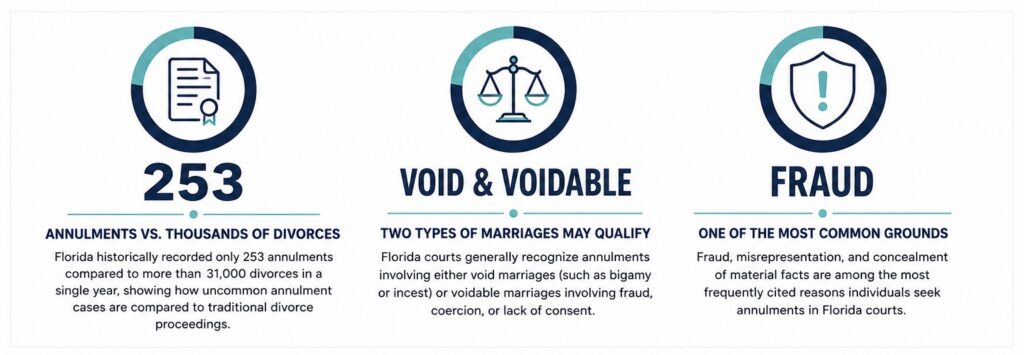
Florida law recognizes two categories of annulment. Void marriages were never legally formed because of a fundamental defect such as bigamy or incest. Voidable marriages were technically formed but contain a defect such as fraud, duress, or incapacity that allows one spouse to seek invalidation. Each category carries different procedural requirements, evidence standards, and timing considerations. Our child support attorney in Tampa, FL can evaluate which category, if any, applies to the facts of a particular marriage.
Types of Annulment Cases We Handle in Tampa

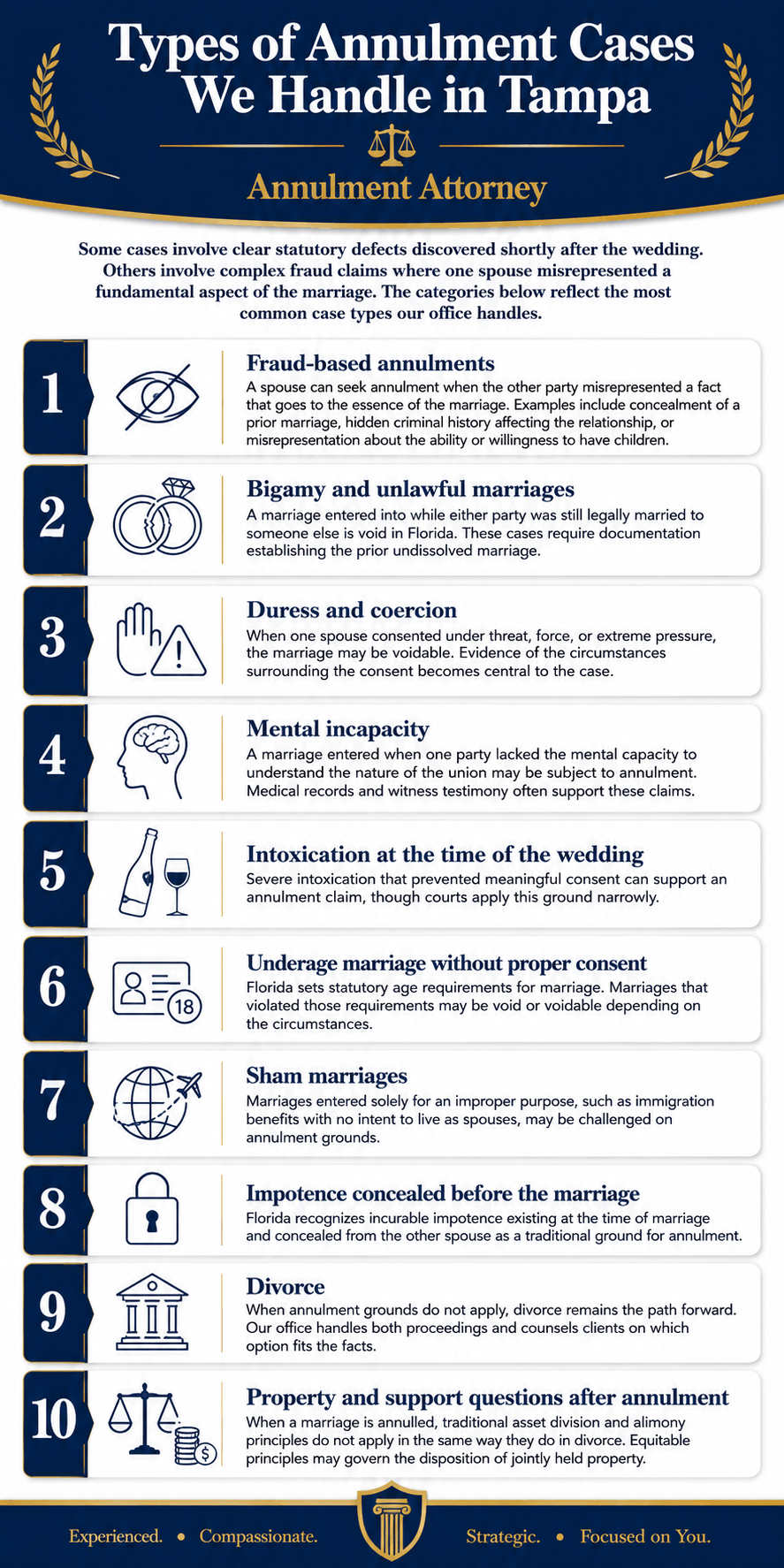
The McKinney Law Group Family & Divorce Lawyers represents Tampa spouses across the range of annulment matters. Some cases involve clear statutory defects discovered shortly after the wedding. Others involve complex fraud claims where one spouse misrepresented a fundamental aspect of the marriage. The categories below reflect the most common case types our office handles.
- Fraud-based annulments. A spouse can seek annulment when the other party misrepresented a fact that goes to the essence of the marriage. Examples include concealment of a prior marriage, hidden criminal history affecting the relationship, or misrepresentation about the ability or willingness to have children.
- Bigamy and unlawful marriages. A marriage entered into while either party was still legally married to someone else is void in Florida. These cases require documentation establishing the prior undissolved marriage.
- Duress and coercion. When one spouse consented under threat, force, or extreme pressure, the marriage may be voidable. Evidence of the circumstances surrounding the consent becomes central to the case.
- Mental incapacity. A marriage entered when one party lacked the mental capacity to understand the nature of the union may be subject to annulment. Medical records and witness testimony often support these claims.
- Intoxication at the time of the wedding. Severe intoxication that prevented meaningful consent can support an annulment claim, though courts apply this ground narrowly.
- Underage marriage without proper consent. Florida sets statutory age requirements for marriage. Marriages that violated those requirements may be void or voidable depending on the circumstances.
- Sham marriages. Marriages entered solely for an improper purpose, such as immigration benefits with no intent to live as spouses, may be challenged on annulment grounds.
- Impotence concealed before the marriage. Florida recognizes incurable impotence existing at the time of marriage and concealed from the other spouse as a traditional ground for annulment.
- Divorce. When annulment grounds do not apply, divorce remains the path forward. Our office handles both proceedings and counsels clients on which option fits the facts.
- Property and support questions after annulment. When a marriage is annulled, traditional asset division and alimony principles do not apply in the same way they do in divorce. Equitable principles may govern the disposition of jointly held property.
Tampa Annulment Infographic
Why Choose The McKinney Law Group Family & Divorce Lawyers for Annulment in Tampa, FL?
Florida family law background
Damien McKinney was admitted to the Florida Bar in 2006 after earning his Juris Doctor from Stetson University College of Law in 2005. He completed his Bachelor of Arts in Psychology at Florida State University in 2002 and is also admitted to practice in North Carolina. His memberships include the Florida Bar Family Law Section, the Hillsborough County Bar Association Family Law Section, and the Buncombe County Bar Association. Annulment cases sit within the broader marital and family law work our office handles as a family lawyer in Tampa, FL, and the procedural overlap with related areas matters in how these cases are positioned.
Recognition and approach
Damien has been named a Super Lawyers Rising Star annually since 2012 and received the Super Lawyers Distinction of Excellence in 2016, an honor reserved for the top five percent of Florida lawyers. The firm has helped clients across Tampa resolve sensitive marital matters that demanded a careful evidentiary approach. Annulment is a results-oriented practice. Either the legal grounds are established to the court’s satisfaction or they are not, and the preparation of evidence determines that outcome.
What Is Important To Understand About Annulment Cases?

Grounds, Liability, and Outcomes for Annulment Cases
Florida does not have a comprehensive annulment statute. The grounds and procedures are drawn primarily from Florida common law, developed through court decisions over many decades. This is a significant distinction from divorce, which is governed by detailed statutory provisions.
A Tampa annulment case typically requires:
- A petition filed in the circuit court for the county where either spouse resides
- Specific identification of the void or voidable ground being asserted
- Service on the other spouse and an opportunity to respond
- Evidentiary support for the ground, often including documents, third-party witnesses, or expert testimony
- A final hearing before a judge, since annulment matters do not involve jury trials in Florida
The burden of proof rests on the party seeking annulment. Courts require clear and convincing evidence in most annulment categories, which is a higher standard than the preponderance of the evidence used in most civil matters. The exact evidentiary standard depends on the ground asserted.
What Are Important Aspects of an Annulment Case?

Time matters in annulment cases. Several voidable grounds are subject to ratification, which means that continuing to live as spouses after discovering the defect can waive the right to seek annulment. A spouse who learns of fraud and then resumes the marriage may lose the ability to pursue an annulment based on that fraud.
Children of an annulled marriage are not affected in terms of legitimacy or parental rights under Florida law. Parenting issues are addressed through standard custody and support procedures, including custody and time-sharing determinations and child support calculations consistent with cases involving divorced parents.
Property issues require careful analysis. Florida’s equitable distribution framework applies to divorce, not annulment. Jointly held property, commingled assets, and contributions during the relationship may be addressed under contract or equitable principles, which produces outcomes that can differ meaningfully from a divorce.
What Is The Annulment Case Timeline?
Annulment cases vary widely in timeline. A clearly documented void marriage may resolve in a few months. A contested fraud-based annulment with disputed facts and witness testimony can extend longer, particularly when the responding spouse opposes the annulment and asserts the marriage was valid.
A typical case progression looks like this:
- Initial petition filed and served on the other spouse
- Responsive pleading or default if the spouse does not appear
- Discovery exchange covering financial records and ground-specific evidence
- Settlement discussions or mediation when feasible
- Evidentiary hearing on the merits
- Entry of the final judgment of annulment or denial
The Tampa family law division of the 13th Judicial Circuit hears annulment petitions alongside the broader docket of divorce and family law matters.
What Should You Bring to Your Annulment Consultation?
Documentation strengthens an annulment claim from the outset. Useful materials for the initial meeting include:
- The marriage certificate
- Any prior marriage records relevant to a bigamy claim
- Communications, photographs, or other documents supporting the ground asserted
- Financial records reflecting joint property, accounts, or debts acquired during the relationship
- Medical or mental health records when capacity is in issue
- A timeline of significant events, including when the alleged defect was discovered
- Contact information for potential witnesses
The consultation is used to determine whether the facts support a recognized annulment ground or whether dissolution of marriage is the more appropriate path.
What Are Important Florida Legal Resources for Annulment Cases?
Annulment law in Florida differs structurally from most other family law areas because it rests on case law rather than a single statutory chapter. Researchers and parties seeking primary sources can consult:
- The Florida Statutes Online portal, which contains the limited statutory provisions touching on marriage formation requirements.
- The Florida Courts Family Courts page, which provides procedural information and forms.
- The Florida Department of Health Bureau of Vital Statistics, which oversees marriage licensing and vital records relevant to annulment proceedings.
Florida applies general statute of limitations principles to certain voidable marriage grounds, with timing rules tied to discovery of the underlying defect rather than the date of the marriage in some categories.
Reach Out to The McKinney Law Group Family & Divorce Lawyers to Schedule a Consultation
Annulment cases require an early assessment of whether the legal grounds are present. Contact us to schedule a consultation with a Tampa annulment attorney about the facts of your marriage and the most appropriate path forward.
Annulment Statistics in Tampa
Annulment is far less common than divorce in Florida. The state records hundreds of thousands of marriages each year and a comparable volume of divorce filings, while annulment proceedings represent a small fraction of family law cases. Hillsborough County, with a population estimated above 1.5 million by the U.S. Census Bureau, processes a meaningful share of the state’s family law filings, though annulment remains a specialized subset.
The rarity of annulment in Florida reflects the narrow grounds available under common law. Most short marriages that end quickly do so through uncontested divorce rather than annulment, because the legal requirements for annulment are not met. National marriage and divorce data published by the Centers for Disease Control and Prevention tracks broader trends in marital dissolution, including the steady prevalence of divorce relative to other forms of marital termination.
Common Causes of Annulment Cases in Florida

The grounds for annulment in Florida are narrow by design. Courts reserve annulment for marriages that contain a fundamental legal defect, not for marriages that simply did not work out. Below are the grounds most often raised in Tampa annulment cases, drawn from Florida common law.
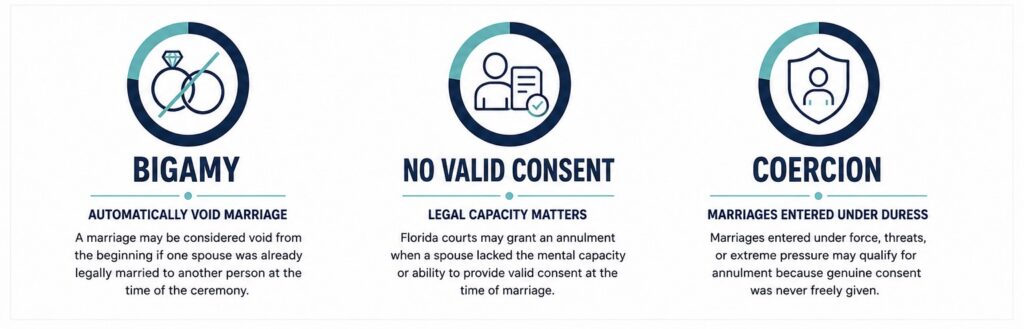
- Bigamy. A marriage entered into while either party was still legally married to a living spouse is void in Florida. Evidence usually consists of marriage and divorce records establishing the prior undissolved marriage. The void status means the marriage was never legally formed in the first place.
- Incest. Marriages between individuals related within prohibited degrees of consanguinity are void under Florida law. These cases are uncommon but absolute when the relationship is established.
- Lack of mental capacity. A spouse who lacked the mental capacity to understand the nature and consequences of marriage at the time of the wedding may seek annulment. Cognitive impairment, severe mental illness, or developmental conditions may support this ground when documented.
- Severe intoxication. A wedding performed when one party was so intoxicated that meaningful consent was impossible may support an annulment. Courts apply this ground narrowly and look for evidence beyond ordinary impairment.
- Fraud going to the essence of the marriage. Misrepresentation about a fundamental aspect of the relationship can support annulment. Examples include concealment of a prior marriage, false claims about the ability or willingness to have children, and certain forms of identity-based fraud. Minor misrepresentations or general dishonesty are not sufficient.
- Duress. A marriage entered under threat, force, or extreme coercion may be voidable. The threatened harm must have been sufficient to overcome the free will of the threatened spouse.
- Sham marriage for an improper purpose. When parties marry solely to obtain an immigration benefit, financial advantage, or other improper purpose, with no intent to live as spouses, annulment may be available depending on the circumstances.
- Concealed impotence existing at the time of marriage. Florida recognizes incurable impotence that existed at the time of marriage and was concealed from the other spouse as a traditional ground for annulment.
- Underage marriage without statutorily required consent. Florida law sets minimum age requirements and consent procedures for marriage. A marriage that violated those requirements may be void or voidable.
- Marriage performed without legal authority. A marriage solemnized by someone without the authority to perform the ceremony, or that failed to comply with licensing requirements, may be challenged on annulment grounds.
Each ground carries its own evidentiary standard, ratification analysis, and procedural considerations. A Tampa annulment attorney can identify which grounds, if any, fit a particular set of facts and advise on the strength of the available evidence.
Tampa Annulment Lawyer FAQs
What is the difference between annulment and divorce?
Divorce ends a valid marriage. Annulment declares that the marriage was never legally valid in the first place, either because it was void from inception or voidable due to a specific legal defect. The categorization affects property division, support, and the legal status of the relationship after the proceeding ends. Annulment is the rarer of the two outcomes because Florida law requires specific grounds, while divorce can be granted on the no-fault basis that the marriage is irretrievably broken.
How long do I have to file for annulment in Florida?
Timing depends on the ground. Some void marriages, such as bigamy, can be challenged at any time because they were never valid. Voidable marriages are subject to ratification, which means that continuing to live as spouses after discovering the defect may waive the right to annulment. The clock typically runs from the discovery of the defect rather than from the date of the marriage. A Tampa annulment attorney can evaluate the specific timing applicable to a particular ground.
Can I get an annulment if my marriage was short?
A short marriage does not automatically qualify for annulment in Florida. The length of the marriage is not a ground. The question is whether one of the recognized void or voidable grounds applies. Many short marriages end through uncontested divorce because the requirements for annulment are not met.
Does Florida allow no-fault annulment?
No. Florida annulment requires a specific recognized ground. The no-fault concept that applies to divorce, where either spouse can dissolve a valid marriage by alleging the marriage is irretrievably broken, does not apply to annulment.
What happens to property in an annulment?
Property division in annulment differs from divorce. Florida’s equitable distribution framework, which governs the division of marital property in divorce, does not apply to annulled marriages in the same way. Jointly held property, contributions during the relationship, and commingled assets may be addressed under contract principles or equitable theories. Outcomes can vary significantly from what a divorce would produce.
Can I receive alimony after an annulment?
Alimony as awarded in divorce cases is generally not available in annulment because the marriage is treated as never having existed. Some equitable remedies may be available depending on the circumstances, but the broad alimony framework that applies to dissolution of a valid marriage does not extend to annulled marriages.
What about children born during an annulled marriage?
Children of an annulled marriage are not affected in terms of legitimacy or parental rights under Florida law. Custody and child support are determined under the same standards that apply in divorce or paternity actions, including the best interests of the child standard for parenting plans and the income shares model for support.
Will my marriage qualify for annulment based on fraud?
Florida recognizes fraud as a ground for annulment, but the fraud must go to the essence of the marriage. Concealment of a prior undissolved marriage, false statements about the willingness or ability to have children, and certain identity-based deceptions have supported annulment claims. General dishonesty, financial misrepresentation, or personality concealment usually does not meet the standard.
What if my spouse contests the annulment?
Contested annulments proceed to an evidentiary hearing where both parties present documents, testimony, and other evidence. The party seeking annulment carries the burden of proof, often under a clear and convincing standard. A contested case can extend the timeline and require significant preparation. Our office handles contested annulments as part of our broader contested divorce and family law practice.
How much does an annulment cost in Tampa?
Costs depend on whether the annulment is contested, the volume of evidence required, and the complexity of any property or parenting issues. Uncontested annulments with clear documentation are typically less expensive than contested cases requiring expert witnesses or extensive discovery. Fee structure is discussed during the initial consultation.
What if I do not qualify for annulment?
When annulment grounds are not present, the standard path is dissolution of marriage under Florida’s no-fault divorce framework. Many spouses who initially consider annulment ultimately proceed with divorce because the legal requirements for annulment are narrower than people assume. Our office handles both proceedings and counsels clients on the appropriate path.
Can a religious annulment substitute for a legal annulment?
No. A religious annulment, such as one granted by a Catholic diocesan tribunal, has religious significance but no legal effect on civil marital status. A civil court annulment is required to terminate the legal marriage. Spouses who obtain a religious annulment must still proceed through civil annulment or divorce to alter their legal status.
Local Information for Tampa Annulment Cases
Tampa Family Court and Local Resources

Annulment cases in Tampa are heard in the family law division of the 13th Judicial Circuit, which covers Hillsborough County. Filings move through the Clerk of the Circuit Court’s office in downtown Tampa, with electronic filing available through the Florida Courts e-Filing Portal. The same division handles divorce, paternity, custody, and related matters.
What Are Important Local Resources for Tampa Annulment?
The following resources are listed for informational purposes only and do not constitute an endorsement.
- Hillsborough County Clerk of Court – (813) 276-8100
- 13th Judicial Circuit Court – (813) 272-5894
- Florida Department of Health Bureau of Vital Statistics – (904) 359-6900
- Hillsborough County Bar Association – (813) 221-7777
About the Attorney
Damien is the founding partner of The McKinney Law Group Family & Divorce Lawyers. His undergraduate background in psychology informs how he approaches cases involving allegations of fraud, capacity, and coercion, which arise more often in annulment than in standard divorce work. Outside the office, he is an active member of the Tampa arts community, a recognized artist at the annual Gasparilla Art Festival, and a supporter of local cultural organizations including Tempus Projects and Tampa Bay Businesses for Culture and the Arts.
What Our Clients Say
★★★★★
“I contacted Mr. McKinney with some questions related to a possible divorce involving international aspects, assets, and residency in Florida. He took the time to listen carefully and address each of my questions in a very clear and thoughtful manner. I really appreciated his honest and professional approach. He explained what typically applies in these situations and was transparent about the limitations of giving advice without knowing all the country specific details. That level of clarity and honesty was very reassuring. Overall, I found his guidance to be clear, professional, and genuinely helpful.”
- Olga Lucia Mendez
Read more reviews on our Google Business Profile.
Contact The McKinney Law Group Family & Divorce Lawyers
Annulment cases turn on whether the legal grounds are present and whether the available evidence supports them. An informed assessment early in the process prevents wasted time on a path that may not produce the desired outcome. Our office represents Tampa spouses seeking annulment and counsels clients on the appropriate next steps when the facts call for a different proceeding. To schedule a consultation with a Tampa annulment lawyer, contact us today.
Visit Our Tampa Annulment Lawyers
1105 W Swann Ave Suite 100, Tampa, FL 33606