

Collaborative Divorce Lawyer Tampa, FL
A collaborative divorce allows spouses to resolve their case through structured negotiation instead of contested court hearings. Our Tampa, FL collaborative divorce lawyer at The McKinney Law Group Family & Divorce Lawyers has spent nearly 20 years handling Florida family law matters and has specific training in the collaborative process. Schedule a consultation to talk through whether this approach fits your situation.
Why Choose The McKinney Law Group Family & Divorce Lawyers for a Collaborative Divorce in Tampa, FL?
Collaborative divorce is a formal process under Florida’s Collaborative Law Process Act. Each spouse hires a separately trained collaborative attorney, and both parties sign a participation agreement committing to resolve the case outside of court. A neutral financial professional and a neutral mental health professional typically join the case team. Settlement meetings replace hearings. Full voluntary disclosure replaces formal discovery. If the process breaks down and either party files a contested action, both collaborative attorneys are disqualified from continuing representation. That disqualification provision is what gives every participant a genuine stake in reaching a negotiated outcome.
Two Decades of Florida Family Law Practice
Our founding partner, Damien McKinney, earned his Juris Doctor from Stetson University College of Law in 2005 and was admitted to the Florida Bar in 2006. His academic background also includes a Bachelor of Arts in Psychology from Florida State University. The psychology background translates directly into collaborative work, where managing the communication and emotional dynamics between spouses is as central to the outcome as the legal analysis itself. Damien serves as a family lawyer in Tampa, FL for clients throughout the region and handles both collaborative and traditionally litigated cases depending on what fits the family.
Training in the Collaborative Process
Collaborative attorneys go through specific training in interest-based negotiation, joint problem-solving techniques, and the procedural mechanics that make collaborative cases function differently from traditional litigation. Collaborative work is its own skill set, and we bring that training to every case, alongside experienced financial and mental health professionals serving as neutrals.
Professional Recognition
Damien has been selected as a Rising Star by Super Lawyers every year since 2012 and received the Super Lawyers Distinction of Excellence in 2016. He is an active member of the Florida Bar Family Law Section and the Hillsborough County Bar Association Family Law Section.
“Damien is a pleasure to work with! He is a great communicator who provides thorough, detailed responses. He is passionate about his clients and business, and doing things right. I can tell he also cares deeply about his community and the clients he serves. Definitely recommend working with Damien!” – Sara Ganster
Read more reviews on our Google Business Profile.
A Civil, Principled Approach
The collaborative framework works only when both sides operate in good faith, which fits naturally with how our firm handles family law matters overall. We advocate for our client’s interests without letting the case drift into personal conflict, which is exactly what the collaborative model requires. The process loses its value when either party treats it as a tactical step before litigation, and we make sure that doesn’t happen from our side.
Types of Collaborative Divorce Cases We Handle in Tampa
Our collaborative divorce practice covers the range of dissolution matters that fit this resolution option. The process works best when both spouses are willing to disclose openly, negotiate in good faith, and commit to reaching a resolution.
- Standard Dissolutions. Couples who want to resolve property division, support, and, if applicable, parenting issues outside of court. These cases account for the largest share of collaborative practice.
- Divorces Involving Children. Parents who want to build a parenting plan together rather than having one imposed by a judge. The collaborative team often includes a mental health professional who assists with the parenting plan drafting.
- High-Asset Divorces. Spouses with significant assets sometimes prefer collaborative because financial details stay out of public court records and the neutral financial professional helps both sides understand the overall picture.
- Business Owner Divorces. When one spouse owns or both spouses share a business, collaborative negotiation allows the parties to address valuation, buy-out terms, and operational continuity without the disruption of court-imposed deadlines.
- Executive Compensation. Stock options, restricted stock units, and deferred compensation each require careful analysis. The collaborative team handles these issues together with the neutral financial professional.
- Ongoing Co-Parenting Needs. When parents know they’ll be working together around their children for years, the collaborative process produces outcomes that tend to preserve the co-parenting relationship.
- Modifications. Post-judgment modifications of alimony, child support, or parenting plans can be handled collaboratively when both parties are willing to participate.
- Prenuptial and Postnuptial Agreements. Some couples use a collaborative framework to negotiate prenup agreements, which often produces terms both spouses feel were reached fairly.
- Divorces With Privacy Concerns. Couples with public profiles, sensitive business information, or a preference for keeping personal matters private often find the collaborative process’s confidentiality valuable.
- Military Divorces. Service members connected to MacDill and their spouses sometimes choose collaboration when both parties are willing to commit to the process despite the scheduling demands of military life.
Tampa Collaborative Divorce Infographic
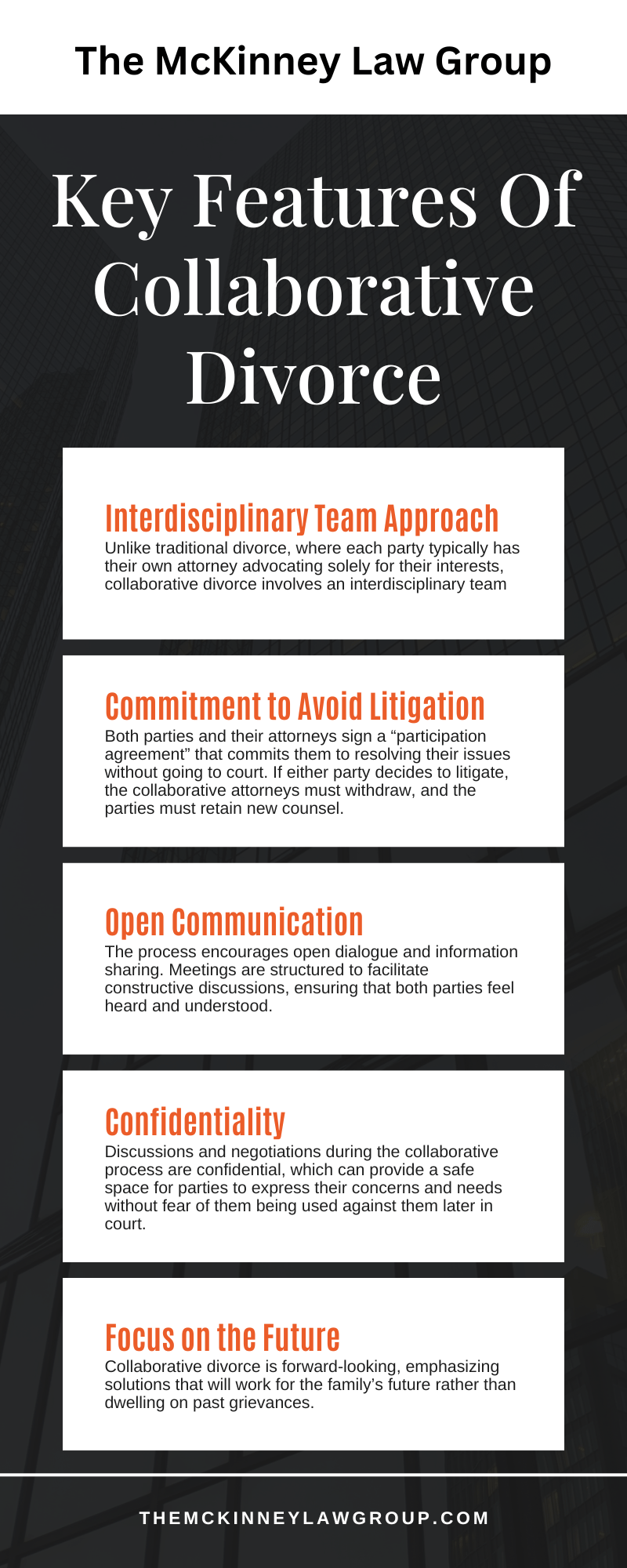
Florida Legal Requirements for Collaborative Divorce
Florida recognizes collaborative divorce as a formal alternative to litigated dissolution, with specific statutory requirements that apply to every collaborative case.
Collaborative Law Process Act. Under Florida Statutes § 61.55 and the related provisions at §§ 61.56 through 61.58, Florida recognizes collaborative law as a distinct method for resolving family law disputes. The statute defines what qualifies as a collaborative matter, what a participation agreement must contain, and when the collaborative process formally begins and ends.
Participation Agreement. A signed participation agreement is the foundation of every collaborative case. The agreement commits both parties and their collaborative attorneys to exchange information voluntarily, work toward a negotiated resolution, and refrain from filing contested court motions while the collaborative process is active.
Disqualification Rule. If the collaborative process fails and either party files a contested matter, both collaborative attorneys are disqualified from continuing representation in any subsequent litigation. The parties have to retain new lawyers for the contested phase. This disqualification provision, codified in the statute, gives everyone involved a practical stake in reaching a collaborative resolution.
Confidentiality. Under the statute and Florida Family Law Rule 12.745, communications made during the collaborative process are generally privileged. Offers, admissions, and information shared in collaborative meetings cannot be used in subsequent litigation if the process fails. That confidentiality is what allows spouses to discuss settlement positions openly without worrying about consequences in a later court proceeding.
Required Team Members. The collaborative team typically includes two collaborative attorneys, a neutral financial professional, and a neutral mental health professional or communication facilitator. In cases with children, the parenting plan often benefits from direct input by the mental health professional.
Full Voluntary Disclosure. Collaborative cases require complete and voluntary exchange of financial information, without formal discovery procedures. Both parties commit to transparency as a condition of participating in the process.
Transition if the Process Fails. If collaboration breaks down, the parties retain the right to file a contested dissolution under Chapter 61. The collaborative attorneys withdraw, and each party retains litigation counsel. Any documents shared during the collaborative process remain confidential and protected.
Florida Family Law Rule 12.745. The Florida Supreme Court adopted specific procedural rules governing collaborative cases, including the required form of the participation agreement, notice requirements to the court, and timelines for when the process is considered to have begun and concluded.
Key Components of a Tampa Collaborative Divorce Case
Collaborative divorces succeed when the parties commit to the process, bring full information to the table, and work together toward a negotiated resolution. The components below shape outcomes.
Determining Whether Collaborative Is the Right Fit
Not every case belongs in the collaborative process. Cases involving domestic violence, untreated substance abuse, serious mental health issues, or a party who isn’t willing to make full financial disclosure are generally not appropriate. Cases where one spouse wants to hide assets or use the process as a delay tactic don’t work either. At the first consultation, we assess whether collaboration is realistic for the couple.
Full Voluntary Disclosure
The entire process depends on both parties exchanging financial and personal information honestly and completely. Tax returns, pay stubs, account statements, business records where applicable, and information about parenting arrangements all get shared voluntarily. When disclosure is incomplete, the process stalls.
Coordination With Neutral Professionals
The neutral financial professional analyzes income, assets, tax consequences, and long-term financial implications of settlement options for both parties. The mental health professional manages communication during joint meetings and often works separately with each spouse between sessions to keep the process moving. We coordinate closely with both neutrals throughout the case.
Structured Settlement Meetings
Collaborative cases move through a series of structured meetings, each with a clear agenda and specific issues to resolve. Meeting preparation, both for our client and in consultation with the other attorney and the neutrals, is what produces progress from session to session. Unprepared meetings waste everyone’s time and can cause the process to stall.
Avoiding Damaging Mistakes
Several patterns can derail a collaborative divorce. Withholding financial information undermines the trust the process requires and generally leads to the case collapsing into litigation. Using collaborative meetings as a delay tactic while actually preparing for court is a violation of the participation agreement. Making side communications or offers outside of collaborative meetings creates confusion about what has actually been agreed. Engaging with the other spouse on contentious issues through text or email between meetings creates records that can undermine the process.
Contact The McKinney Law Group Family & Divorce Lawyers
Collaborative divorce offers couples a structured, private alternative to courtroom litigation, but it works only when both spouses commit to the process and to full transparency. Whether you’re exploring whether collaboration is right for your situation or ready to begin the process with your spouse, we’re prepared to protect your best interests and advocate for your future. We work with clients throughout Tampa and the surrounding region. Contact us to schedule a consultation and begin strategizing a path forward.
Collaborative Divorce Statistics in Tampa, FL

Divorce touches more Florida families than most people expect. According to the CDC’s Florida state vital statistics, Florida’s 2023 divorce rate was 3.0 per 1,000 residents, which is well above the national rate of 2.4 per 1,000 reported across 45 states. National marriage and divorce trend data from the CDC National Vital Statistics System shows the U.S. recorded 672,502 divorces in 2023, and broader estimates consistently place between 40 and 50 percent of first marriages on a path toward dissolution.
The question is not whether dissolution is possible; it is how it happens. Florida’s collaborative divorce framework provides a court-recognized path that many Tampa couples find more dignified and manageable than traditional litigation.
10 Important Steps in a Tampa Collaborative Divorce Process
Collaborative divorce is one of the most structured ways to dissolve a marriage. Unlike contested litigation, it requires both spouses to commit to a process before it begins. Here is what that typically looks like in Tampa, FL.
- Both spouses retain collaborative attorneys. Each party works with their own collaborative divorce lawyer in Tampa, attorneys who have agreed not to represent either client in court if the process breaks down.
- The participation agreement is signed. Everyone involved signs a formal agreement committing to transparency, good-faith negotiation, and a prohibition on litigation. This document holds all parties accountable.
- Financial disclosure is exchanged voluntarily. Both spouses provide full, open disclosure regarding income, assets, debts, retirement accounts, and property without formal discovery subpoenas.
- Neutral professionals are engaged as needed. Tampa collaborative divorce cases often bring in financial neutrals, child advocates, or mental health professionals who serve both parties, not just one side.
- Joint sessions are held to identify priorities. Meetings bring both spouses and their attorneys together to map goals, surface areas of agreement, and work through disagreements in a structured setting.
- Parenting plans are developed if children are involved. When children are part of the picture, a parenting plan and time-sharing schedule must be drafted. The collaborative model gives parents, not a judge, control over those decisions.
- Property division and asset valuation are addressed. The parties work through the division of marital assets, including real estate, retirement accounts, and personal property. A financial neutral may assist with valuations.
- Spousal support is negotiated. If alimony is at issue, both parties reach a figure and structure they can accept rather than leaving it to judicial discretion.
- A marital settlement agreement is drafted. Attorneys prepare a comprehensive agreement reflecting every decision the parties have made together.
- The agreement is submitted to court. The finalized agreement is filed with the Hillsborough County family court. A judge reviews it and, if everything is in order, enters a final judgment of dissolution without a contested hearing.
Tampa Collaborative Divorce Lawyer FAQs
What is collaborative divorce and how does it differ from traditional divorce?
Collaborative divorce is a voluntary process in which both spouses agree to resolve all issues, including property, support, and parenting, outside a courtroom, with trained collaborative attorneys and, when appropriate, neutral professionals. Traditional contested divorce proceeds through Hillsborough County family court with formal discovery, hearings, and a judge making final decisions if the parties cannot agree. Collaborative divorce puts those decisions back in the hands of the spouses.
Is collaborative divorce available in Tampa, FL?
Yes. Florida recognizes the collaborative process under state law, and the 13th Judicial Circuit family court accepts agreements reached through it. The process is available throughout Hillsborough County and the broader Tampa area.
What happens if we cannot reach an agreement?
If the collaborative process breaks down, both attorneys must withdraw. Each spouse then retains new litigation counsel to proceed through the courts, a structure that encourages serious, good-faith engagement before anyone walks away.
Is collaborative divorce faster than going to court?
Generally, yes. Contested divorce proceedings in Hillsborough County can take a year or longer. Collaborative cases move at the pace the parties set, and couples who engage in good faith sometimes complete the process in months.
Do we still need attorneys for collaborative divorce?
Absolutely. Each spouse retains their own Tampa collaborative divorce attorney throughout. An attorney protects your interests, verifies that the legal framework is sound, and makes certain any agreement you reach is enforceable under Florida law.
Can collaborative divorce work if we have children?
Yes. Many Tampa families choose it specifically because it shields children from adversarial dynamics. A child-focused professional may be brought in to help develop arrangements that genuinely serve the children’s interests, and both parents retain meaningful input into the final parenting plan.
What does a Tampa collaborative divorce typically cost?
Costs vary by complexity, but the collaborative process is generally less expensive than contested litigation because it avoids court hearings, minimizes procedural battles, and resolves issues faster. High-conflict situations can affect cost in either setting.
Can we use the same attorney for collaborative divorce?
No. Each spouse must have independent counsel. One attorney representing both parties creates an irresolvable conflict of interest.
What if my spouse is hiding assets?
Voluntary financial transparency is foundational to the collaborative model. If deliberate concealment is discovered, it typically ends the process. The case would then proceed to litigation, where formal discovery tools are available to uncover hidden assets.
How is alimony handled in a Tampa collaborative divorce?
Spousal support is addressed as part of the negotiation. The parties discuss need, ability to pay, and the length of the marriage. Because no judge is deciding, there is more flexibility to craft arrangements in amount, duration, and structure that both parties find workable.
What is a participation agreement?
A participation agreement is the signed document that formally launches the collaborative process. It commits each party to transparency and good-faith negotiation, and prohibits either attorney from later representing their client in litigation. All four parties sign before any joint sessions begin.
Can collaborative divorce address business interests?
Yes. Business interests are a common subject of collaborative negotiation for Tampa business owners. A financial neutral may assess business value, and the parties negotiate how to address it as part of the broader settlement.
What happens after the collaborative process ends successfully?
Once a marital settlement agreement is finalized, attorneys prepare the legal filings and submit the matter to the Hillsborough County family court. A judge reviews the agreement and, assuming it meets legal requirements, enters a final judgment of dissolution.
Local Information for Tampa, FL Collaborative Divorce Cases
Tampa, FL Family Court and Local Resources
Family law matters in Tampa fall under the Unified Family Court of the 13th Judicial Circuit in Hillsborough County. Divorce filings, including marital settlement agreements reached through the collaborative process, are handled through the Hillsborough County Clerk of the Circuit Court, Family Division, located at 800 E. Twiggs St., Tampa, FL 33602.
What Are Important Local Resources for Tampa Collaborative Divorce Cases?
The following resources may assist Tampa residents navigating family law matters. Their inclusion is for informational purposes only. The McKinney Law Group Family & Divorce Lawyers does not endorse or maintain a formal affiliation with any of these organizations.
- Hillsborough County Clerk: 800 E. Twiggs St., Tampa, FL 33602, (813) 276-8100. The primary filing location for family law matters, including final collaborative divorce agreements.
- Florida Child Support Program: Statewide at (850) 488-5437. Handles child support establishment, modification, and enforcement in Hillsborough County and statewide.
- The Spring of Tampa Bay: Hotline (813) 247-7233. A Hillsborough County domestic violence crisis center offering emergency shelter, legal advocacy, and 24-hour support.
- Bay Area Legal Services: (800) 625-2257. Provides free civil legal assistance and family law information to low-income residents of the Tampa Bay area.
- Hillsborough County Bar Association: 1610 N. Tampa St., Tampa FL 33602, (813) 221-7777. A professional resource for attorney referrals and family law guidance in the Tampa Bay region.
About The McKinney Law Group Family & Divorce Lawyers
The McKinney Law Group Family & Divorce Lawyers was founded by Damien McKinney, who has been practicing family and marital law for nearly 20 years. Admitted to the Florida Bar in 2006, Damien earned his Juris Doctor from Stetson University College of Law and holds a degree from Florida State University. He is a Florida Supreme Court certified family law mediator and a trained Guardian Ad Litem, which are two credentials that inform how he approaches negotiated resolutions. Recognized annually as a Rising Star by Super Lawyers since 2012, Damien also received the Super Lawyers Distinction of Excellence in 2016, an honor reserved for the top 5% of Florida attorneys.
What Our Clients Say
★★★★★
“Damien was extremely elegant in answering my various questions. It is very nice to be able to ask tough questions and get a genuine and thoughtful response in return. I felt like he was actively listening and answered every question with extreme professionalism. I would highly suggest talking with The McKinney Law Group, if you or someone you know needs someone dedicated. Thank you!” — Colton Eisenhart
Read more reviews on our Google Business Profile.
Contact The McKinney Law Group Family & Divorce Lawyers
If you and your spouse are open to resolving your divorce without a courtroom battle, The McKinney Law Group Family & Divorce Lawyers can explain how the collaborative process works and whether it fits your circumstances. Our Tampa, FL collaborative divorce lawyer works with spouses who want to shape their own outcomes rather than hand those decisions to a judge. Contact us to schedule a consultation.