


A Tampa visitation rights practice grounded in nearly two decades of Florida family law experience.
If you are facing a visitation rights dispute in Tampa, the schedule that governs your time with your child is more than a calendar. It is the framework that shapes your relationship with your child during a divided household. Our office represents parents on both sides of these disputes, including parents seeking to enforce existing visitation arrangements, parents seeking modifications, and parents responding to allegations that justify changes to the current schedule. Founding attorney Damien McKinney and attorney Stephanie Koether represent parents throughout Hillsborough County as a Tampa, FL visitation rights lawyer focused on protecting court-ordered time with children.
Visitation Rights Lawyer Tampa, FL

What are visitation rights, and how does Florida law treat them? Visitation rights, addressed under Florida law primarily through time-sharing provisions, refer to the legal right of a parent to spend designated time with their child following a separation, divorce, or paternity action. The schedule is set out in a parenting plan that becomes part of a court order, and both parents are legally obligated to follow it. Violations of the schedule are not informal disputes between parents but enforceable breaches of a court order.
Florida courts approach visitation as one component of the broader time-sharing and parental responsibility framework, with the schedule built around the child’s best interests. A Tampa visitation rights attorney handles cases involving the initial establishment of the schedule, modifications when circumstances change, enforcement when one parent interferes with the other’s time, and disputes over specific provisions such as holidays, travel, and special occasions.
Types of Visitation Rights Cases We Handle in Tampa

The McKinney Law Group Family & Divorce Lawyers represents Tampa parents across the full range of visitation rights matters. Some cases involve initial schedule disputes during a divorce. Others involve enforcement of existing orders when one parent denies access. Still others involve third-party visitation claims by grandparents or stepparents.
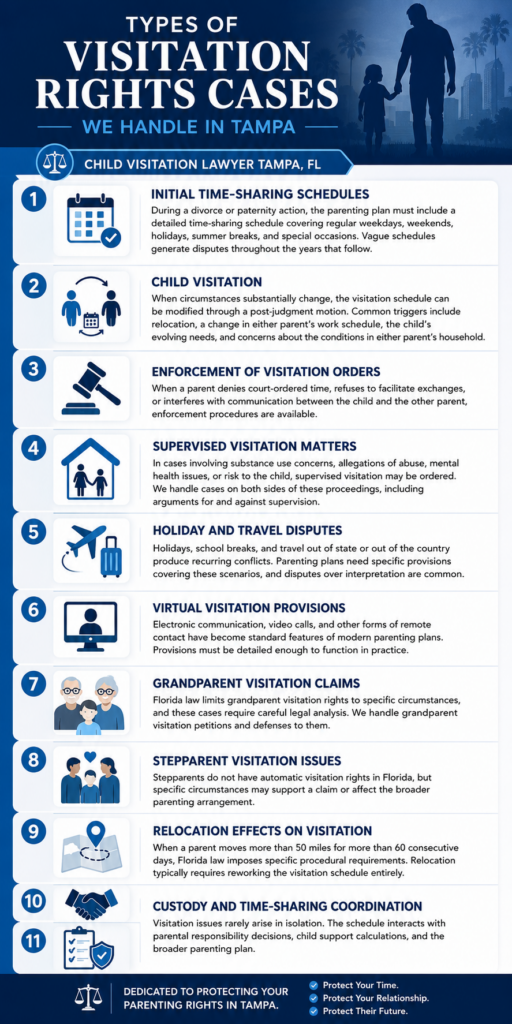
- Initial time-sharing schedules. During a divorce or paternity action, the parenting plan must include a detailed time-sharing schedule covering regular weekdays, weekends, holidays, summer breaks, and special occasions. Vague schedules generate disputes throughout the years that follow.
- Child visitation. When circumstances substantially change, the visitation schedule can be modified through a post-judgment motion. Common triggers include relocation, a change in either parent’s work schedule, the child’s evolving needs, and concerns about the conditions in either parent’s household.
- Enforcement of visitation orders. When a parent denies court-ordered time, refuses to facilitate exchanges, or interferes with communication between the child and the other parent, enforcement procedures are available.
- Supervised visitation matters. In cases involving substance use concerns, allegations of abuse, mental health issues, or risk to the child, supervised visitation may be ordered. We handle cases on both sides of these proceedings, including arguments for and against supervision.
- Holiday and travel disputes. Holidays, school breaks, and travel out of state or out of the country produce recurring conflicts. Parenting plans need specific provisions covering these scenarios, and disputes over interpretation are common.
- Virtual visitation provisions. Electronic communication, video calls, and other forms of remote contact have become standard features of modern parenting plans. Provisions must be detailed enough to function in practice.
- Grandparent visitation claims. Florida law limits grandparent visitation rights to specific circumstances, and these cases require careful legal analysis. We handle grandparent visitation petitions and defenses to them.
- Stepparent visitation issues. Stepparents do not have automatic visitation rights in Florida, but specific circumstances may support a claim or affect the broader parenting arrangement.
- Relocation effects on visitation. When a parent moves more than 50 miles for more than 60 consecutive days, Florida law imposes specific procedural requirements. Relocation typically requires reworking the visitation schedule entirely.
- Custody and time-sharing coordination. Visitation issues rarely arise in isolation. The schedule interacts with parental responsibility decisions, child support calculations, and the broader parenting plan.
Tampa Visitation Rights Infographic
Why Choose The McKinney Law Group Family & Divorce Lawyers for Visitation Rights in Tampa, FL?
Florida family law experience
Founding attorney Damien McKinney was admitted to the Florida Bar in 2006 and has practiced marital and family law for nearly two decades. He earned his Juris Doctor from Stetson University College of Law in 2005 and his Bachelor of Arts in Psychology from Florida State University in 2002. He is also admitted in North Carolina. Stephanie Koether was admitted to the Florida Bar in 2017 and earned her Juris Doctor with Honors Distinction from the University of Miami School of Law in 2016. Memberships include the Florida Bar Family Law Section and the Hillsborough County Bar Association Family Law Section. Visitation rights cases form a significant share of the firm’s work as a child custody lawyer in Tampa, FL, and the team handles enforcement, modification, and initial schedule matters across the full spectrum of family law.
Recognition and approach to visitation matters
Damien has been named a Super Lawyers Rising Star annually since 2012 and received the Super Lawyers Distinction of Excellence in 2016, an honor reserved for the top five percent of Florida lawyers. The firm has handled visitation disputes across Tampa, from straightforward schedule modifications to contested supervised visitation determinations. Visitation outcomes depend on documentation. The parent who can demonstrate consistent involvement, compliance with the existing order, and willingness to support the child’s relationship with the other parent is positioned strongly under the Florida best interests framework.
What Is Important To Understand About Visitation Rights Cases?

Types of Custody and Best Interest Factors
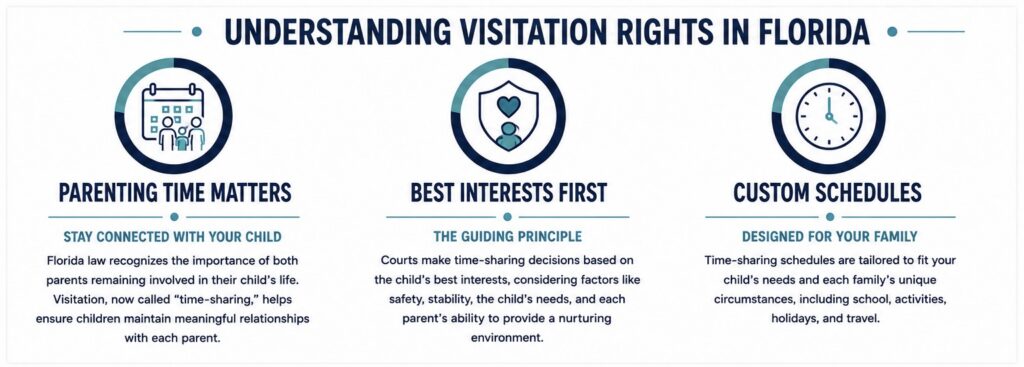
Florida law uses the term time-sharing rather than visitation in most contexts, but the substantive concepts are the same. The schedule allocates the child’s time between both parents, and the parenting plan is the document that controls how the schedule operates. Several arrangement types appear in Tampa cases:
- Standard alternating weekend schedules with weekday dinners
- Week-on, week-off rotations
- 2-2-3 and 2-2-5-5 rotations designed for younger children
- Extended summer or school-year arrangements when parents live in different areas
- Supervised visitation arranged through approved providers
- Therapeutic visitation supervised by a mental health professional
The Florida best interests of the child standard governs both the initial schedule and any subsequent modifications. Statutory factors include each parent’s capacity to facilitate a close relationship with the other parent, the historical division of caregiving, the geographic viability of the schedule, the mental and physical health of each parent, the home and community record of the child, and the reasonable preference of a sufficiently mature child. The factors are weighted based on the specific evidence presented rather than through a fixed formula.
What Are Important Aspects of a Visitation Rights Case?
Two factors drive most visitation disputes. The first is the specificity of the existing order. Vague schedules generate recurring conflicts, while detailed orders covering exchanges, communication, travel, and holidays leave less room for disagreement. The second is the willingness of both parents to comply consistently. When one parent treats the schedule as suggestive rather than mandatory, the other parent’s enforcement options become central.
Several practical aspects shape outcomes in visitation cases:
- The completeness and specificity of the existing parenting plan
- Documentation of any denied visitation, late exchanges, or schedule interference
- Communication records between the parents about scheduling matters
- Any history of substance use, mental health issues, or domestic violence relevant to the schedule
- The geographic relationship between the parents’ households
- The child’s school schedule, extracurricular commitments, and developmental stage
A parent who documents the schedule and any deviations from it, in writing and contemporaneously, builds a record that supports either enforcement or defense against an enforcement motion.
What Is The Visitation Rights Case Timeline?
Most visitation rights cases in Tampa resolve in a few months to about a year, depending on whether the case is contested and the nature of the relief sought. Enforcement motions tend to resolve faster than modifications because the underlying order already exists and the inquiry is narrower.
A typical case progression includes:
- Filing of the initial motion, whether for enforcement, modification, or initial schedule determination
- Service on the other parent and a response period
- Temporary relief hearing if immediate access issues are present
- Discovery into the disputed conduct or changed circumstances
- Court-ordered mediation in most contested family law matters
- Final hearing or settlement
- Entry of the final order modifying or enforcing the visitation schedule
The 13th Judicial Circuit handles Hillsborough County family law matters, including visitation enforcement and modification proceedings.
What Should You Bring to Your Visitation Rights Consultation?
Documentation supports a strong visitation case from the first meeting. Useful materials include:
- A copy of the current parenting plan or any temporary orders in place
- A log or calendar of recent visitation exchanges, including any that were denied or modified
- Communication records with the other parent about scheduling issues
- Information about the child’s school schedule and extracurricular commitments
- Any documentation supporting concerns about the other parent’s household
- A summary of recent changes in either parent’s work schedule, residence, or circumstances
- Contact information for any third-party witnesses such as teachers or family members
The consultation is used to identify the strengths of the case, assess the available evidence, and outline the procedural path forward.
What Are Important Florida Legal Resources for Visitation Rights Cases?
Florida law governing visitation rights is located primarily in Chapter 61 of the Florida Statutes, which addresses time-sharing, parenting plans, and modification standards, with related provisions in Chapter 742 for paternity matters and Chapter 752 for grandparent visitation.
- The Florida Statutes Online portal contains the current statutory text covering time-sharing, parenting plans, and visitation enforcement.
- The Florida Courts Family Law Self-Help page provides procedural information and approved forms used in custody and parenting plan filings.
- The Florida Department of Children and Families maintains the list of court-approved parent education providers and resources for families navigating schedule changes.
Florida applies general statute of limitations principles to certain enforcement actions, with timing rules tied to the obligation rather than to the date of the original order.
Reach Out to The McKinney Law Group Family & Divorce Lawyers to Schedule a Consultation
Visitation rights cases turn on the parenting plan, the documented conduct of both parents, and the specific relief available under Florida law. Contact us to schedule a consultation with a Tampa visitation rights attorney about your situation and the options for protecting your time with your child.
Visitation Rights Statistics in Tampa
Hillsborough County, with a population estimated above 1.5 million by the U.S. Census Bureau, generates a substantial volume of family law filings each year. The 13th Judicial Circuit processes thousands of dissolution, paternity, and post-judgment matters annually, with visitation enforcement and modification representing a meaningful share of the post-judgment docket.
National data published by the U.S. Census Bureau Current Population Survey tracks living arrangements of children and the prevalence of joint custody and time-sharing arrangements. Florida patterns parallel national trends, with growing recognition of the value of meaningful time with both parents and a corresponding rise in detailed parenting plans that allocate time more specifically than older orders typically did. Tampa courts handle both initial schedule determinations and the steady volume of enforcement and modification motions that follow from imperfect compliance with existing orders.
Common Types of Issues in a Visitation Rights Case

Visitation disputes in Tampa fall into recognizable categories. The issues below appear repeatedly in family court and produce a meaningful share of post-judgment family law filings. Each carries its own evidentiary considerations and remedial options.
- Denial of scheduled visitation. One parent simply refuses to make the child available at the agreed exchange time, sometimes citing the child’s preference, an extracurricular conflict, or a stated concern about the other parent. Courts treat repeated denials seriously, particularly when the denying parent cannot produce a legitimate basis for the refusal.
- Chronic late exchanges and time interference. Less dramatic than outright denial but equally damaging over time, a pattern of late arrivals, abbreviated visits, or returning the child early reduces the receiving parent’s effective time. Documentation of these incidents builds a record that supports enforcement action.
- Holiday schedule disputes. Christmas, Thanksgiving, spring break, and summer vacation generate the most contested scheduling issues. Vague parenting plans that simply alternate holidays without specifying dates and times produce annual conflict.
- Travel disputes. Out-of-state or international travel with the child often requires specific notice, consent, and itinerary provisions. Disputes arise when one parent travels without proper notice or when the other parent unreasonably withholds consent.
- Communication interference. Some parenting plans include provisions for phone, video, or text communication between the child and the non-residential parent during the other parent’s time. Blocking these communications, screening calls, or making the child unavailable for scheduled contact constitutes interference.
- New partners and household concerns. When one parent’s new partner moves into the home, the other parent may have concerns about the partner’s background, conduct, or fitness for contact with the child. The court can address these concerns when supported by evidence.
- Schedule conflicts with extracurricular activities. Sports, music lessons, and other activities that fall during the non-residential parent’s time create friction. Parenting plans should address who decides about activities and how time is allocated when conflicts arise.
- School-related disputes. Disagreements about school enrollment, school events, and transportation for school-related activities affect the visitation schedule. The interaction between the school week schedule and the parenting plan is a common source of dispute.
- Allegations of substance use or unfitness. When one parent raises concerns about the other parent’s substance use, mental health, or fitness for unsupervised contact, the court may order supervised visitation, drug testing, or other protective measures. Evidence matters in these cases.
- Grandparent contact disputes. Disagreements over a grandparent’s role, particularly when one parent’s family is heavily involved while the other parent’s family is not, produce conflicts. Florida law limits enforceable grandparent visitation rights to specific circumstances.
- Relocation effects on existing schedules. When one parent relocates, the existing visitation schedule may become unworkable. The relocation procedure requires court involvement when the move is more than 50 miles for more than 60 consecutive days.
- Refusal to follow the parenting plan during contentious periods. Some parents revert to informal arrangements during a period of cooperation, then revert to the parenting plan when conflict resumes. The court treats the written order as controlling regardless of informal arrangements between the parents.
Florida judges evaluate visitation disputes based on the specific evidence presented. A parent who arrives in court with documented, contemporaneous records of the disputed conduct is positioned far better than one who relies on general allegations and post-hoc summaries.
Tampa Visitation Rights Lawyer FAQs
What can I do if my ex denies me my court-ordered visitation?
Florida law treats violations of a parenting plan as enforceable breaches of a court order. Remedies include make-up time for missed visitation, modification of the parenting plan, fines, attorney’s fees, and contempt of court. Documenting each denied visitation with dates, times, and any communications about the denial supports an enforcement motion. A single missed exchange typically does not justify drastic relief, but a documented pattern does.
Can I withhold visitation if my ex is not paying child support?
No. Florida treats visitation and child support as separate obligations. Even if the other parent is behind on child support, you cannot legally deny their court-ordered visitation. Doing so exposes you to enforcement action and may damage your position in any future modification. Child support nonpayment is addressed through separate enforcement procedures, not through interference with visitation.
How do I modify a visitation schedule?
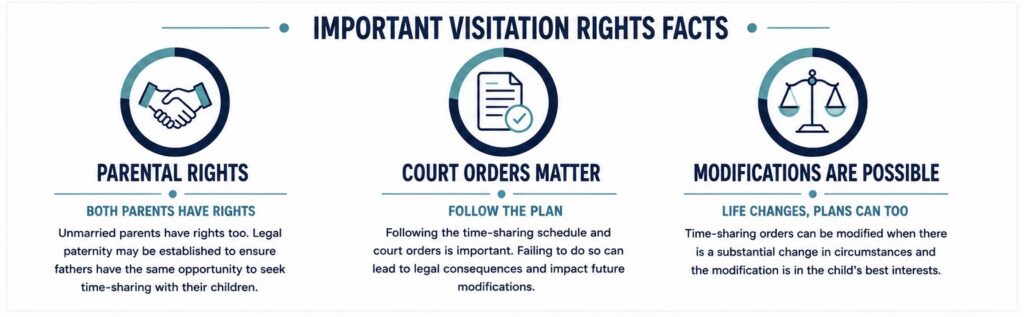
A modification requires a substantial, material, and unanticipated change in circumstances that affects the child’s best interests. Common bases include relocation, significant changes in either parent’s work schedule, changes in the child’s needs as they age, or evidence of conduct that affects parenting capacity. Modifications are filed as motions in the original case and require the same documentation and preparation as the original parenting plan determination.
What is supervised visitation and when is it ordered?
Supervised visitation requires the visiting parent’s time with the child to occur in the presence of an approved third party, often a professional supervisor or a designated family member. It is ordered when the court finds that unsupervised contact poses a risk to the child, typically based on documented substance use, allegations of abuse, mental health concerns, or other safety considerations. Supervised visitation is generally transitional, with a path back to unsupervised contact when conditions are addressed.
Can grandparents get visitation rights in Florida?
Florida law allows grandparent visitation only in specific circumstances, primarily when both parents are deceased, missing, or in a persistent vegetative state, or when one parent is deceased or missing and the other parent has been convicted of a felony or violent offense. The threshold for grandparent visitation is high, and these cases require careful legal analysis.
What happens if my ex tries to relocate with our child?
Florida law requires specific procedures for parental relocation involving moves of more than 50 miles for more than 60 consecutive days. The relocating parent must either obtain written consent from the other parent or petition the court for approval. The other parent can object by filing a response and presenting evidence that the move is not in the child’s best interests. Relocation without compliance can result in contempt findings and potential modification of the parenting plan.
Can I travel out of state with my child during my visitation?
Most parenting plans address travel with the child, including notice requirements, itinerary disclosure, and consent procedures for out-of-state and international travel. Review the parenting plan before planning any travel that takes the child out of Florida. When the parenting plan does not specifically address a travel scenario, written consent from the other parent is the safest approach.
What if my child does not want to go to visitation?
Florida courts may consider the reasonable preference of a mature child, but parents are generally obligated to encourage and facilitate court-ordered visitation. Allowing a child to refuse visitation, particularly when the refusal coincides with the residential parent’s apparent disapproval of the other parent, can expose the residential parent to enforcement action and may suggest parental rights concerns that the court will address.
Can I record exchanges or my child’s behavior to support my case?
Florida is a two-party consent state for audio recording, which limits the use of certain recordings. Video recording of exchanges in public places generally raises fewer legal issues, but the rules are nuanced. Discuss any planned recording with counsel before relying on it as evidence. Documenting in writing what is observed is generally a safer approach.
How does the court view a parent who interferes with my visitation?
Florida courts treat persistent interference seriously. The capacity of each parent to facilitate the child’s relationship with the other parent is one of the most heavily weighted best interests factors. A parent who undermines the other parent’s visitation rights damages their own custody and time-sharing position and may face direct sanctions, including modification of the parenting plan or contempt.
What is virtual visitation and is it enforceable?
Virtual visitation refers to electronic communication between a child and the non-residential parent through video calls, phone calls, text messages, or other means. When the parenting plan includes specific provisions for virtual visitation, those provisions are as enforceable as in-person time. Blocking or interfering with court-ordered virtual visitation supports an enforcement motion.
Should I consider mediation for a visitation dispute?
Most contested family law cases in Florida require mediation before final hearing. Visitation disputes are well suited to mediation because the issues are typically about scheduling rather than fundamental disagreements about parenting capacity. Mediated agreements tend to be more durable than court-imposed schedules because both parents have ownership of the terms.
Local Information for Tampa Visitation Rights Cases

Tampa Family Court and Local Resources
Tampa visitation rights cases are heard in the family law division of the 13th Judicial Circuit, which covers Hillsborough County. Filings move through the Clerk of the Circuit Court’s office in downtown Tampa, with electronic filing available through the Florida Courts e-Filing Portal. The family law division handles initial parenting plans, modifications, enforcement motions, and related post-judgment proceedings.
What Are Important Local Resources for Tampa Visitation Rights?
The following resources are listed for informational purposes only and do not constitute an endorsement.
- Hillsborough County Clerk of Court – (813) 276-8100
- 13th Judicial Circuit Court – (813) 272-5894
- Florida Department of Children and Families – (850) 487-1111
- Hillsborough County Bar Association – (813) 221-7777
About the Attorney
Damien is the founding partner of The McKinney Law Group Family & Divorce Lawyers. His background in psychology shapes the firm’s approach to visitation matters, particularly cases involving co-parenting communication breakdowns, allegations of interference, and children adjusting to changing schedules. Stephanie Koether brings her academic distinction from the University of Miami School of Law and her undergraduate psychology training from Fordham University to the firm’s visitation practice, complementing the depth of the family law team.
What Our Clients Say
★★★★★
“Damien is a pleasure to work with! He is a great communicator who provides thorough, detailed responses. He is passionate about his clients and business, and doing things right. I can tell he also cares deeply about his community and the clients he serves. Definitely recommend working with Damien!” – Sara Ganster
Read more reviews on our Google Business Profile.
Contact The McKinney Law Group Family & Divorce Lawyers
Visitation rights cases turn on the parenting plan, the documented conduct of both parents, and the strategic positioning of the case under Florida law. The parent who arrives with a clear record and a workable proposed resolution is consistently positioned ahead of the parent who arrives without one. Our office represents parents in initial schedule determinations, modifications, and enforcement matters throughout Tampa and Hillsborough County. To schedule a consultation with a Tampa visitation rights lawyer, contact us today.
Visit Our Tampa Visitation Rights Lawyers
1105 W Swann Ave Suite 100, Tampa, FL 33606