

Not every divorce has to become a drawn-out court battle. Some spouses already agree that the marriage is over and want to end it with less conflict, less public stress, and fewer unnecessary hearings. When both spouses can agree on property, debts, parenting issues, support, and the terms of the final judgment, an uncontested divorce may be the right path.
The McKinney Law Group Family & Divorce Lawyers helps clients in Tampa, Hillsborough County, and throughout the surrounding area with uncontested divorce matters. If you are searching for an Uncontested Divorce Lawyer Tampa, FL, our firm can help you understand whether your case qualifies, prepare the required documents, draft a clear marital settlement agreement, and move your case toward a final judgment.

An uncontested divorce is still a legal case. The court still needs the right paperwork. Financial disclosures may still be required. Parenting plans, child support calculations, and property division terms must be clear. A simple mistake can delay the case or create problems after the divorce is final. Our goal is to help clients resolve their divorce in a respectful, organized, and legally sound way.
What Is an Uncontested Divorce in Florida?
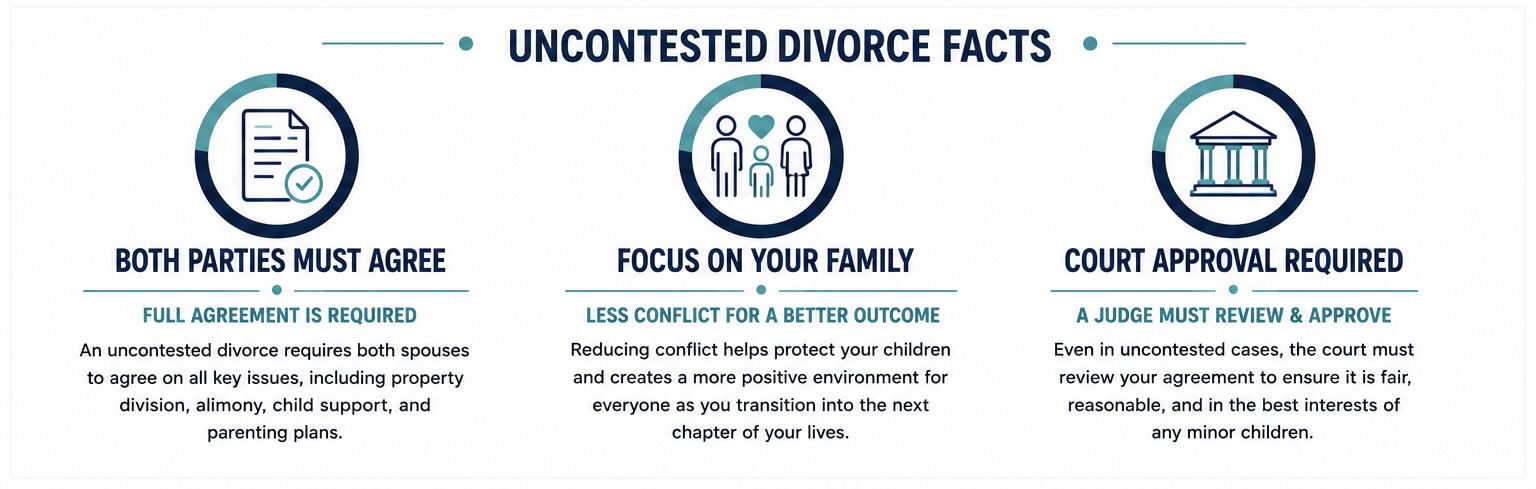
An uncontested divorce is a dissolution of marriage where both spouses agree on every issue that must be decided before the divorce can be finalized. This usually means both spouses agree that the marriage is irretrievably broken and agree on how to handle all financial, property, and family-related issues.
Depending on the marriage, those issues may include division of marital assets, division of marital debts, alimony, retirement accounts, the marital home, vehicles, bank accounts, credit cards, business interests, tax issues, attorney’s fees, parental responsibility, time-sharing, child support, health insurance for children, daycare costs, and a parenting plan.
If even one major issue remains disputed, the divorce is not fully uncontested. A case may start as contested and later become uncontested after negotiation or mediation. A case may also start as uncontested but become contested if one spouse changes positions, refuses to sign documents, hides financial information, or disagrees about the final terms.
An uncontested divorce does not mean the divorce is unimportant. It means the spouses are choosing to resolve the case by agreement instead of asking a judge to decide their future.
Why Tampa Spouses Choose an Uncontested Divorce
Many people choose an uncontested divorce because they want a lower-conflict process. Divorce is already stressful. When spouses can cooperate, they often preserve more control over the outcome and reduce the emotional strain on the family.
An uncontested divorce can also be more efficient than contested litigation. There is usually less formal information exchange, fewer hearings, and less back-and-forth between attorneys. That can reduce cost and help both spouses move forward sooner.
Privacy is another benefit. Any divorce filing becomes part of the court process, but an uncontested case may involve fewer public disputes, fewer contested motions, and less testimony about private family matters. Spouses who own businesses, have children in school, or simply want a quieter transition often value that.
For parents, an uncontested divorce can set the tone for future co-parenting. A well-drafted parenting plan can reduce conflict over school nights, holidays, exchanges, extracurricular activities, travel, and communication. When parents agree on terms early, they may be better positioned to work together after the divorce is final.
Uncontested Divorce Is Not the Same as a DIY Divorce
Some people assume that if the divorce is uncontested, they do not need legal guidance. That assumption can be costly. The problem is not always getting divorced. The problem is living with unclear or incomplete terms after the divorce.
A marital settlement agreement should address the details that matter. Who keeps the home? Will it be sold or refinanced? Who pays the mortgage until then? What happens if the refinance is denied? How are retirement accounts divided? Who pays which credit card? What happens to tax refunds or tax debt? Are personal belongings already divided? Does one spouse waive alimony? If so, is the waiver clear?
For parents, the risks can be even greater. A parenting plan should address weekly time-sharing, holidays, school breaks, transportation, decision-making, medical care, extracurricular activities, child support, health insurance, daycare, tax dependency, travel, and communication. A vague agreement can lead to repeated conflict.
An uncontested divorce lawyer in Tampa can help turn a general agreement into a court-ready set of documents that protects the client from avoidable problems.
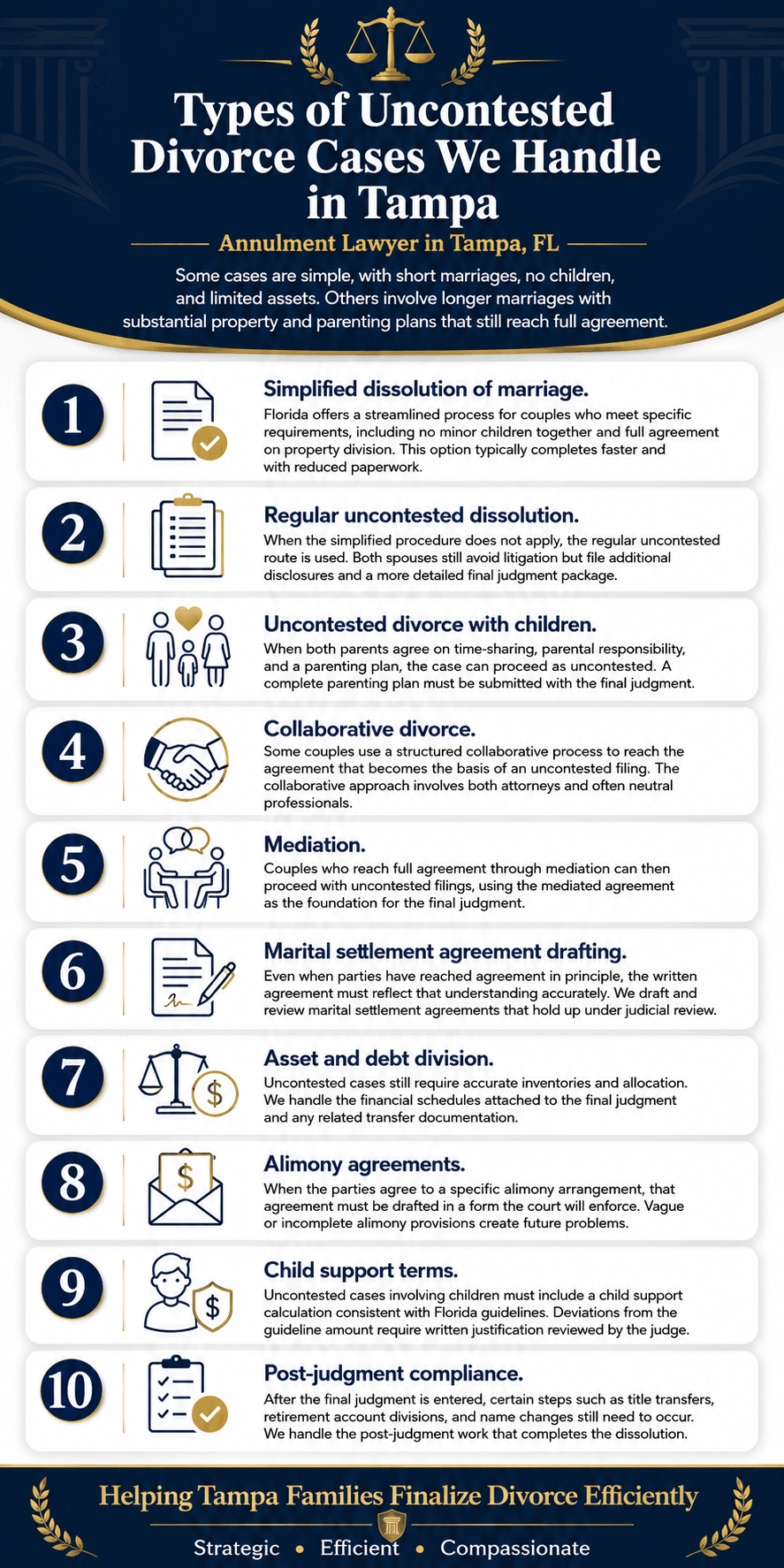
Tampa Uncontested Divorce Infographic:
Florida Residency Requirement for Divorce
Before filing for divorce in Florida, at least one spouse must meet the state residency requirement. Florida law generally requires one party to have lived in Florida for at least six months before the petition for dissolution of marriage is filed.
Residency can usually be proven with a Florida driver’s license, Florida identification card, voter registration card, affidavit, or witness testimony, depending on the facts and timing. If neither spouse meets the residency requirement, the court may not have authority to grant the divorce yet.
For Tampa residents, the case is typically filed in the appropriate circuit court for Hillsborough County if venue is proper. Filing in the correct location and using the correct forms matters, even when both spouses agree.
Simplified Dissolution vs. Regular Uncontested Divorce
Florida has a simplified dissolution process, but not every uncontested divorce qualifies. This is a common point of confusion.
A simplified dissolution may be available when the spouses meet specific requirements. Generally, the spouses must agree the marriage cannot be saved, have no minor or dependent children together, have no pregnancy involved, agree on division of property and debts, and neither spouse may seek alimony. Both spouses must be willing to sign the petition and participate in the required process.
Many uncontested divorces do not fit the simplified dissolution rules. For example, spouses with minor children may still have an uncontested divorce, but they usually need a regular dissolution process with a parenting plan and child support terms. A spouse seeking alimony, retirement division, or detailed property terms may also need a regular uncontested divorce instead of the simplified procedure.
The right path depends on the facts. Choosing the wrong process can create delays, rejected paperwork, or terms that do not fully address the parties’ rights.
What Must Be Agreed Upon in an Uncontested Divorce?
For a divorce to be truly uncontested, the spouses need agreement on every issue that applies to their marriage. The exact list depends on whether the spouses have children, assets, debts, income differences, business interests, or support issues.
Most uncontested divorces require agreement on the following areas:
Marital property. This includes the home, vehicles, bank accounts, investment accounts, furniture, personal property, business interests, and any other assets acquired during the marriage.
Marital debts. This includes mortgages, car loans, credit cards, personal loans, tax debts, medical bills, and other liabilities.
Alimony. The spouses must agree whether alimony will be paid, waived, reserved, or structured in a specific way.
Retirement accounts. Retirement division often requires more than a sentence in the settlement agreement. Some accounts need a separate order, such as a qualified domestic relations order.
Parenting plan. If minor children are involved, the parents need a plan for parental responsibility, time-sharing, holidays, transportation, and communication.
Child support. Florida child support must be calculated using income, overnight time-sharing, health insurance, daycare, and other guideline factors.
Attorney’s fees and costs. The agreement should say whether each spouse pays their own fees or whether one spouse contributes to the other’s fees.
A complete agreement reduces the chance of post-divorce conflict. It also gives the judge a clear record of what both spouses are asking the court to approve.
Case Finder
What Does Your Fathers’ Rights Case Need?
Answer three quick questions and get a starting point—plus the evidence you should begin gathering right now.
1. Where do things stand with your child’s mother right now?
2. What are you mainly trying to accomplish?
3. Is anything time-sensitive right now?
Start building your file
0 of 5 gatheredThis tool offers general information only and does not constitute legal advice. See full disclaimer below.
Attorney Advertising — Disclaimer
This Case Finder tool is provided for general informational purposes only and is not intended as, and should not be relied upon as, legal advice. The results generated are based on general principles of Florida and North Carolina family law as of the date of publication, do not account for every fact pattern, and may not reflect the current state of the law in your jurisdiction or any changes that have occurred since this tool was published.
Use of this tool, and any information you enter into it, does not create an attorney-client relationship between you and The McKinney Law Group. An attorney-client relationship is formed only through a signed engagement agreement. Do not send any confidential or time-sensitive information through this tool.
Every case is different, and the outcome of any legal matter depends on its specific facts and circumstances. Prior results described or implied by this tool do not guarantee a similar outcome in your case. Nothing in this tool should be construed as a promise or guarantee regarding the outcome of your legal matter.
If you are facing a time-sensitive legal issue, do not rely on this tool — contact a licensed attorney in your jurisdiction directly.
No warranty. This tool is provided “as is” and “as available,” without warranties of any kind, express or implied, including any warranty that the information generated will be accurate, complete, current, or applicable to your circumstances. The McKinney Law Group makes no representation regarding the reliability, suitability, or completeness of the results.
Limitation of liability. To the fullest extent permitted by law, The McKinney Law Group, its attorneys, and its staff disclaim all liability for any loss, damage, or legal outcome arising from or related to your use of, or reliance on, this tool, including any action taken or not taken as a result of information it provides. Use of this tool is at your own risk.
This tool may be updated, modified, or discontinued at any time without notice.
Marital Settlement Agreements in Tampa Uncontested Divorce Cases
The marital settlement agreement is one of the most important documents in an uncontested divorce. It is the written contract that states how the spouses are resolving their divorce issues. Once approved by the court and incorporated into the final judgment, it becomes enforceable.
A strong marital settlement agreement should be specific, practical, and complete. It should not leave important terms to memory or assumption. If the spouses agree to sell a home, the agreement should address listing, pricing, repairs, mortgage payments, closing costs, access to the home, and what happens if one spouse refuses to cooperate. If one spouse keeps a vehicle, the agreement should address title, loan payment, insurance, and indemnification.
When retirement accounts are involved, the agreement should identify the account, the division amount or percentage, valuation date, gains and losses, and who will prepare any needed order. When debts are involved, the agreement should clarify responsibility between the spouses, even if creditors are not bound by the divorce judgment.
The goal is not to make the agreement longer for no reason. The goal is to make it clear enough that both spouses know what is required after the divorce.
Uncontested Divorce With Children
Parents can have an uncontested divorce in Florida, but the paperwork must address child-related issues carefully. The court will not simply approve an agreement that ignores the children’s needs.
A parenting plan should identify how major decisions will be made, how the parents will communicate, where the children will live during the week, how holidays and school breaks will work, who handles transportation, and how disputes will be handled. Florida uses the term time-sharing rather than custody or visitation, and the schedule should be detailed enough to follow without constant renegotiation.
Child support must also be addressed. The parents may agree on many things, but child support is based on Florida guidelines. The calculation usually considers both parents’ incomes, overnight time-sharing, health insurance costs, daycare costs, and other allowed adjustments.
An agreement that seems fair informally may not meet the court’s requirements. We help parents prepare parenting and support terms that are more likely to hold up and reduce future disagreements.
Uncontested Divorce Without Children
An uncontested divorce without minor children may be more straightforward, but it still requires care. The spouses still need to address property, debts, alimony, retirement accounts, taxes, insurance, name changes, and any other financial issues.
Some couples have very few assets and can resolve their case quickly. Others have no children but still have significant financial matters, such as a marital home, business interests, investment accounts, inherited assets, premarital property claims, or retirement accounts. The absence of children does not automatically make a divorce simple.
Before signing an agreement, each spouse should understand what is being kept, what is being waived, and what obligations continue after the divorce. Once the final judgment is entered, changing property terms can be difficult.
Financial Disclosure in an Uncontested Divorce
Even when spouses agree, financial disclosure remains important. Florida family cases often require financial affidavits and disclosure of income, assets, debts, tax returns, pay stubs, bank records, retirement account statements, and related information.
Financial disclosure helps both spouses make informed decisions. It also protects the agreement from later claims that a spouse did not understand the financial picture. If one spouse controls most of the financial records, disclosure can prevent an agreement from being based on incomplete information.
Some disclosure requirements may be waived or limited by agreement in certain situations, but not every requirement can be ignored. Before relying on a waiver, it is wise to understand what is being waived and what the court still expects.
When an Uncontested Divorce May Not Be the Right Fit
An uncontested divorce works best when both spouses are honest, informed, and willing to sign clear documents. It may not be the right fit when there is domestic violence, intimidation, hidden assets, major power imbalance, serious substance abuse, unresolved parenting concerns, or pressure to sign quickly.
It may also be risky when one spouse owns a business, has unusual compensation, controls the bank accounts, or has moved money before filing. In those cases, additional review may be needed before settlement.
Uncontested does not have to mean rushed. A spouse can want an amicable divorce and still take time to review the facts. A calm process should not require giving up important rights without understanding the consequences.
How Long Does an Uncontested Divorce Take in Tampa?
The timeline depends on the court’s calendar, the completeness of the documents, whether children are involved, whether service is required, whether both spouses sign promptly, and whether the judge has questions about the agreement.
Some uncontested divorces can be completed relatively quickly after the required paperwork is filed and accepted. Others take longer because documents need correction, financial terms need more detail, a parenting plan needs revision, or the spouses are still working through final issues.
The best way to avoid delay is to prepare the case correctly from the start. Complete documents, accurate financial affidavits, clear settlement terms, and a properly drafted proposed final judgment can help the case move more smoothly.
The Uncontested Divorce Process in Tampa
Every case is different, but many uncontested divorce matters follow a similar path.
First, we review the facts of the marriage. This includes the length of the marriage, residency, children, income, assets, debts, support issues, property, and any agreements already reached.
Second, we identify the correct filing path. Some spouses may qualify for simplified dissolution. Others need a regular petition for dissolution of marriage with a marital settlement agreement, parenting plan, child support guidelines worksheet, or other supporting documents.
Third, we prepare or review the settlement terms. This step is important because the agreement will control what happens after the divorce. We look for missing details, unclear language, tax issues, parenting gaps, support problems, and terms that may be difficult to enforce.
Fourth, the case is filed with the court. Depending on the situation, the other spouse may need to be served or may sign documents accepting the filing and waiving formal service.
Fifth, required documents are submitted. This may include financial affidavits, mandatory disclosure certificates, parenting course documentation, child support worksheets, proposed orders, and other court forms.
Sixth, the court reviews the case. Some cases may require a short final hearing. Others may be handled differently depending on the judge, local procedure, and the nature of the filing.
Finally, the judge enters a final judgment of dissolution of marriage. Once the final judgment is entered, the divorce is legally complete, but some follow-up tasks may remain, such as refinancing, title transfers, retirement division orders, beneficiary changes, or estate planning updates.
Why Hire an Uncontested Divorce Lawyer?
Hiring a lawyer for an uncontested divorce is not about creating conflict. It is about making sure the agreement is accurate, complete, and legally workable.
A lawyer can help identify terms that are missing, language that may cause future disputes, and financial issues that should be handled before signing. A lawyer can also help with court filings, final judgment language, child support calculations, parenting plan details, and deadlines.
This is especially important when children, retirement accounts, real estate, alimony, business interests, military benefits, or significant debts are involved. These issues can create long-term problems if they are not handled correctly the first time.
Why Choose The McKinney Law Group Family & Divorce Lawyers
The McKinney Law Group Family & Divorce Lawyers represents clients in Tampa divorce and family law matters with a focus on clear communication, sound strategy, and practical results. Founding attorney Damien McKinney has practiced marital and family law for over 20 years. He was admitted to The Florida Bar in 2006, earned his law degree from Stetson University College of Law, and completed his undergraduate studies in psychology at Florida State University.
Our firm understands that an uncontested divorce still matters deeply. Clients are making decisions about their finances, children, property, and future. We help clients resolve agreed divorces without turning the process into a fight, while still paying close attention to the legal details that can affect life after the final judgment.
We work to make the process organized and direct. We review the issues, prepare the documents, explain the options, and help clients avoid common mistakes. When a case can be resolved respectfully, we support that approach. When a proposed agreement is incomplete or unfair, we help the client understand the risk before signing.
Common Mistakes in Uncontested Divorce Cases
One common mistake is using vague language. “We will split everything fairly” is not enough. A settlement agreement should say exactly who receives each asset and who pays each debt.
Another mistake is ignoring retirement accounts. A divorce judgment alone may not divide certain retirement accounts. Additional orders or plan-specific language may be needed.
Parents sometimes use parenting schedules that are too general. A plan should address school nights, weekends, holidays, summer, transportation, communication, and decision-making.
Some spouses also forget tax issues. Filing status, dependency claims, refunds, tax debt, mortgage interest deductions, and sale of property can all matter.
Finally, many people sign too quickly. An uncontested divorce should be efficient, but it should not be careless. Taking time to review the agreement can prevent expensive post-divorce disputes.
FAQs About Uncontested Divorce in Tampa, FL
What makes a divorce uncontested in Florida?
A divorce is uncontested when both spouses agree on every issue needed to end the marriage. This may include property division, debts, alimony, parenting plans, time-sharing, child support, retirement accounts, and attorney’s fees.
Can we get an uncontested divorce if we have children?
Yes. Parents can have an uncontested divorce if they agree on a parenting plan, time-sharing schedule, parental responsibility, child support, health insurance, daycare costs, and related child issues.
Do both spouses need to sign the divorce papers?
In most uncontested cases, both spouses sign settlement documents and other required paperwork. If one spouse refuses to sign or cooperate, the case may become contested or may need a different procedural approach.
Do I have to go to court for an uncontested divorce in Tampa?
Some uncontested divorces require a short final hearing. The need for a hearing can depend on the type of case, the judge, local procedure, and whether all documents are complete.
Is simplified dissolution the same as uncontested divorce?
No. Simplified dissolution is a specific Florida process with strict requirements. An uncontested divorce is broader. Spouses with children or alimony issues may still be uncontested, but they may not qualify for simplified dissolution.
How much does an uncontested divorce cost?
The cost depends on the issues involved, the documents needed, whether children are involved, whether the agreement is already complete, and whether any terms need to be negotiated or revised.
Can one lawyer represent both spouses?
A lawyer cannot represent both spouses when their interests may differ. One lawyer may represent one spouse and prepare documents for that client. The other spouse may choose to review the agreement with separate counsel.
What happens if we agree on most issues but not everything?
If one or more issues remain unresolved, the case is not fully uncontested yet. Negotiation or mediation may help resolve the remaining points so the case can move forward by agreement.
Can an uncontested divorce be changed later?
Some terms may be modifiable, such as child support, time-sharing, or certain support terms, depending on Florida law and the facts. Property division terms are usually much harder to change after the final judgment.
Divorce?
The following resources are listed for informational purposes only and do not constitute an endorsement.
- Hillsborough County Clerk of Court – (813) 276-8100
- 13th Judicial Circuit Court – (813) 272-5894
- Florida Department of Children and Families – (850) 487-1111
- Hillsborough County Bar Association – (813) 221-7777
About the Attorney
Damien is the founding partner of The McKinney Law Group Family & Divorce Lawyers. His approach to uncontested matters emphasizes drafting precision, because the strength of a marital settlement agreement determines how the final judgment functions years later. Outside the office, Damien is an active member of the Tampa arts community, a recognized artist at the annual Gasparilla Art Festival, and a supporter of local cultural organizations including Tempus Projects and Tampa Bay Businesses for Culture and the Arts.
What Our Clients Say
★★★★★
“Damien and Nathan helped me create a somewhat complex agreement having multiple in-depth revisions within a very tight timeline. They were both extremely professional and knowledgeable. They came very well prepared to calls to ensure we didn’t waste any time and and ultimately were able to get everything done by the deadline. Would definitely recommend them to anyone looking for similar legal services.” – Matt Klooster
Read more reviews on our Google Business Profile.
Contact The McKinney Law Group Family & Divorce Lawyers
An uncontested divorce works only when the paperwork accurately reflects what the parties intended. Sloppy drafting is the leading cause of post-judgment disputes between former spouses who originally separated amicably. Our office prepares marital settlement agreements and final judgment packages built to function as written. To schedule a consultation with a Tampa uncontested divorce lawyer, reach out through our contact page.
Visit Our Tampa Uncontested Divorce Lawyers
1105 W Swann Ave Suite 100, Tampa, FL 33606
Speak With a Tampa Uncontested Divorce Lawyer
An uncontested divorce can be a respectful way to end a marriage, but the agreement must be handled with care. The paperwork should match Florida law, the settlement terms should be clear, and the final judgment should reflect the full agreement between the spouses.
The McKinney Law Group Family & Divorce Lawyers helps clients in Tampa and Hillsborough County prepare, review, and finalize uncontested divorce cases. Whether your case involves children, property, retirement accounts, support, or a simple agreement to part ways, we can help you understand the process and move forward with confidence.