

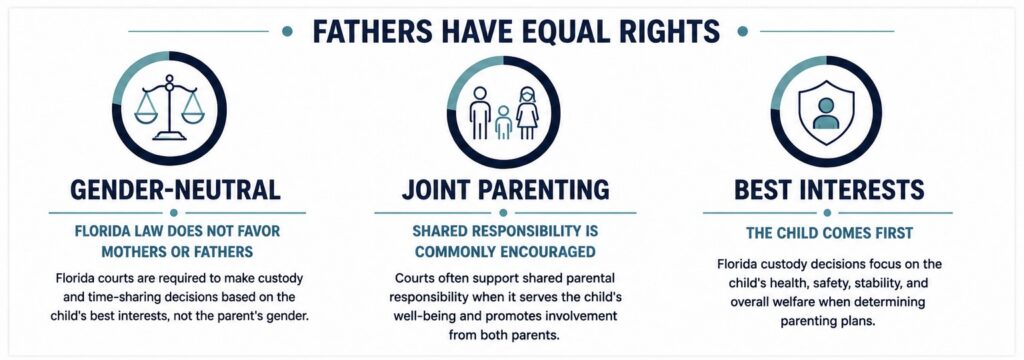
When your relationship with your child is at risk, the legal process can feel personal from the first filing. Fathers often come to us worried that they will be treated like a secondary parent, reduced to every other weekend, or forced to fight uphill just to stay active in their child’s life. Florida law does not give mothers automatic preference over fathers in parenting disputes. The court looks at the child’s welfare, the history of each parent’s involvement, the practical schedule that will work for the family, and the evidence presented.
The McKinney Law Group Family & Divorce Lawyers represents fathers in Tampa, Hillsborough County, and the surrounding area in custody, paternity, time-sharing, child support, relocation, enforcement, and modification matters. If you are looking for a Fathers’ Rights Lawyer Tampa FL, our role is to help you understand your rights, organize the facts, and present your parenting history in a way that supports your long-term relationship with your child.

A father’s rights case is not about attacking the other parent. It is about making sure your role is taken seriously. Whether you are married, divorced, separated, or never married to your child’s mother, the decisions made now can affect birthdays, school nights, holidays, medical decisions, travel, child support, and day-to-day access for years.
What Fathers’ Rights Mean Under Florida Law
“Fathers’ rights” is a practical term more than a separate area of Florida law. The same statutes that apply to mothers apply to fathers. In Florida, parenting cases focus on parental responsibility, time-sharing, and the best interests of the child.
Parental responsibility means decision-making authority. This includes major decisions about education, health care, religious upbringing, extracurricular choices, and other important parts of a child’s life. Florida courts often favor shared parental responsibility when both parents can safely and reasonably participate in those decisions. In some cases, one parent may receive ultimate decision-making authority over specific issues, or sole parental responsibility may be ordered if shared decision-making would harm the child.
Time-sharing is the schedule that decides when the child is with each parent. Many people still say “custody” or “visitation,” but Florida law uses time-sharing. A time-sharing schedule should address weekdays, weekends, holidays, summer break, transportation, school pickups, travel, phone contact, and how changes to the schedule will be handled.
Florida law starts with a rebuttable presumption that equal time-sharing is in the child’s best interests. That does not mean every case ends in a 50/50 schedule. It means equal time is the starting point unless the facts show that a different arrangement better serves the child. A father who wants equal time-sharing should be ready to show involvement, stability, availability, cooperation, and a realistic plan for the child’s routine.
Do Fathers Have Equal Rights in Tampa Family Court?
Yes. Fathers have the same right as mothers to ask for shared parental responsibility, equal time-sharing, majority time-sharing, child support, enforcement, or modification. A Tampa family court judge should not base a parenting decision on gender. The decision should be based on the evidence and the statutory factors that apply to the child’s welfare.
That said, fathers sometimes face practical obstacles. A mother may have handled more school communication, medical appointments, or daily routines in the past. A father may have worked long hours to support the household and now needs to show that his work schedule still allows meaningful parenting time. An unmarried father may need to establish legal paternity before a court can enter a parenting plan. A father defending against allegations may need to respond with records, witnesses, and a calm presentation rather than emotion.
The father who is prepared is in a much stronger position than the father who assumes the court will already know his role. Judges rely on evidence. That evidence can include school records, medical records, calendars, text messages, photos, witness testimony, coaching schedules, travel records, and records showing who handled the child’s daily needs.
Fathers’ Rights Cases We Handle in Tampa
The McKinney Law Group Family & Divorce Lawyers assists fathers in a wide range of Tampa family law matters. Some fathers need help for the first time. Others already have a court order and need to fix a schedule that no longer works.
We handle paternity actions for unmarried fathers who need to establish legal parentage and request a parenting plan. We represent fathers in divorce cases where time-sharing, parental responsibility, and child support are disputed. We help fathers request equal or substantial time-sharing when the facts support it. We also handle relocation disputes when one parent wants to move with the child, child support cases where overnight time and income must be calculated correctly, and enforcement actions when a parent refuses to follow an existing parenting plan.
We also work with fathers in modification cases. A parenting plan that worked when a child was three may not work when the child is in school, playing sports, or dealing with medical or emotional needs. A father’s work schedule may change. A mother may move. A child may begin struggling under the current arrangement. When a substantial, material, and unanticipated change occurs, a modification may be available.
Paternity Rights for Unmarried Fathers in Florida
Paternity is one of the most important fathers’ rights issues in Florida. If a child is born during a marriage, the law generally treats the husband as the legal father. If the parents were never married, legal paternity may need to be established before the father can fully protect his rights.
Paternity can be established in different ways, including a court order, a properly signed voluntary acknowledgment, or other legally recognized methods. Since Florida law changed in 2023, a father who has established paternity has a stronger position as a natural guardian of the child. Still, establishing paternity and having a clear, enforceable time-sharing schedule are not always the same thing.
This is where many fathers get confused. A father may be listed on the birth certificate or may have signed paperwork at the hospital, but if the parents do not agree on overnights, holidays, decision-making, travel, and communication, a court-approved parenting plan may still be needed. Without a clear order, disagreements can quickly become disputes over access.
A paternity action can address legal fatherhood, parental responsibility, time-sharing, child support, health insurance, daycare costs, tax dependency issues, and other child-related matters in one case. For unmarried fathers in Tampa, taking this step can be the difference between informal access that depends on the mother’s cooperation and a court order that defines each parent’s rights and duties.
Time-Sharing and Parenting Plans for Fathers
A strong parenting plan does more than say which parent gets which days. It should be specific enough to reduce future conflict. Vague agreements often create new disputes later, especially when parents do not communicate well.
For fathers, a practical parenting plan may address school-year schedules, summer schedules, transportation, exchange locations, holiday rotations, birthdays, Father’s Day, Mother’s Day, school breaks, travel notice, passports, extracurricular activities, medical appointments, homework, phone calls, video calls, and emergency communication. It should also state how the parents will make major decisions and what happens if they disagree.
In Tampa, parenting plans must also work around real life. Some fathers work rotating shifts, own businesses, serve in the military, travel for work, or live in a different part of the Bay Area from the child’s school. A schedule that looks equal on paper may fail if it does not fit school start times, traffic, daycare, extracurricular activities, or the child’s sleep routine. A schedule that is realistic is often stronger than a schedule that sounds good but falls apart in practice.
Case Finder
What Does Your Fathers’ Rights Case Need?
Answer three quick questions and get a starting point—plus the evidence you should begin gathering right now.
1. Where do things stand with your child’s mother right now?
2. What are you mainly trying to accomplish?
3. Is anything time-sensitive right now?
Start building your file
0 of 5 gathered
This tool offers general information only and does not constitute legal advice. See full disclaimer below.
Attorney Advertising — Disclaimer
This Case Finder tool is provided for general informational purposes only and is not intended as, and should not be relied upon as, legal advice. The results generated are based on general principles of Florida and North Carolina family law as of the date of publication, do not account for every fact pattern, and may not reflect the current state of the law in your jurisdiction or any changes that have occurred since this tool was published.
Use of this tool, and any information you enter into it, does not create an attorney-client relationship between you and The McKinney Law Group. An attorney-client relationship is formed only through a signed engagement agreement. Do not send any confidential or time-sensitive information through this tool.
Every case is different, and the outcome of any legal matter depends on its specific facts and circumstances. Prior results described or implied by this tool do not guarantee a similar outcome in your case. Nothing in this tool should be construed as a promise or guarantee regarding the outcome of your legal matter.
If you are facing a time-sensitive legal issue, do not rely on this tool — contact a licensed attorney in your jurisdiction directly.
No warranty. This tool is provided “as is” and “as available,” without warranties of any kind, express or implied, including any warranty that the information generated will be accurate, complete, current, or applicable to your circumstances. The McKinney Law Group makes no representation regarding the reliability, suitability, or completeness of the results.
Limitation of liability. To the fullest extent permitted by law, The McKinney Law Group, its attorneys, and its staff disclaim all liability for any loss, damage, or legal outcome arising from or related to your use of, or reliance on, this tool, including any action taken or not taken as a result of information it provides. Use of this tool is at your own risk.
This tool may be updated, modified, or discontinued at any time without notice.
Equal Time-Sharing Is Not Automatic
Florida’s rebuttable presumption of equal time-sharing is important for fathers. It gives dads a meaningful starting point when asking for a fair schedule. But equal time-sharing is not automatic, and it is not awarded just because a father asks for it.
The court may consider each parent’s historical role, the child’s needs, the distance between the homes, school logistics, the parents’ ability to communicate, the stability of each home, any history of violence or substance abuse, and whether each parent is likely to support the child’s relationship with the other parent. A father who wants equal time-sharing should come to the case with a plan that shows how the schedule will benefit the child, not just the parent.
That plan may include a proposed weekly schedule, proof of housing stability, records of school involvement, evidence of medical appointment participation, and a record of appropriate communication with the mother. The goal is to show that equal time-sharing is not only fair to the father, but workable and healthy for the child.
Tampa Fathers’ Rights Lawyer Infographic

Child Support and Fathers’ Rights
Child support and time-sharing are closely connected. Florida child support is generally calculated using both parents’ incomes, the number of overnights each parent has, health insurance costs, daycare costs, and other adjustments allowed by law. Fathers can be ordered to pay support, but fathers can also receive support depending on the income and time-sharing numbers.
A father should not agree to an inaccurate overnight count just to end the case quickly. Overnights affect support. So do income calculations. If one parent is self-employed, underemployed, paid in cash, receiving bonuses, earning commissions, or hiding income, support may need closer review.
A child support order should match the actual facts. If the time-sharing schedule later changes in a meaningful way, child support may also need to be reviewed. Informal changes can create problems when the written order says one thing but the parents are doing something else.
Relocation Disputes Involving Fathers
Relocation cases are high-stakes for fathers because distance can change the entire parent-child relationship. Under Florida law, relocation generally involves a move of at least 50 miles for at least 60 consecutive days. A parent who wants to relocate with a child usually needs either written agreement from the other parent or court approval.
A father can object to relocation when the move would harm his time-sharing, disrupt the child’s stability, or weaken the child’s relationship with him. Relocation disputes often involve job offers, remarriage, family support, school opportunities, cost of living, transportation, and the child’s ties to Tampa. The parent requesting relocation must present a plan for how the child’s relationship with the other parent will continue.
For fathers, the strongest relocation response is usually specific. It should explain the father’s involvement, the current schedule, the child’s ties to the community, the practical effect of the move, and a proposed alternative if relocation is denied. If relocation is granted, the father may need a long-distance schedule that protects school breaks, summers, holidays, travel costs, virtual contact, and transportation duties.
Enforcement When the Other Parent Interferes
A father with a parenting plan should not have to beg for the time already ordered by the court. If the other parent withholds the child, cancels exchanges, blocks phone contact, refuses to share school or medical information, or makes unilateral decisions, enforcement options may be available.
The first step is documentation. Keep a detailed record of missed exchanges, late arrivals, denied calls, hostile messages, withheld information, and any pattern of interference. Use written communication when possible. Stay calm. Do not retaliate by withholding support or violating the order yourself.
Depending on the facts, the court may order make-up time, require compliance, modify exchange terms, award attorney’s fees, or hold a parent in contempt. In more serious cases, repeated interference may support a modification of the parenting plan.
Modification of Parenting Plans
A final parenting plan is not always final forever. Life changes. Children get older. School schedules change. Parents move. Work schedules shift. Safety concerns may arise. A father may become more available than he was when the original order was entered. In other cases, the current schedule may no longer serve the child’s needs.
To modify parental responsibility or time-sharing in Florida, a parent generally must show a substantial, material, and unanticipated change in circumstances and that the requested change is in the child’s best interests. This is a higher standard than simply proving that the father wants more time.
Examples may include a parent’s relocation, repeated denial of time-sharing, a major change in a parent’s work schedule, a child’s serious school or health issue, substance abuse concerns, unsafe living conditions, or a long-term informal schedule that differs from the written order. The facts matter, and the evidence must connect the change to the child’s welfare.
False Allegations, DCF Issues, and Safety Concerns
Some fathers face allegations of abuse, neglect, substance use, anger issues, or unsafe parenting. Some allegations are true and need to be addressed with seriousness. Others are exaggerated or false. Either way, the response must be careful.
Do not respond with threats, angry texts, social media posts, or impulsive behavior. Those reactions can become evidence. Instead, document the facts, comply with lawful requests, preserve communication, identify witnesses, and speak with an attorney before making statements that could affect both the family law case and any related investigation.
When a father has legitimate safety concerns about the mother, the court needs evidence, not accusations alone. Police reports, treatment records, school reports, medical records, witness statements, drug testing, photographs, and prior court orders may all matter. A father who raises safety concerns should also be ready to propose a practical protective solution.
Evidence Fathers Should Start Gathering
Fathers can strengthen their position long before the first hearing. Start with a parenting timeline showing who handled school pickups, homework, bedtime, doctor visits, extracurricular activities, meals, transportation, and discipline.
Gather school records, teacher emails, parent portal messages, medical records, activity schedules, payment receipts, photos, calendars, and messages with coaches or childcare providers. Save communication with the other parent, especially texts and emails about access, schedule changes, threats, agreements, or denied time. The goal is to build a clear, organized record that shows your role in the child’s life.
Why Choose The McKinney Law Group Family & Divorce Lawyers
The McKinney Law Group Family & Divorce Lawyers brings a focused family law background to fathers’ rights cases in Tampa. Founding attorney Damien McKinney has practiced marital and family law for nearly two decades and has handled custody, time-sharing, support, paternity, and divorce matters throughout Florida. He earned his law degree from Stetson University College of Law and studied psychology at Florida State University, a background that supports the firm’s practical approach to family conflict.
Our firm’s approach is civil, prepared, and direct. We do not build father’s rights cases on slogans. We build them on facts. That means understanding the history, identifying the legal issues, preparing the evidence, and working toward a result that protects the parent-child relationship. Some cases should settle through negotiation or mediation. Others require a firm litigation posture. We help fathers understand which path fits the facts.
Clients come to us during some of the hardest periods of their lives. We take that seriously. Your case may involve your child’s school week, your holiday time, your financial duties, and your future as an active parent. Those details deserve careful attention.
The Tampa Fathers’ Rights Case Process
The process depends on the type of case, but many fathers’ rights matters follow a similar path. We review the facts, current court orders, the child’s schedule, and the history of each parent’s involvement. From there, we decide whether the right filing is a divorce petition, paternity action, supplemental petition to modify, enforcement motion, or another request.
Temporary issues may need to be addressed early, especially if a father is being denied access, relocation is threatened, child support is disputed, or safety allegations are involved. The case may then move through disclosure, discovery, mediation, and, if needed, trial. A father who is prepared for court is often in a stronger position at mediation.
What to Bring to a Consultation
Bring any current court orders, parenting plans, child support orders, divorce filings, paternity paperwork, or notices you have received. Bring a written summary of the current schedule, the schedule you want, your work schedule, the child’s school and activity schedule, communication records, proof of child-related payments, income documents, and any records tied to allegations, safety concerns, or relocation.
FAQs About Fathers’ Rights in Tampa, FL
Does Florida favor mothers over fathers?
No. Florida law is gender-neutral in parenting cases. Courts focus on the child’s best interests, parental responsibility, time-sharing, and the evidence presented. A father who can show steady involvement and a workable parenting plan has the right to ask for meaningful time with his child.
Can a father get 50/50 custody in Florida?
Yes, a father can ask for equal time-sharing. Florida law starts with a rebuttable presumption that equal time-sharing is in the child’s best interests. The court can still order a different schedule if the facts show that equal time would not serve the child well.
What rights does an unmarried father have in Florida?
An unmarried father may need to establish legal paternity before a court enters a parenting plan or time-sharing schedule. Once paternity is established, the father can ask for parental responsibility, time-sharing, child support, and related relief.
Is signing the birth certificate enough?
Not always. The legal effect depends on whether paternity was properly established through a valid acknowledgment or other legal method. Even when paternity is established, a court-approved parenting plan may still be needed if the parents disagree about time-sharing or decision-making.
Can a mother keep a child away from the father?
If there is no court order, the situation may depend on whether paternity has been established and what legal rights already exist. If there is a parenting plan, the mother must follow it unless a court changes it. A father denied court-ordered time may have enforcement options.
Can fathers receive child support?
Yes. Child support depends on income, overnights, health insurance, childcare costs, and other guideline factors. A father with substantial or majority time-sharing may receive support if the calculation supports it.
Can I stop my child’s mother from moving away?
You may be able to object if the proposed move qualifies as a relocation under Florida law. Relocation cases require a close look at distance, duration, notice, the child’s interests, and how the move would affect the father-child relationship.
How can I improve my fathers’ rights case?
Be consistent with your child, communicate respectfully, follow court orders, document your involvement, stay involved with school and medical care, avoid social media conflict, and get legal advice before taking major action.
Visit Our Tampa Fathers’ Rights Lawyers
1105 W Swann Ave Suite 100, Tampa, FL 33606
Speak With a Tampa Fathers’ Rights Lawyer
A father’s relationship with his child should not depend on assumptions, informal promises, or outdated ideas about parenting roles. Florida law gives fathers meaningful rights, but those rights must be asserted with preparation and evidence.
If you are dealing with paternity, time-sharing, child support, relocation, enforcement, or modification, The McKinney Law Group Family & Divorce Lawyers can help you evaluate your options. We represent fathers throughout Tampa and Hillsborough County in family law matters that affect their children, finances, and future.
About the Attorney
Damien is the founding partner of The McKinney Law Group Family & Divorce Lawyers. His undergraduate background in psychology informs how the firm handles fathers’ rights matters, particularly cases involving allegations, co-parenting communication breakdowns, and parental alienation claims.
What Our Clients Say
★★★★★
“Mr. McKinney is not only great at what he does, but he’s also a genuine, good person. He’s easy to talk to, explains things clearly, and really takes the time to make sure you feel informed and comfortable. You can tell he truly cares about the people he works with, and that kind of support makes a big difference. I highly recommend him to anyone looking for a family lawyer who really goes the extra mile!!” – Kennedy Koonce
Read more reviews on our Google Business Profile.
Contact The McKinney Law Group Family & Divorce Lawyers
Fathers’ rights cases are won on documentation, preparation, and credibility. The way a father’s involvement is presented, the consistency of testimony with the documentary record, and the strategic management of allegations all shape the outcome. Our office prepares fathers’ rights cases with attention to those details and represents fathers throughout Tampa and Hillsborough County. To schedule a consultation with a Tampa fathers’ rights lawyer, contact us today.